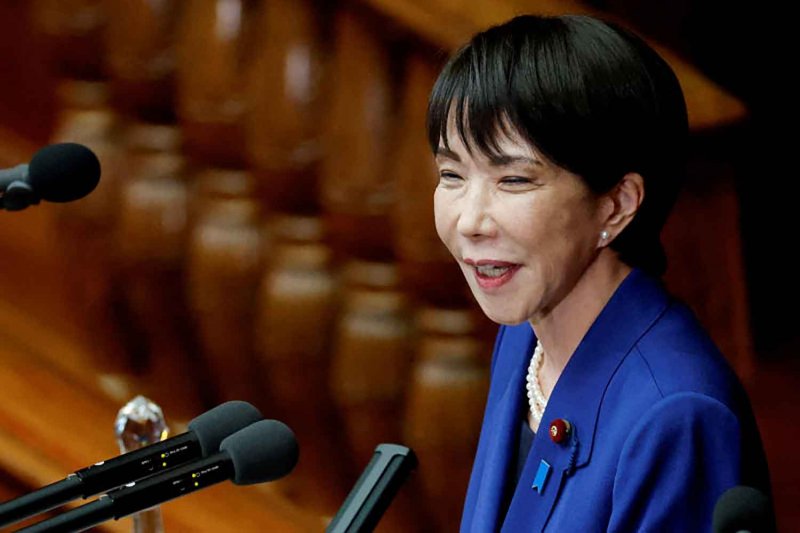
For the first time in its history, Japan’s parliament has selected a woman, Takaichi Sanae of the Liberal Democratic Party, to be prime minister. In this sense, Ms Takaichi has already followed in the footsteps of her political idol, Margaret Thatcher — the UK’s first female PM. But whether she is remembered as Japan’s own “Iron Lady” will depend on her ability to manage three key challenges: inflation, low female labour-force participation and a fraught geopolitical environment.
A protégé of former PM Abe Shinzo, who was assassinated in 2022, Ms Takaichi has promised to revive his economic-policy approach which used monetary and fiscal expansion to lift Japan out of decades of deflation and recession. But the situation Abe confronted in 2012 was very different from the one Ms Takaichi faces today. Back then, an overvalued yen had triggered deflation and was fuelling underemployment, so aggressive monetary easing was vital to stem currency appreciation.
Today, by contrast, Japan is experiencing its first bout of inflation in decades. Yen depreciation is causing Japan’s terms of trade to deteriorate, with lower export prices reducing revenues, and higher import costs squeezing Japanese households. Moreover, as of September 2025, the jobs-to-applicants ratio was 1.2, indicating that, far from an unemployment problem, Japan is now grappling with a labour shortage. And while the stock market appears strong, there is a risk of a bubble, which could harm investors in the event of a collapse.
Far from Abenomics-style monetary expansion, current conditions dictate that the Bank of Japan should raise the short-term policy rate. BoJ governor Kazuo Ueda is well aware of this imperative, but he is hesitating to act on it. The last thing he wants is a repeat of the stock-market turmoil in September 2023, after he floated the idea of hiking short-term interest rates.
But that reaction simply reflected how accustomed to low interest rates Japanese investors have become; it did not mean that the policy was misguided. Mr Ueda must now find the courage to do what he failed to do in 2023: raise the policy rate, and keep it raised. While there may be some short-term pain, it will soon become clear that reining in inflation is much easier than escaping deflation, as Japan did under Mr Ueda’s predecessor.
On the second challenge, Ms Takaichi might seem like the ideal candidate to drive progress, given her success in shattering Japan’s political glass ceiling. And she did make some encouraging pledges during her campaign, such as tax breaks for companies that provide in-house childcare services and expanded women’s health services. She also vowed to increase the number of women in Japan’s cabinet to close to 50%.
At the same time, however, Ms Takaichi is a genuine conservative, who has long advocated traditional gender roles. For example, she has opposed legislation allowing married women to keep their maiden names. And she has so far appointed only two women ministers to her cabinet. Fortunately, one of them is Finance Minister Satsuki Katayama, who could remove one key barrier to women joining the workforce: the additional tax burdens dual-income households face if the second partner’s income exceeds 1.5 million yen (about 313,000 baht) per year.
The third challenge may be where Ms Takaichi is best-suited to shine. Like Abe, she takes a tough-minded approach to security, reflected in her calls to ease restrictions on the country’s Self-Defense Forces, which are prohibited from developing offensive capabilities, and accelerate a military buildup.
Given Japan’s proximity to China and North Korea, this stance may be more justifiable than the pacifism to which most Japanese still cling. While there is no place for antagonism, Japan must be able to stand its ground. At her recent meeting with Chinese President Xi Jinping in Gyeongju, Ms Takaichi signalled that she was prepared to do just that, coming across as confident and resolute.
As for the US, Ms Takaichi’s conservative nationalism has ingratiated her with President Donald Trump, who lavished her with praise on his recent trip to Tokyo. But Ms Takaichi must remain vigilant in her dealings with the erratic, transactional Trump. The bilateral trade deal Ms Takaichi and Mr Trump signed at their meeting is likely to undermine the Japanese people’s welfare. She should also embrace Abe’s vision of a “Free and Open Indo-Pacific”, to navigate a world shaped by the US-China rivalry.
Thatcher’s legacy reflects not only her iron will, but also her oft-forgotten policy flexibility and realism. If Ms Takaichi is to be the leader Japan needs, she must deliver on both fronts. ©2025 Project Syndicate