It is timely to take stock of last month’s Asean-related summits as the first year of US President Donald Trump’s second term comes to a close. A key question is whether “Asean centrality” — the notion that the bloc anchors regional diplomacy and convenes leaders to promote peace and prosperity — still holds sway. While Asean has suffered setbacks amid ongoing adversity, there are signs that its longstanding status as a glass “half-empty and leaking” since 2012, when Cambodia’s chairmanship blocked a joint statement on the South China Sea, may again be shifting toward “half-full”.
The 2025 summit season, held amid intensifying US-China rivalry and Mr Trump’s blatant economic nationalism, allowed the ten-member grouping to regain measured traction and initiative. Asean not only weathered Mr Trump’s threats and pressure but also admitted Timor-Leste as its 11th member, reaffirmed the Five-Point Consensus (5PC) on Myanmar’s civil war and looming sham elections, and deepened the China-Asean Free Trade Agreement. Brazil’s President Luiz Inacio Lula da Silva and Canada’s Prime Minister Mark Carney also joined the proceedings, reflecting a broader effort by middle powers to build coalitions with Asean beyond the US-China structural binary.
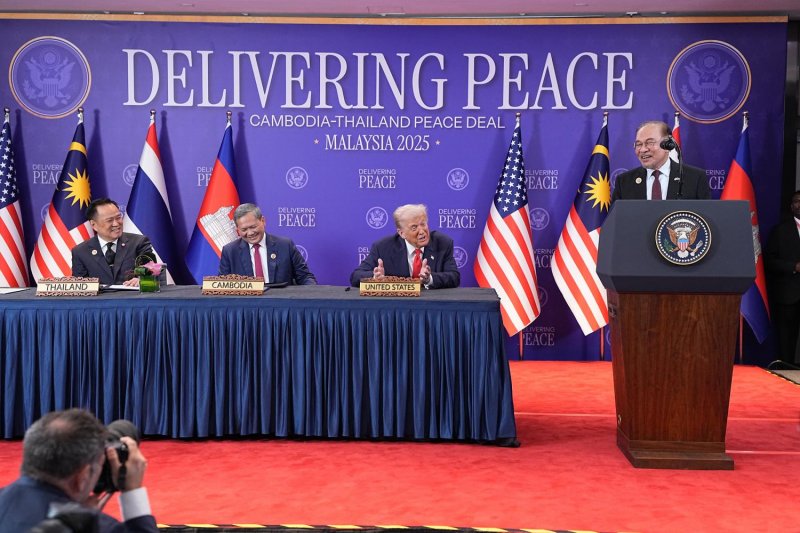
In the event, Asean’s most recent summitry opened as a contest between Asean centrality and Mr Trump’s transactional approach. Mr Trump conditioned his attendance on the signing of a peace agreement between Thailand and Cambodia, part of an effort to burnish his credentials for a Nobel Peace Prize. As Asean chair, Malaysia needed Mr Trump to show up because he was the most powerful among the participating leaders. Yet Cambodian Prime Minister Hun Manet and Thai Prime Minister Anutin Charnvirakul also had pragmatic incentives to let Mr Trump preside over the signing, since both sought to finalise trade and tariff deals with Washington. Ultimately, the two leaders inked a “peace accord”, with Mr Trump and Malaysian Prime Minister Anwar Ibrahim witnessing the ceremony.
Despite the uneasy Thai-Cambodian truce and the risk of renewed military conflict, Asean held its ground. It is plausible Mr Trump would not have attended had he failed to secure the symbolic agreement he wanted. His ceremonial appearances at the Asean-US Summit and the East Asia Summit underscored that his real priorities were trade and investment packages with Japan and South Korea. To the US leader, Asean was a sideshow as he set the agenda and extracted what he sought during a weeklong Asia trip. In this sense, Asean appeared to have bent to accommodate and appease him.
Yet Asean also gained from Mr Trump’s presence. He attended both summits and finalised trade deals with Malaysia and Cambodia, while Thailand and Vietnam secured framework agreements. More importantly, Asean forged ahead with its broader diplomatic agenda. The bloc held substantive meetings with Japan, the European Union, Brazil, and Canada, among other dialogue partners, and discussions on a potential EU-Asean trade pact progressed. Asean also convened a Regional Comprehensive Economic Partnership (RCEP) leaders’ meeting and upheld the 5PC by continuing to bar Myanmar junta chief Senior General Min Aung Hlaing from all top-level summits. After Mr Trump left Kuala Lumpur, the remaining meetings conjured up an image of a “world minus one”, as Southeast Asia deepened cooperation on security and trade with other partners in the US’s absence.
A more cohesive Asean is in every member state’s interest. A strong bloc gives Southeast Asian states leverage to maintain strategic autonomy vis-à-vis China, whereas a weak grouping allows Beijing greater influence. China has played a divisive role in Asean since 2012, but even smaller, heavily indebted states such as Laos and Cambodia have little desire to rely exclusively on Beijing. A weakened Asean reduces the region to a mere geographic expression rather than a political-security, economic and socio-cultural community, leaving it more vulnerable to outside manipulation from the superpowers.
At the same time, Asean states do not want a US-China military confrontation and conflict. The US is Asean’s largest export market, while China is its biggest economic partner. Asean centrality provides a collective platform to navigate this rivalry. For small economies like Brunei, Cambodia, Laos, and now Timor-Leste, Asean is indispensable, without which their leaders would hardly have opportunities to engage directly with presidents like Mr Trump or Xi Jinping. Asean remains Southeast Asia’s primary diplomatic vehicle and its only meaningful platform on the world stage.
For the US, Asean unity is not inherently problematic because the bloc sees Washington as a necessary “offshore balancer” against China. Yet Mr Trump, unlike Barack Obama and Joe Biden, has adopted a divide-and-rule approach by negotiating bilaterally rather than with Asean collectively, mirroring China’s tactics. Southeast Asian states fear domination by either superpower, though China’s geographic proximity makes the threat feel more immediate. Mr Trump’s tariffs and protectionist measures amount to their own form of pressure and dominance over the region. This dynamic explains why Asean continually hedges between the two giants and seeks “third-way” partners. Japan is a preferred alternative pole of leadership, which helps explain Indonesia and Thailand’s interest in the Japan-led CPTPP. Indonesia’s membership entry into Brics+ earlier this year, alongside partnerships by Malaysia, Thailand, and Vietnam, reflects a desire to expand strategic options beyond the US-China competition. Asean’s growing outreach to the Global South — including deeper cooperation with China and the Gulf Cooperation Council — follows the same logic. Brazil’s active participation in this summit cycle may pave the way for new Southeast Asia–Latin America linkages. Overall, the region is increasingly frustrated with Mr Trump’s heavy-handed approach and remains wary of China’s assertiveness in the South China Sea and Mekong region.
For Asean, the logic of staying united is straightforward and logical. Its members have more incentive to hang together than risk being “hanged apart”. Without Asean, Southeast Asia would be far more exposed to superpower rivalry and the destabilising effects of a US-China conflict. The bloc may continue to frustrate analysts who expect more decisive action or institutional depth, but the fear of disintegration keeps member states committed. They have no viable alternative framework for collective diplomacy or economic coordination. As the Asean chair rotates to Manila and then Singapore in 2026–27, the 2025 summit cycle offered renewed hope and intention that the grouping remains resilient and relevant, even within its limitations.

Senior fellow of the Institute of Security and International Studies at Chulalongkorn University
A professor and senior fellow of the Institute of Security and International Studies at Chulalongkorn University’s Faculty of Political Science, he earned a PhD from the London School of Economics with a top dissertation prize in 2002. Recognised for excellence in opinion writing from Society of Publishers in Asia, his views and articles have been published widely by local and international media.