
Prime Minister Anutin Charnvirakul is finding himself caught in a tightening political vice.
As tensions show no sign of ebbing along the Thai-Cambodian border with renewed flare-ups in recent days, his rather cautious handling of the dispute is drawing flak from nationalists and hardliners who accuse him of being indecisive.
At stake are not just stable foreign relations, but also the political fortunes of the ruling Bhumjaithai Party, which he leads and whose electoral strength could wane if public perception continues to tilt against him.
The conflict, which began as a series of localised border skirmishes and diplomatic exchanges over land demarcation and illegal crossings, has since evolved into a test of leadership.
In times of heightened nationalism, Thai leaders have traditionally projected a firm stance against perceived foreign encroachments. Yet, Mr Anutin’s approach — measured, procedural and at times heavy on diplomatic language — has failed to satisfy those expecting a muscular assertion of sovereignty.
Mr Anutin’s statements in recent weeks have underscored his preference for dialogue and restraint. He has repeatedly attached importance to “regional stability”, “constructive engagement” and “mutual respect”. Such phraseology might appeal to international observers, but domestically, it has raised doubts about his decisiveness.
Analysts note that Mr Anutin’s careful tone, while intended to prevent escalation, risks alienating nationalist-leaning voters who equate firmness with patriotism.
“There is a growing perception that the prime minister is more concerned about maintaining diplomatic niceties than defending national pride,” said a political scientist at Thammasat University. “This perception, whether fair or not, could become politically costly.”
Bhumjaithai, traditionally pragmatic and centrist, has never positioned itself as overtly nationalist. Its support base is rooted in provincial development and policy pragmatism — especially in health, infrastructure, and tourism. However, in an election climate where border security and national dignity dominate public discourse, a neutral stance risks being interpreted as weakness.
History offers many examples of how nationalist sentiment can shape, and sometimes upend, political trajectories, according to a source.
Former prime ministers Abhisit Vejjajiva and even Yingluck Shinawatra faced moments when cross-border tensions with Cambodia became domestic flashpoints. In both cases, public expectations for a strong response forced leaders to adopt tougher rhetoric, often at the expense of diplomatic flexibility.
Mr Anutin, in contrast, seems determined to avoid sabre-rattling. His foreign policy — seeking Asean mediation and calling for joint security committees — reflects a technocratic sensibility. But politics, unlike diplomacy, often rewards emotive symbolism over cautious pragmatism.
Critics within the opposition and even some coalition allies have begun questioning whether the prime minister’s measured response conveys strength or uncertainty.
Social media sentiment mirrors this ambivalence. Hashtags calling for a “decisive response” to Cambodian “provocations” have trended intermittently, while pro-government defenders argue that escalation could harm border communities and trade. The narrative battle — between prudence and patriotism — is unfolding in real time, and Mr Anutin appears to be losing the optics war, said one observer.
The implications for Bhumjaithai are significant. Having emerged as a major coalition player and later securing the premiership through consensus rather than confrontation, Mr Anutin’s legitimacy rests on his reputation as a stabiliser. Yet, stability alone rarely excites voters.
In recent months, party strategists have reportedly expressed concern that Bhumjaithai’s brand — pragmatic, development-oriented, and regionally grounded — lacks emotional resonance. The ongoing border tensions could have been an opportunity for Mr Anutin to project strong leadership and rally patriotic sentiment behind his administration. Instead, the party risks being outflanked by rivals eager to exploit nationalist rhetoric for electoral gain.
The main opposition People’s Party (PP), despite its reformist credentials, has subtly criticised Mr Anutin’s “lack of clarity,” while the Democrats have urged a firmer stance to “safeguard national interests”.
Even Pheu Thai, traditionally wary of nationalist posturing, has joined the chorus, framing Mr Anutin’s approach as “too passive”. The criticism across party lines suggests that Bhumjaithai’s political capital is eroding faster than expected.
Yet, a shift towards a more aggressive posture carries its own dangers, said one observer. Mr Anutin’s diplomatic instincts are not without merit. A miscalculation in tone or military deployment could inflame tensions, jeopardising trade and livelihoods in the border provinces, particularly those where Bhumjaithai enjoys the strongest support.
In provinces such as Buri Ram, Surin, and Si Sa Ket — areas with deep cultural and economic links to Cambodia — wariness towards confrontation runs deep.
“People here live off cross-border commerce and tourism,” said a local community leader from Surin. “They don’t want politicians playing tough at the expense of peace.” For these constituencies, Mr Anutin’s restraint may still hold appeal — but the message must be communicated more effectively to avoid being drowned out by louder nationalist voices.
What Mr Anutin faces now is less a policy dilemma than a perception problem, the observer said. His leadership is being tested not by what he does behind closed doors in negotiations, but by how his actions are perceived in the public sphere. In Thai politics, image often trumps substance. Voters who perceive hesitation in the face of external challenges may interpret it as a lack of leadership mettle.
Some within the government argue that Mr Anutin needs to reclaim the narrative quickly — not through inflammatory gestures, but through assertive communication. This could mean outlining concrete steps being taken to protect national interests, showcasing military readiness without threatening escalation, and showing Thailand’s commitment to both sovereignty and peace.
“Mr Anutin has to prove that diplomacy is not indecision,” said a veteran commentator. “If he can reframe calmness as strength — and peace as victory — he might still turn this around.”
As the country edges towards another election, tentatively in January next year, every decision Mr Anutin makes will be viewed through a microscope.
The border conflict with Cambodia may not be a full-blown crisis yet, but its symbolic resonance is powerful. It touches upon national pride, territorial integrity, and leadership credibility — issues that can make or break governments.
For now, Mr Anutin walks a precarious path, the commentator said. His challenge lies in proving that restraint is not weakness, that diplomacy can coexist with patriotism, and that calm leadership can still command respect in turbulent times.
If he fails to strike that balance, Bhumjaithai may discover that the true battleground is not the border itself — but the hearts and minds of voters, the commentator said.
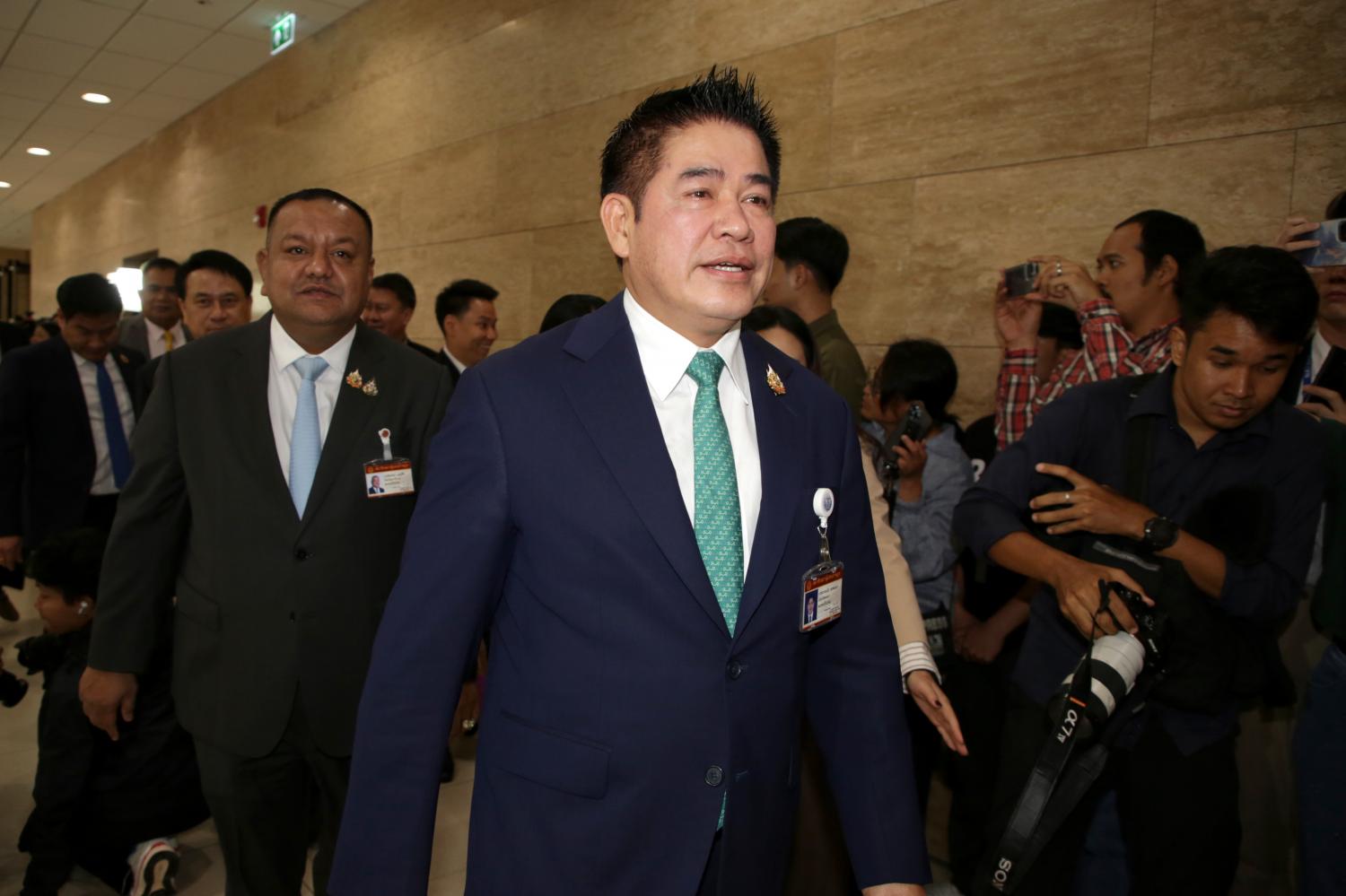
Thamanat: Under increasing pressure
Looks like the knives are out
Deputy Prime Minister and Agriculture Minister Thamanat Prompow is feeling the heat with analysts saying the campaign against him is being driven not only by “grey money” allegations, but also by competition for House seats in the Klatham Party’s stronghold in the upcoming election.
The Klatham Party, under the guidance of Thamanat, who serves as its chief adviser, holds a significant number of constituency seats, particularly in the North. The Pheu Thai Party’s waning support has seen many defections to Klatham.
However, recent allegations linking Klatham figures to online gambling have apparently seen other prospective defectors hesitate and have undermined the party’s popular appeal.
Targeting Thamanat, who has a questionable background, can weaken the Klatham Party, according to observers.
The main opposition People’s Party (PP) has been heaping pressure on Prime Minister Anutin Charnvirakul to remove Thamanat from the cabinet to prove the government is serious about tackling illicit networks. PP deputy leader and list-MP Rangsiman Rome has used the case of Klatham MP for Songkhla, Chonnaphat Naksua, to step up the pressure.
Mr Chonnaphat is under investigation for alleged links to online gambling, and the Anti-Money Laundering Office has frozen his assets, including cryptocurrency holdings, luxury cars, property and land worth about 159 million baht.
The House committee on national security, border affairs and reform, chaired by Mr Rangsiman, recently summoned Mr Chonnaphat to reply to allegations regarding his involvement with online gambling networks following the asset freeze.
According to Mr Rangsiman, the networks stretch beyond a single MP and reflect a wider problem within law enforcement.
“This cannot end with Mr Chonnaphat,” he said. “It must lead to Thamanat. What is most worrying is that some police officers continue to receive money from gambling and scam networks. This is how grey money is taking hold of the country.”
Mr Rangsiman portrayed the Klatham heavyweight as a core element that undermines confidence and suggested that Thamanat no longer possessed the credibility required for a cabinet minister.
The PP lawmaker questioned what damage could possibly be done to the country if Thamanat was removed from office, saying that his ouster would instead send a signal that the government is committed to addressing scam networks.
If the prime minister refused to act, it risked perceptions of conflict of interest and undermined public trust in the government’s anti-scam efforts, according to the opposition MP.
“Does the prime minister want to leave it like this? This will damage the country further and allow grey business to infiltrate the country,” said Mr Rangsiman.
The PP deputy leader did not rule out the opposition filing a no-confidence motion over the government’s handling of scam networks and said discussions with Pheu Thai on the issue were underway.
Olarn Thinbangtieo, a political scientist at Burapha University, said that the PP’s focus on Thamanat and the Klatham Party is not only about corruption but political competition as the PP aims to go up against Klatham in several constituencies in the upcoming election expected at the end of January.
Klatham is being weighed down by allegations of links to scam networks, making some MPs reluctant to defect to the party for fear their election chances could suffer if they are associated with the party.
These developments benefit both the PP and the ruling Bhumjaithai Party, which now have a clearer path to capturing seats Klatham currently hold. The PP and Bhumjaithai could also make inroads into Pheu Thai strongholds, according to Mr Olarn.
He added that targeting Klatham may ultimately help Bhumjaithai the most. Backed by substantial financial resources and a growing regional base, Bhumjaithai could increase its bargaining power in the next coalition.
“Deep down, [Bhumjaithai] must have seen Klatham as a potential threat. With strong financial resources, the party might well gain more seats. If Klatham were to grow significantly, Bhumjaithai might even risk losing the powerful Interior Ministry in future coalition formation talks, just as Pheu Thai lost it to Bhumjaithai after the previous election,” he said.
In his view, Bhumjaithai could let the PP intensify scrutiny on Thamanat through a censure debate without a vote. This will force him into a difficult position, and Klatham would subsequently suffer at the polls, he said.
