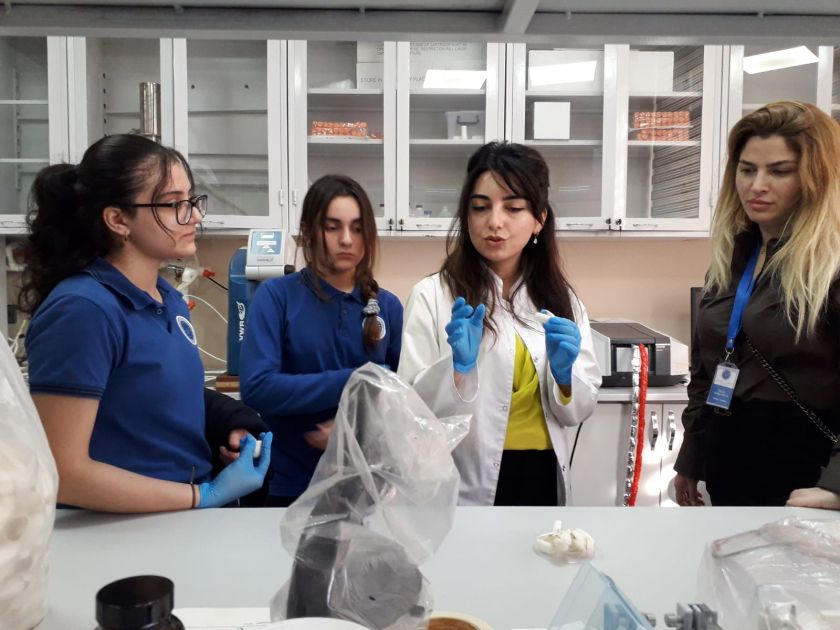
8th-grade students of the European Turkish Lyceum visited the
Institute of Biophysics.
Azernews reports, citing Azertag, that the
purpose of the visit was for schoolchildren to connect the
theoretical knowledge they gained in biology classes with the real
research process, as well as to form a broader understanding of
biomolecular and medical research.
During the tour of the Institute’s “Molecular and Cellular
Biochemistry” laboratory, the students were explained the process
of studying cell surface receptors and signaling proteins involved
in the development of cancer diseases – including lung, breast, and
colon carcinomas. In this context, stages such as gene isolation,
cloning into plasmid vectors, and transformation into E. coli
cells, and the extraction of total RNA from healthy and diseased
tissues with TRIzol and other reagents was demonstrated. The
students also observed how the process of studying proteins such as
HER1, HER2, and RAS in signaling pathways was carried out.
Then, the students visited the “Structure, Dynamics and Function
of Biomolecules” laboratory. Here, they were informed about the
formation of amyloid by proteins during neurodegenerative diseases,
the kinetic characteristics of this process, factors that slow down
the formation of amyloid, and the mechanisms of decomposition of
the formed structures. At the same time, the development of a
classification model for the diagnosis of lung cancer based on the
Fourier Transform Infrared (FTIR) spectra of human blood plasma
using artificial intelligence technologies and the possibilities of
applying this direction for future wide screening were explained to
the students.
The trip was important in terms of introducing the students to a
real scientific environment, closely observing laboratory
processes, and increasing their interest in biology. The students
not only strengthened their theoretical knowledge, but also had the
opportunity to see more clearly the role of biomolecular research
in medical diagnostics and scientific development.