
Separating US tariffs from the Thai-Cambodian border dispute is like “rainfall without flash floods in Bangkok”.
Chulalongkorn University political science Prof Siripan Nogsuan Sawasdee fashioned the simile when she was asked during a Thai PBS TV programme whether it is possible to treat the two issues separately, as the US Trade Representative vowed not to proceed with tariff negotiations with Thailand after Prime Minister Anutin Charnvirakul announced the suspension of the Thai-Cambodian peace accord, brokered by Washington and Kuala Lumpur on Oct 26.
Mr Anutin suspended the agreement on Nov 10 after four Thai soldiers were injured by a new landmine allegedly planted by the Cambodian side, saying it was an act of hostility.
US President Donald Trump later suggested he would not link suspension of the joint declaration to ongoing tariff talks, but Prof Siripan said she believes tariffs will remain Trump’s key tool to address geopolitical conflicts, trade, drug smuggling and immigration.
“Tariffs are like paracetamol for Trump,” said Prof Siripan.
If trade and security cannot be disentangled, she said it will be an uphill task for the Anutin government to make progress on both issues simultaneously. Whether the administration can strike a balance between the two issues or prioritise the former over the latter remains a tricky question, said Prof Siripan.
Once negotiations are on track, Thailand can look into how tariffs really affect exports, especially after the US Supreme Court rules on whether Trump’s tariffs are legal.
EMOTIONAL CONTROL
Though it is difficult to strike a balance between actions to address the border dispute and steps to achieve a trade agreement with the US, the government can start by avoiding becoming frustrated with Cambodia’s alleged non-compliance with the peace accord as it negotiates with the Trump administration, said Tanit Sorat, vice-chairman of the Employers’ Confederation of Thai Trade and Industry.
He echoed the sentiments of analysts monitoring the situation, warning the government that some decisions intended to protect Thai sovereignty may end up slowing down tariff negotiations.
“We cannot think of only what [penalty] Cambodia deserves. It’s fine if villagers think so, but the government must always remain cautious in its actions,” said Mr Tanit.
He urged the government to come up with a clearer policy and communication to ensure solutions to trade and security issues are aligned.
This does not mean Thailand should completely bow to Trump in terms of tariffs or the border conflict, but instead the government should follow the requirements of the peace accord and ask Washington to act against Cambodia if it does not comply with the agreement, said Prof Siripan, adding Phnom Penh is also under tariff pressure.
Thailand will gain no benefits if it strays from the accord, which calls for mine clearance operations and a crackdown on scammers, she said. The US is an important trading partner, with Thai-US trade value commanding an 18-20% share of GDP, said Prof Siripan.
Thailand’s export structure is based on “made-to-re-export” production, particularly for high-tech products exported to the US. For every 100 baht worth of exports to the US, Thailand typically imports about 40 baht worth of components from abroad for assembly, according to Thailand Development Research Institute (TDRI).
“We cannot lose the American market,” insisted Mr Tanit. “We must show we are mature, with sensible reasons for our actions.”
PARALLEL APPROACH
Somjai Phagaphasvivat, a political economist, said national sovereignty must remain paramount, adding territorial integrity and the safety of military personnel are crucial, though trade is also important.
Thailand’s economy depends on exports, which accounted for 60% of GDP last year. Nearly 20% of exports, worth about 3 trillion baht, went to the US, making that market extremely important, he said.
“I don’t believe Trump will separate the border dispute from trade negotiations. Historically, the US has linked various issues to trade talks. For example, pressuring countries to increase investment in the US; insisting Brazil’s Supreme Court release a former Brazilian president imprisoned for organising a coup; or tweaking India for not giving the US credit for helping to promote peace in the India-Pakistan border conflict, which resulted in the US imposing high tariffs on India,” said Mr Somjai.
He said Trump emphasises peace initiatives to demonstrate US policy can shape the global order and reinforce his own sense of geopolitical influence.
Mr Somjai said Thailand must pursue a parallel strategy. On sovereignty, Thailand has not withdrawn from agreements. The issue stems from the other party failing to honour the terms. Thailand must make clear it is not the one breaching the agreement, he said.
In parallel, Thailand must manage trade relations. If trade pressure threatens national sovereignty, Thailand cannot accept it, said Mr Somjai.
“Trump is a negotiator. He does not rely solely on emotion, but uses emotional displays as a tool to increase leverage. Thailand must prepare, as Trump may make additional demands,” he said.
TRADE-OFF
Nonarit Bisonyabut, a research fellow at TDRI, said the more a country is integrated into the global market and the more it develops its democracy, the less independent decision-making power it retains, citing the world economy theory proposed by Dani Rodrik, a political economist specialising in globalisation.
“As Thailand depends more on global markets, it must follow global rules — an unavoidable condition for a small country. For example, if Thailand wants to export products to foreign markets, it must comply with European environmental standards. Similarly, if Thailand seeks assistance from institutions such as the IMF or World Bank, there are conditions requiring democratic governance according to Western criteria,” he said.
“These are constraints faced by all countries. If Thailand wants to trade with the US or receive lower tariffs, it must comply with US demands. Thailand could choose not to comply, opting for increased autonomy in security and economic policymaking in exchange for reduced access to the US market.”
Mr Nonarit said Trump is creating new rules centred around the US, eschewing the globalisation model in which all countries liberalise equally.
He said shifting away from dependence on the US market is not easy. A large share of Thai shipments head to the US, a result of 20-30 years of development. Adjustments are necessary, but difficult, said Mr Nonarit.
CAMBODIA IN FOCUS
The US will be an undeniable influence on Thailand’s decisions on security and trade issues as long as Washington treats Cambodia as a strategically and economically significant location in Southeast Asia, said Aat Pisanwanich, an economic analyst and Asean affairs advisor at Intelligence Research Consultant Co Ltd.
He said the US wants to preserve its relations with Cambodia to counteract China’s growing influence in that nation across economic, geopolitical and security dimensions. This includes addressing concerns over the South China Sea and the Ream Naval Base in Sihanoukville, which the US considers crucial to maintaining military stability in the region.
Moreover, the US is keen to increase investments in Cambodia, particularly in clean energy, technology and electric vehicles, leveraging its lower production costs. American investment significantly lags Chinese outlays in Cambodia, with US capital primarily allocated to auto parts, beverage cans and furniture.
Mr Aat said the US also needs Cambodia to intensify its efforts in preventing call centre scams, which have caused about US$10 billion in financial losses for American citizens.
The US perceives Cambodia as a “least developed nation” in need of assistance, and reduced the reciprocal tariffs on Cambodian exports from 49% to 19%, while also providing other support.
“I expect the Thai-US trade agreement faces significant delays due to the unresolved peace accord. The negotiations are unlikely to be finalised by the end of this year,” he said.
Mr Aat considers Washington’s suspension of negotiations a tactic aimed at bringing Thailand back to the negotiating table, a move he said Thailand also wants.
“The Trump administration uses reciprocal tariffs as leverage to influence its trade partners,” he said.
REAL IMPACT
If the government can press on with tariff negotiations despite the border unrest, it can concentrate on how tariffs will affect Thai exports in the long term, said Kriengkrai Thiennukul, chairman of the Federation of Thai Industries.
The US Supreme Court is considering whether Trump exceeded his legal authority in imposing tariffs worldwide, with a verdict expected by June of next year. If the justices rule the president issuing tariffs is unconstitutional, US importers can file a petition demanding the government return the levies it collected, according to Kasikorn Research Center.
“Countries are monitoring the case, which can stop Trump’s aggressive policy,” said Mr Kriengkrai, adding US trading partners have begun to doubt whether the tariffs can really be imposed. “This means Thailand may gain some advantages.”
Earlier in May, the US Court of International Trade ruled Trump’s tariffs were illegal because he exceeded the power outlined in the International Emergency Economic Powers Act, according to media reports. The ruling caused the government to lodge an appeal, which is considered by higher courts, including the Supreme Court.
According to Mr Aat, some analysts expect the Supreme Court to suspend the Trump tariffs.
“Extending negotiations into 2026 is not expected to significantly impact Thai exports to the US. If the Supreme Court bars the tariffs under this law, Trump may respond by trying to use other laws to maintain the tariffs,” he said.
Mr Aat estimated the tariff negotiations will continue as the US sees benefits from the agreement with Thailand. He recommended several strategies for Thailand to pursue in negotiations, including presenting new proposals that align with US interests and proposing direct investments in the US.
Thai businesses should seek partnerships with US importers who are interested in Thai goods, particularly those listed in the US Tariff Annex III, where tariff relief may be available, said Mr Aat. Special terms regarding pricing, quality and standards can be offered to encourage these importers to support Thailand’s interests during negotiations with the US Trade Representative and the Trump administration, he said.
Meanwhile, Thai agricultural exports could benefit from Trump’s order titled “Modifying the Scope of the Reciprocal Tariff with Respect to Certain Agricultural Products”, issued on Nov 14, which exempts 237 items from import tariffs.
“In addition, the government should work closely with the US Scam Center Strike Force to tackle scam operations,” said Mr Aat.
Moreover, he said Thailand should increase its market presence in regions where it holds a minor share, such as India, the Gulf Cooperation Council countries, Africa, Australia and BRICS countries, while expediting new trade agreements.
Mr Kriengkrai warned Thailand may still face a negative impact from US trade policy even if the tariffs are barred. Trump may exercise Section 232 of the US Trade Expansion Act to add tariffs or quotas to imports if officials find they harm national security, he said. Thai products that could be covered by this law include electronics, notably integrated circuits and transistors.
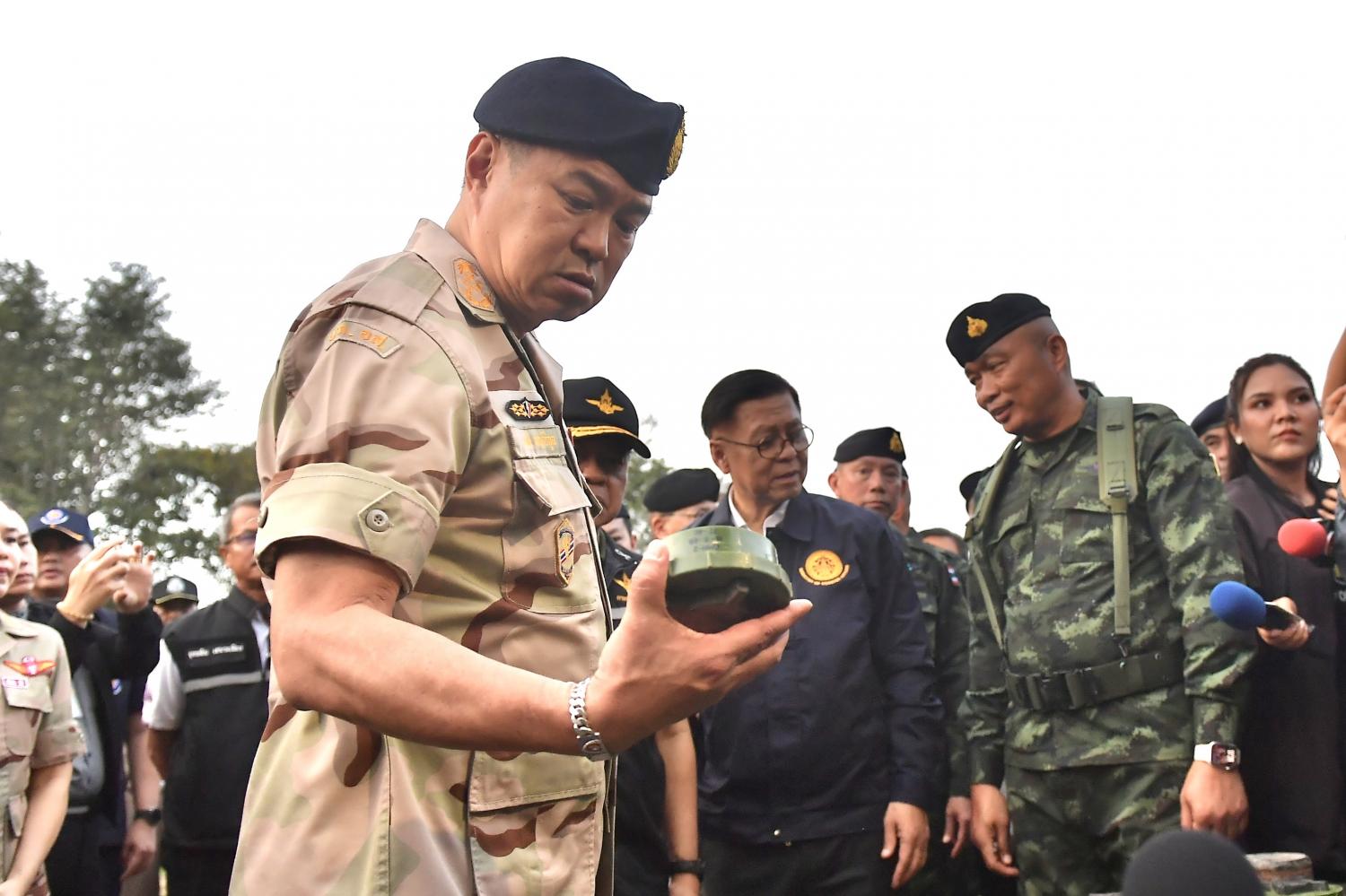
Mr Anutin inspects a recovered PMN-2 mine while receiving a briefing on border security at the 11th Infantry Battalion at Phu Makua, Kantharalak district, Si Sa Ket, earlier this month. Government House

Cars trudge through a flooded underpass on Liab Tang Rotfai Road, Bang Sue district, Bangkok following heavy rains in early November. Flooding in the capital following monsoon rains was compared with the linked nature of trade talks with the US and the border pact with Cambodia. Pattarapong Chatpattarasill