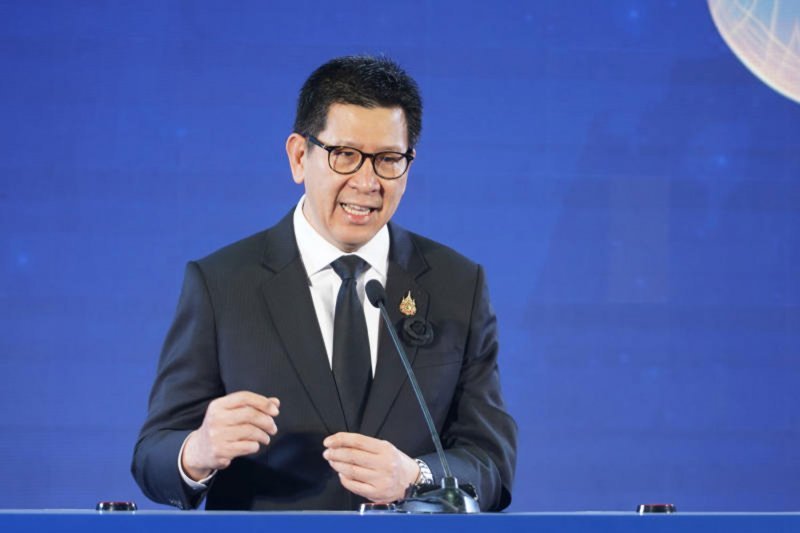
The proposal to raise value-added tax from 7% to 8.5% in 2028, and to 10% in 2030, by Deputy Prime Minister and Finance Minister Ekniti Nitithanprapas is a display of political courage rarely seen in a political landscape where politicians are quick to spend money in the name of “economic stimulus” but stay mum when asked how to finance the schemes.
Public debt reached 64.8% of GDP at the end of September and is expected to exceed 65% next year, only a short distance from the 70% permitted ceiling.
At the same time, recurrent expenditure, including salaries and the fast-rising cost of state welfare programmes, now accounts for roughly 70% of the budget and is still expanding. This places growing pressure on Thailand’s competitiveness and sovereign credit rating. Moody’s has already assigned a Baa1 rating with a negative outlook, while Fitch maintains BBB+ with a stable outlook. These warnings cannot be dismissed.
Although Thailand’s VAT legislation already allows for a ceiling of 10%, no government over the past three decades has dared to raise the rate, fearing an electoral backlash. Mr Ekniti’s proposal shows the need to confront reality instead of evading it.
A VAT increase indeed is inevitable as Thailand cannot sustain a tax-to-GDP ratio of around 16% while public debt edges closer to the legal limit and essential services face mounting long-term obligations. Without new and dependable revenue, the alternatives would be deeper borrowing or cuts to vital social programmes.
But support for a VAT rise must be conditional. Public reluctance does not stem from the tax itself but from years of watching public money diverted into political giveaways, wasteful projects and inefficient spending.
Examples abound. One recent case concerns the National Health Security Office’s questionable allocation of taxpayer funds to NGO projects while some state hospitals under the scheme complain of delays in allocations.
Before hiking VAT, the government must show how it intends to correct these failures.
The government needs to raise more money from VAT collections, to be sure, but it must be used for public benefit, and under transparent regulatory monitoring.
For example, the government must specify how the extra funds will be used and limit spending to essentials. Priority areas should include education and reskilling, healthcare, infrastructure that raises competitiveness, and research and innovation.
But raising VAT alone is not enough. The government must find a way to tax informal business and the underground economy which is thought to represent as much as 40% of total economic activity. VAT is an efficient and broadly fair tax, as people who consume more pay more. But it is not perfectly equitable because the same rate applies to both rich and poor.
Measures to cushion low-income households from the impact of higher prices will be even more necessary, especially given the steep rise in food costs despite low headline inflation, and the burden of essential goods such as medicines. If these safeguards are honoured, the public can accept that a VAT increase serves the country’s future, not political convenience.
So, if VAT is to increase, it must be raised for the right reasons: to secure Thailand’s long-term fiscal stability and competitiveness, not to finance electoral calculations or sustain a bureaucracy resistant to reform. The government has a choice, and the public is watching.