Susan Lorincz’s trial for the murder of Ajike “AJ” Owens is back in the headlines following the release of the hit Netflix documentary, The Perfect Neighbor.
The Perfect Neighbor, which dropped on Netflix in October 2025, unpacks the events leading up to Owens’s death, which occurred in June 2023. Owens, a Black woman, and Lorincz, a white woman, were neighbors in Ocala, Florida. Lorincz consistently called the police on Owens’ kids for playing in the yard next door to her home over the course of three years. (Owens was the mother of four children: sons Isaac, Israel and Titus and daughter Afrika.)
The women’s tension escalated after one incident between Lorincz and Owens’ children. Owens went over to Lorincz’s home to speak with her. After knocking multiple times, Lorincz shot Owens through her front door and in the chest. She was transported to a local hospital, where she was pronounced dead. Lorincz was arrested days later and charged with manslaughter with a firearm, culpable negligence, battery and two counts of assault.
The Perfect Neighbor uses primarily 911 calls and body cam footage from law enforcement’s frequent visits to Lorincz and Owens’ neighborhood. The documentary does not include clips of Owens’ murder.
Keep scrolling to see what happened with Lorincz’s trial and sentencing:
What Did Susan Lorincz Do?
Lorincz had an altercation with Owens’ children after one reportedly went to obtain a tablet that was left behind in the yard they were previously playing in. Lorincz allegedly threw a pair of roller skates and swung an umbrella at the kids, per an affidavit obtained by CNN. An additional neighbor claimed to authorities that Lorincz called the children racial slurs, per the filing.
After the kids told their mother about the incident, Owens went to Lorincz’s home to confront her neighbor and address the issue. Owens reportedly asked Lorincz to come outside to speak to her. Lorincz did not leave her home and, instead, shot and killed Owens through her front door. Owens’ son was next to her at the time she was shot.
What Was Susan Lorincz’s Defense?
When law enforcement arrived at the scene, Lorincz claimed she felt threatened by Owens and acted in self-defense. She alleged that Owens was knocking so aggressively that she feared her door would burst open. The investigation found no indication that Owens had attempted to enter Lorincz’s home or that she posed an imminent threat. After being charged with manslaughter with a firearm, Lorincz pleaded not guilty.
Was Susan Lorincz Found Guilty?
A jury found Lorincz guilty of manslaughter in August 2024.
When Was Susan Lorincz Sentenced to Prison?
In November 2024, Lorincz was sentenced to 25 years in prison.
What Did Susan Lorincz Say in Court?
While Lorincz did not take the stand during her trial, she shared a statement of remorse following her sentencing.
“I am so sorry I took AJ’s life,” Lorincz said at her sentencing, per CNN. “I never intended to kill her.”
Lorincz claimed that she felt confused during the night of the shooting because Owens was allegedly screaming at her.
Where Is Susan Lorincz Serving Her Sentence?
Lorincz is behind bars at the Homestead Correctional Institution in Homestead, Florida. Her release is scheduled for on April 8, 2048, per the Florida Department of Corrections.
Dakota Johnson won’t be saying goodbye to the naked dress trend anytime soon.
Johnson, 36, opened up to Vogue Germany about what she really thinks of the sheer fashion trend taking over Hollywood red carpets in a new cover story published on Tuesday, October 21.
When asked if she ever feels like a skin-baring look is “too sexy,” Johnson replied, “I really don’t care.”
She added, “I’ve been able to wear some of the most beautiful dresses, and I feel beautiful in them, so I wear them.” The Verity actress explained that not all naked dresses look “good” on her, but when she finds one she loves, she’ll be rocking it.
“If I find a beautiful dress that I feel comfortable in, of course I want to wear it! And it’s fun to wear a sexy dress,” she noted.
Johnson shared that her mom, actress Melanie Griffith, “was very open about the topic of bodies,” making her feel confident while growing up.
“She taught us how to take care of our bodies and love them, and that our bodies are beautiful,” she explained. “And I think that’s something really important for a young girl because we’re constantly told that we’re not good enough.”
Johnson added, “And if you’re not told from a young age by the woman you look up to the most that you’re perfect and smart and special and strong and brave, it can really break you. It’s hard to re-teach yourself that love later on. That was a huge gift she gave me.”
Frederic J. Brown / AFP
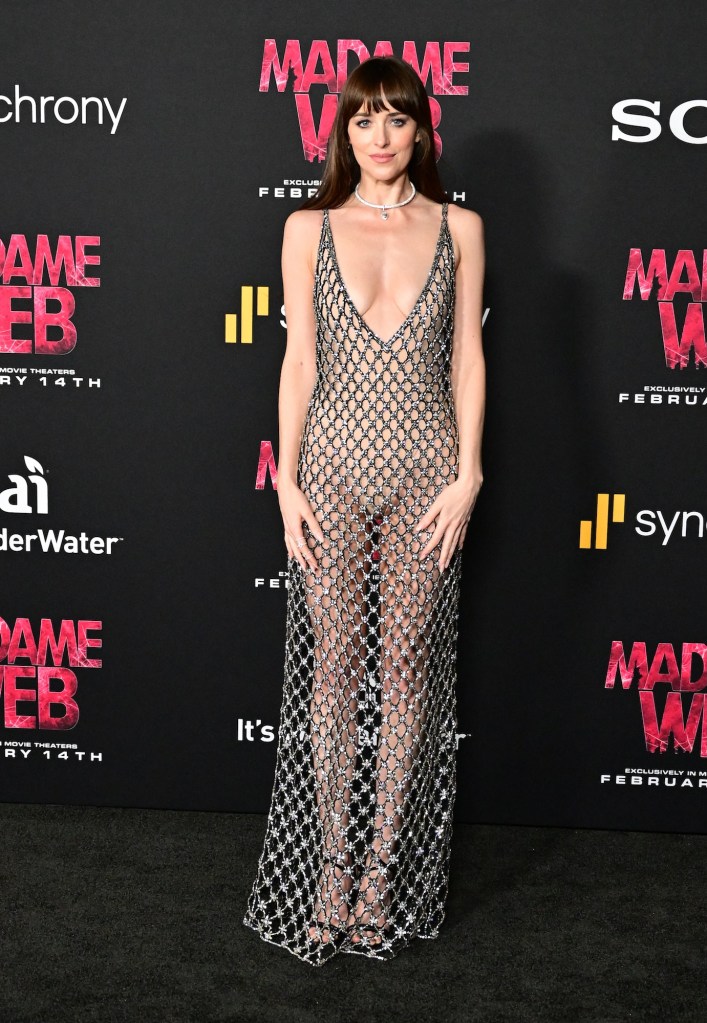
Johnson has been leading the risqué style fad as of late, rocking several revealing looks at star-studded events. In February 2024, she stunned in a custom Gucci dress at the Madame Web premiere in Los Angeles.
The crystal-embellished design featured a sheer silhouette, a plunging neckline and thin straps. Underneath, she wore nothing but a flesh-toned bodysuit.Johnson added even more glamour to her ensemble with a sparkly choker complete with a dangling gem.
For glam, she donned smokey eyeshadow, long lashes, rosy cheeks and pink lips. Her brunette hair was parted down the middle and worn down and straightened, with her bangs blown out over her forehead.
Just one day after news broke of her breakup with Chris Martin in June 2025, she showed off her figure in a sheer getup while out and about in New York City.
Her outfit included a completely see-through black tulle dress that flared at her calves. Underneath, she wore a red bodysuit complete with a strapless neckline and high-cut legs. Johnson styled her look with a brown leather Gucci purse and pointed-toe heels. (Johnson and Martin, 48, dated for eight years and got engaged before they split, a source told Us Weekly last March.)
Just one month ago, Johnson put her curves on display at the Kering Caring for Women dinner during New York Fashion Week. Her look featured a sheer bodice with delicate black lace embellishments that covered her figure. Underneath, she wore a strapless black bra and a coordinating thong.
Johnson let the look speak for itself, opting for no jewelry and a simple updo. Her makeup was complete with a touch of eyeliner, mascara and glossy lips.
A plane crash in Venezuela claimed the lives of two people onboard … and, the whole incident was captured on shocking video. According to the local paper El Nacional, a Cheyenne model plane crashed as it was taking off from Paramillo Airport in…
Life’s a real beach when you’re Olivia Ponton — the internet personality was playin’ in the sand and showin’ off her year-round beach bod … totally on brand!!! Nature’s finest, Olivia modeled her teeny weeny green bikini for her followers,…
Lori Loughlin and Mossimo Giannulli no longer have a “Full House” … so, they’ve decided to get rid of the one they still share — and they’ve found a buyer! The 6-bedroom, 9-bathroom home in the Hidden Hills area near Los Angeles went under…
Gen V season 2 fans believed Marie and Jordan were finally gearing up to be endgame, so their breakup during the finale came as a total shock. But according to the show’s star Derek Luh, the split might not stick.
“When you’re young, who doesn’t on-again off-again, break up [and] get back together, take a break [and] go figure it out,” Luh, 33, told Us Weekly exclusively just before Gen V’s explosive (literally) second season finale. “It happens in the real world. It happens in TV shows. I do think that they will find a way, and this is just a little speed bump for them.”
The Gen V season 2 finale, which premiered via Prime Video on Wednesday, October 22, showed Jordan (Luh and London Thor) forgive Marie (Jaz Sinclair) for leaving them — twice. However, Jordan told a tearful Marie that they were better off as friends.
“Who couldn’t see this coming?” Luh quipped. “I think if Marie didn’t leave, they could have worked that out.”
Momodu Mansaray/Getty Images
According to Luh, Marie using her powers against Jordan marks a turning point for the two characters.
“I think it’s going to be tough [to come back from that], and I don’t know how the writers are going to bring them back together,” he added. “They have their work cut out for him.”
When it comes to Jordan’s forgiveness, Luh ultimately doesn’t know if that will stick.
“I really, truly believe in my heart that Jordan wanted to [forgive]. I think they really do, truly love Marie, deep down, and really wanted to forgive them but it’s hard,” Luh added. “You can forgive but you can’t forget.”
Luh noted that “love makes you do crazy things” which is part of the reason why Jordan can “justify” Marie’s actions. Still, there’s a lot of “questioning” going on.
“It’s hard for Jordan,” Luh added.
Gen V viewers are very protective over Jordan and Marie’s relationship, which has really resonated with the fandom.
“It’s just fun to see young love, it’s not this polished thing. That’s what’s nice about it, it’s clunky and it’s awkward,” Luh explained. “There’s tender moments, and there’s real moments.”
Jaz Sinclair and Derek Luh.JC Olivera/Getty Images for Prime Video
He also noted that “resentments” can also come about.
“It’s a really dynamic, three-dimensional, fleshed-out relationship,” Luh said. “I think a lot of people — whether you’re Gen Z, millennial — you recognize that relationship. You’ve had one of those relationships. So you’ve had that interaction. I think maybe that’s why it resonates with people on the internet.”
Aside from the shocking split between Jordan and Marie, the Gen V season 2 finale finally showed the defeat of Thomas Godolkin (Ethan Slater). However, Marie and her newfound group of rebels had to flee in fear of Vought’s wrath.
But don’t ask Luh if we’ll be seeing any Gen V stars in The Boys’ upcoming fifth and final season.
“I don’t know,” he said. “I have no idea.”
All episodes of Gen V are now available to stream via Prime Video.
In Us Weekly‘s exclusive clip from the Sunday, October 26, episode of the hit CBS series, Urban, 57, and costar Gretchen Wilson congratulate the remaining musicians still competing on the show as they tease what is still to come.
“You guys are going to be doing two songs a piece,” he explains. “You will each be performing an original song and a cover. I think it is going to be a lot of fun.”
Urban notes that there will be “two separate concerts in Dallas” to break up the musicians into two groups, adding, “One person is going to have to go home [from each group].”
In a confessional, one of the artists says that Urban’s update “puts a lot of pressure” on them despite his encouragement that they “rise to the occasion” for the next show.
The Road follows 12 emerging musicians who are competing as opening acts for Urban while he tours across America. The contestants advance to the next city based on the reaction from the crowds at their respective shows. By the end of the season, only one act is left standing.
In addition to Urban, Blake Shelton is also an executive producer while Wilson, 52, appears in the role of Tour Manager. Country music stars Jordan Davis, Karen Fairchild, Dustin Lynch and Brothers Osborne will also join as special guest advisors throughout the season.
“Without a shiny floor in sight, the docu-follow format captures the high-stakes unfiltered musical journeys of these triple threats — singers, songwriters and instrumentalists — offering a backstage pass into the gritty and unforgiving life of a touring musician,” the official synopsis for the series reads. “With exclusive access to behind-the-scenes workings of the music industry, viewers will see what happens when some of the best emerging musicians pile into a tour bus and tackle a grueling schedule in pursuit of their dreams.”
Before the show’s premiere, Urban spoke exclusively with Us about the advice he gave each contestant about the “discipline” required to succeed in the music industry.
“I just played a show in Vegas last night and I had another one tomorrow night, and [taping] this finale fell in between. So I came home after the show last night, got in at 5 a.m., here we are, and then take off tomorrow, go to Vegas,” he shared with Us. “I think that never changes, as far as the discipline required to do what we do. And it’s been great watching Gretchen handle them as well and give really good advice. [She’s] like Mama Bear, in the best way.”
“For me, this has been a really amazing experience,” Wilson exclusively told Us. “All the years that I’ve had that have kind of built me into who I am, and all the things that I’ve done on the road, I was able to bring that experience to it.”
She added: “When you’re out there doing this for a living, you’re the one who doesn’t have a beer at 2 o’clock in the afternoon because you’re resting on the bus and you’re taking care of your instrument, your voice. [It’s] not just [about] how do you win this competition, but how do you take care of yourself and how do you have the longevity that a lot of it takes to endure in this business?”
The Road airs on CBS Sundays at 9:30 p.m. ET before streaming on Paramount+.
There are basically the following four alternative socioeconomic systems:
1.1 The Traditional Economy: The term “traditional economy” refers to an ancient and spontaneous type of socioeconomic system that, in modern times, exists in rural parts of developing countries, and that is typically based on small-scale, subsistence-type of, farming mainly intended to meet the basic needs of families with little or no surplus output for sale, and that is accomplished by means of hoes, axes, sickles, and other archaic and less-productive forms of farming technology. It is alternately referred to as the “traditional economic system.”
1.2 The Free-Market System: The “free-market system”—also referred to alternately as the “capitalist system,” the “laissez-faire system,” or simply the “market economy”—is essentially a socioeconomic system that is generally characterized by the following features:
(a) Private ownership of such means or factors of production and distribution as land and the various forms of capital—including raw materials, financial assets and institutions, manufacturing facilities, assembly plants, machinery and equipment, transportation facilities, service centres, and retail outlets.
(b) Multi-party politics, including political parties whose platforms are based on a diversity of political, economic and other facets and aspirations of human endeavour.
(c) No government ownership or control of news outlets. And
(d) A pluralistic social system—that is, a social system characterized by a multiplicity of interest groups, including cultural, political, religious, environmental, and other non-governmental groupings.
The “free-market system” is founded upon the ideology of capitalism or the free enterprise ideology, whose core elements are individualism, freedom to promote and protect one’s personal interests, private property, profit, equal opportunity, competition, the work ethic, and limited government.
1.3 The State-Controlled Economy: Essentially, the state-controlled socioeconomic system is generally characterized by the following features: (a) state ownership of the means of production and distribution; (b) total ownership and control of all news outlets; (c) price and foreign exchange controls; (d) strict investment restrictions; (e) monopolistic, single-party politics; and (f) a monolithic or homogenous social system.
Such a system is characteristic of communist countries, examples of which include China, Cuba, Laos, North Korea, and Vietnam. It is alternately referred to as the “communist system,” the “command economy,” the “centrally planned economy,” the “centrally controlled economy,” the “centrally planned socioeconomic system,” or the “centrally controlled socioeconomic system.”
1.4 The Intermediate System: The term “intermediate system” refers to a socioeconomic system that generally possesses the following characteristics: (a) existence of both private and state ownership of the means of production and distribution; (b) limited or generally prohibited multi-party politics; (c) a pluralistic social system; and (d) total ownership and control of the national communications apparatus and allowance for continually censored locally based news outlets.
It is alternately referred to as the “socialist system,” the “mixed economy” or the “mixed socioeconomic system.” Examples of countries which portray characteristics of a mixed socioeconomic system include Great Britain, Canada, France, and Italy.
Note: Government coercion increases in the direction of the centrally controlled socioeconomic system away from the capitalist system, while political, social and market freedom increases in the direction of the capitalist system away from the state-controlled socioeconomic system.
And societal members’ demands on, and expectations of, business institutions are greater in socialist and capitalist systems than they are in centrally planned socioeconomic systems.
This should perhaps be expected considering the fact that people in centrally planned economies are mainly served by coercive governments and monopolistic, state-owned companies, which are generally insensitive to their special needs, demands and expectations.
2. The Zambian Context
From the time of its political independence on 24th October 1964, Zambia has been governed by four political parties; that is, the United National Independence Party (UNIP), the Movement for Multiparty Democracy (MMD), the Patriotic Front (PF), and the United Party for National Development (UPND).
Let us examine the nature of the country’s socioeconomic system during the reign of each of the four political parties.
2.1 The UNIP Era. In April 1968, August 1969 and November 1970, former president, the late Dr. Kenneth D. Kaunda, made policy pronouncements in his addresses to the National Council of UNIP—pronouncements which were aimed at nationalising and/or expropriating privately owned enterprises.
By the end of 1969, State ownership of business entities encompassed all industrial and services sectors of the country’s economy under the Industrial Development Corporation (INDECO), including agriculture, airline and bus services, baking, hotels and tourism, milling, mining, real estate (partly the construction of houses), the timber industry, and the supply of electricity.
Essentially, UNIP’s socialist policies barred both local and foreign private investors from medium and large-scale commercial and industrial sectors of the country’s economy from the mid-1960s to 1991.
Naturally, the monopolistic position enjoyed by State companies in the country’s economy culminated in complacence and gross inefficiency because, in the absence of competition, they apparently found it unnecessary to seek or use technological inventions and innovations that would have improved the quality and quantity of their outputs.
The culmination of such a state of affairs was a national economy that was characterised by rampant and unprecedented shortages of commodities, and, among other socioeconomic ills, an escalation of black markets for the commodities.
2.2 The MMD Era. The late President Frederick T. J. Chiluba (1991 – 2002) embarked on an ambitious privatisation program upon his inauguration in October 1991 in a deliberate attempt to boost competition in commerce and industry, among other rationales.
In making the transition, he summed up his thinking about the role his administration was going to play in the creation of an economic system in which commercial and industrial activities were the preponderance of the private sector in the following words: “Never shall the Government allow the selling of soap and foodstuffs to be its business” (E. Nyakutemba, 1992:32), and “We will privatise everything … from a toothbrush to a car assembly plant” (M. Ham, 1992:41).
As D. M. Chilipamushi (1994:16) has noted, privatisation was expected to stimulate private investment, give economic power to a greater number of people through stock ownership, promote competition and encourage efficiency in commerce and industry, beef up government coffers through the sale of government holdings in state enterprises, as well as ease the financial burden of state companies on the public treasury.
And, as C. Pitelis and T. Clark (1993:7) have maintained, the reduction of government involvement in commerce and industry that would follow the privatisation of State enterprises was expected to result in reduced public-sector borrowing and government spending.
Also, State-owned assets and enterprises, to paraphrase G. N. Muuka and B. Abubaker (2002:16), could easily become vehicles for embezzlement and bribery for personal aggrandisement, often at the expense of the implementation of aid-financed projects, and could also foster the development of cronyism through patronage at the highest levels of government.
Moreover, they could bolster the siphoning-off of public resources for party, political or factional purposes, as well as trigger the packing of public enterprises with supporters of the ruling political party without regard for genuine personnel requirements.
The following excerpts should provide some of the other worthwhile benefits associated with privatisation:
“Privatisation of state enterprises is an extension of democracy because it removes political interference from the running of businesses” (V. Chitalu, 1996).
And
“There are heavy costs associated with the conversion of a State-controlled economy into a free market system, such as increased unemployment; in the long run, however, the free-market system holds great promise for everyone” (L. Mwewa, 1996:36).
The next MMD administrations of the late Levy P. Mwanawasa (2002 – 2008) and the late Rupiah B. Banda (2008 – 2011) did not tamper with the country’s socioeconomic system introduced by the late Frederick T. J. Chiluba.
2.3 The PF Era. During the late Michael C. Sata’s administration between 2011 and 2015, the Zambian government changed course and reverted to socialist economic policies pursued by UNIP between 1968 and 1991 by creating the Industrial Development Corporation (IDC) in 2014—a corporation that was different from the Industrial Development Corporation (INDECO) that was established by the UNIP government in abbreviation only.
According to the PF administration, IDC was a state-owned enterprise (SOE) charged with the mandate to spearhead the country’s commercial investments agenda aimed at strengthening the country’s industrial base and job creation. It is wholly owned by the government through the Ministry of Finance.
And, like its predecessor, IDC’s operations encompassed all industrial and services sectors of the country’s economy, including agriculture and forestry, energy, financial services, healthcare, information and communications technology, infrastructure, manufacturing, mining, real estate, tourism, and transportation and logistics.
The next PF government led by the late Edgar C. Lungu (2015 – 2021) did not make any changes to the socioeconomic system introduced by the late Michael C. Sata.
2.4 The UPND Era. Zambia’s socioeconomic system has not changed under the national leadership of Dr. Hakainde Hichilema (2021 to date) and the UPND Alliance. The country’s economy is, therefore, still captained by the IDC established by the late Michael C. Sata.
3. Concluding Notes
Zambia was a single-party state between 1972 and 1990 under the leadership of UNIP and the late Kenneth D. Kaunda. From 1991 to date, the country has been a multi-party state.
With respect to the country’s socioeconomic system, its economy is, by and large, still administered through the IDC established by the late Michael C. Sata.
And, to date, the country’s major newspapers—that is, the Times of Zambia and the Zambia Daily Mail—and its radio and TV broadcasting services are owned by the ruling political party. Privately owned and community-based TV and radio broadcasting services, on the other hand, are deliberately designed and restricted to cater to the needs of citizens in districts across the country as provided for by the Radio Communications Act No. 25 of 1994 and the Independent Broadcasting Authority Act No. 17 of 2002.
Zambia is clearly not a capitalist country; it is still a socialist country.
Finally, there is a need for Zambia—and other developing countries as a matter of fact—to provide adequately for various kinds of guarantees, inducements and essential public services and facilities designed to incentivize both local and foreign private investors in order to facilitate the country’s transition to a more robust market-based socioeconomic system, such as the following:
1. A well-developed transportation infrastructure and adequate transportation services to industrial, commercial and residential areas to ease or facilitate the distribution of production inputs and finished products;
2. Adequate public services (including police protection, fire protection, public utilities, and decent housing), as well as telecommunications, educational, vocational, health, and recreational facilities;
3. Equitable sales, corporate, and other taxes, as well as tax concessions and inducements that are more attractive than those in alternative countries or regions which investors are likely to consider for investment;
4. A viable and efficient financial system, including the Lusaka Stock Exchange (LuSE) and all other financial institutions in the country;
5. Renunciation of both price and exchange-rate controls;
6. Assistance by the national government in nurturing entrepreneurial and management skills;
7. A reversal of the current emphasis on stabilizing inflation at the expense of job creation and economic growth by placing greater emphasis on job creation and economic growth through low interest rates and progressive reductions in taxes in order to stimulate investment, savings and consumption;
8. An ambitious program designed to lure private investments which can lead to the creation of new jobs, facilitate socioeconomic development, and create a more competitive economic setting that can promote efficiency, as well as compel business entities to improve the quality of their products, increase the quantity of their outputs, and charge relatively lower prices;
9. Political and civic leaders who are fair and honest in their dealings with private business institutions, and stable economic policies (including a formal assurance against nationalization and/or expropriation of privately owned business undertakings by the national government);
10. Political and civic leaders who are genuine and resolute in their fight against the scourge of corruption in both governmental and non-governmental settings;
11. Less bureaucratic licensing, import, export, and other procedures, and adequate information about investment and marketing problems and opportunities in the various sectors of a country’s economy and in cross-border markets;
12. A system of justice that is fair, impartial and independent in both word and deed;
13. Unyielding implementation of policies designed to protect the fragile natural environment, and to relentlessly address the various forms of environmental pollution, including air, water, solid-waste, aesthetic, and noise pollution; and
14. A social safety net designed to adequately cater to the needs of economically disadvantaged members of society that is not subject to political meddling or manipulation.
These inducements, services, facilities, and guarantees, among a host of other things, can enable economic units to operate more efficiently and eventually deliver economic and social outputs to society at reasonable costs and prices.
Long live the Republic of Zambia—61 years of political independence on October 24, 2025!
Henry Kyambalesa
Disclaimer: Much of the content of this article is mainly based on material excerpted and adapted from Kyambalesa, Henry, The Size and Functions of Government (Lambert Academic Publishing, 2022), Chapter 10; and Kyambalesa, Henry, International Trade: Theory, Strategy and Challenges(Saarbrucken, Germany: Lambert Academic Publishing, 2019), Chapter 7.
The cocreator/director of “Outer Banks” put his hands on a production assistant and shook her while shouting in her face, and several of the show’s stars had to intervene … TMZ has learned. Multiple sources with direct knowledge tell TMZ … the…
Despite going through multiple shocking cast exits, Tracker is dropping hints about expanding the universe with a possible spinoff.
Before the season 3 premiere on Sunday, October 19, executive producer Elwood Reid spoke exclusively to Us Weekly about teasing another show focused on Jensen Ackles‘ character Russell.
“I just threw [spinoff hints] in there hoping fans do some work. We just threw in a bunch of teases in these two upcoming episodes,” he noted. “[Jensen and Justin Hartley] [are] so much fun together and they complement each other in a weird way.”
Reid has loved writing scenes for the onscreen brothers, adding, “Jensen does not do what Justin does and Justin doesn’t do what Jensen does. They’re so interesting together to watch and then they play off each other in such an interesting way.”
While CBS hasn’t officially picked up a spinoff yet, Tracker is always laying the groundwork.
“I will always take Jensen whenever he’s available. I text him all the time and ask him about that. Right now, he’s gainfully employed on The Boys spinoff. But you never know,” Reid continued. “I put it in those scripts and I dangle it out there. Hopefully the audience will respond to it and hopefully the network will pay attention to it. But Jensen is someone who I’ve loved writing for for a long time.”
Tracker, which premiered in February 2024, quickly found success because of Hartley’s character Colter — with a little extra help from familiar faces such as Hartley’s wife, Sofia Pernas, Ackles, Melissa Roxburgh, Jennifer Morrison and more.
Before Tracker returned for season 3, Reid defended shaking up the show with Velma (Abby McEnany) and Bobby’s (Eric Graise) surprise departures.
“Justin has to carry so much of the show. So I don’t want the other characters that are in the show to just be phone-a-friend where whenever he’s in trouble, he just picks up the phone. The challenge in season 3 has been how do we build [an] actual good story out of [it],” Reid teased.
“Reenie takes a lot of the guilt [from her season 2 case] on and she’s brought Randy up there to fix it. You get to see them in the office. That forms a good bond between those two. Then we’re going to bring in another character as she tries to expand her law office a little bit. That will be interesting,” he shared. “It’s just building out those story lines. The challenge we set up for ourselves this season was to build out those people’s world a little bit.”
Reid continued: “It’s about trying to get a little bit of lightness [into the show] because sometimes Colter is doing some really dark and heavy stuff. It’s life or death.”
Tracker airs on CBS Sundays at 8:30 p.m. ET before streaming the next day on Paramount+.