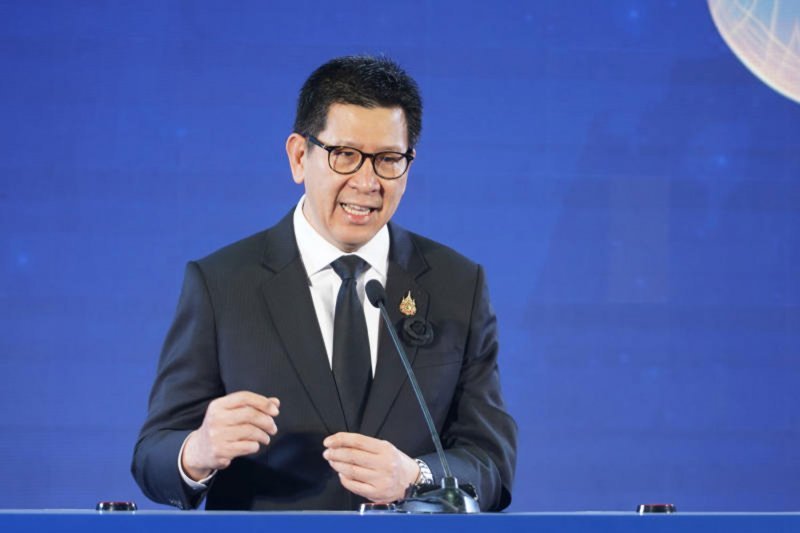
Deputy Prime Minister and Finance Minister Ekniti Nitithanprapas
The proposal to raise value-added tax from 7% to 8.5% in 2028, and to 10% in 2030, by Deputy Prime Minister and Finance Minister Ekniti Nitithanprapas is a display of political courage rarely seen in a political landscape where politicians are quick to spend money in the name of “economic stimulus” but stay mum when asked how to finance the schemes.
Public debt reached 64.8% of GDP at the end of September and is expected to exceed 65% next year, only a short distance from the 70% permitted ceiling.
At the same time, recurrent expenditure, including salaries and the fast-rising cost of state welfare programmes, now accounts for roughly 70% of the budget and is still expanding. This places growing pressure on Thailand’s competitiveness and sovereign credit rating. Moody’s has already assigned a Baa1 rating with a negative outlook, while Fitch maintains BBB+ with a stable outlook. These warnings cannot be dismissed.
Although Thailand’s VAT legislation already allows for a ceiling of 10%, no government over the past three decades has dared to raise the rate, fearing an electoral backlash. Mr Ekniti’s proposal shows the need to confront reality instead of evading it.
A VAT increase indeed is inevitable as Thailand cannot sustain a tax-to-GDP ratio of around 16% while public debt edges closer to the legal limit and essential services face mounting long-term obligations. Without new and dependable revenue, the alternatives would be deeper borrowing or cuts to vital social programmes.
But support for a VAT rise must be conditional. Public reluctance does not stem from the tax itself but from years of watching public money diverted into political giveaways, wasteful projects and inefficient spending.
Examples abound. One recent case concerns the National Health Security Office’s questionable allocation of taxpayer funds to NGO projects while some state hospitals under the scheme complain of delays in allocations.
Before hiking VAT, the government must show how it intends to correct these failures.
The government needs to raise more money from VAT collections, to be sure, but it must be used for public benefit, and under transparent regulatory monitoring.
For example, the government must specify how the extra funds will be used and limit spending to essentials. Priority areas should include education and reskilling, healthcare, infrastructure that raises competitiveness, and research and innovation.
But raising VAT alone is not enough. The government must find a way to tax informal business and the underground economy which is thought to represent as much as 40% of total economic activity. VAT is an efficient and broadly fair tax, as people who consume more pay more. But it is not perfectly equitable because the same rate applies to both rich and poor.
Measures to cushion low-income households from the impact of higher prices will be even more necessary, especially given the steep rise in food costs despite low headline inflation, and the burden of essential goods such as medicines. If these safeguards are honoured, the public can accept that a VAT increase serves the country’s future, not political convenience.
So, if VAT is to increase, it must be raised for the right reasons: to secure Thailand’s long-term fiscal stability and competitiveness, not to finance electoral calculations or sustain a bureaucracy resistant to reform. The government has a choice, and the public is watching.
TV Girl, an American indie pop band, will give their Bangkok debut concert “TV Girl Perform Their Hits Live” at the Samyan Mitrtown Hall of Samyan Mitrtown, Rama IV Road, on Dec 1 at 8pm. Formed in San Diego in 2010 as an outlet to blend a love…
TV Girl, an American indie pop band, will give their Bangkok debut concert “TV Girl Perform Their Hits Live” at the Samyan Mitrtown Hall of Samyan Mitrtown, Rama IV Road, on Dec 1 at 8pm.
Formed in San Diego in 2010 as an outlet to blend a love of Spector-esque girl group pop with hip-hop, TV Girl consists of lead vocalist Brad Petering, drummer Jason Wyman and keyboardist Wyatt Harmon.
Featuring shimmering vocals and sampled beats, their self-titled debut mini album of the same year turned heads immediately. They released two more mini albums before their first full-length album French Exit was launched in 2014.
The album kept true to the TV Girl charm with a bevy of electronic samplings infused throughout light and airy guitars, whirring organs and ethereal vocals that tell the tale of moody characters fuelled by revenge as often as love, underpinned by a desperation and deep yearning to connect.
Their second album Who Really Cares followed in 2016, finding the band doubling down on their heavy use of samples. The record saw TV Girl combine the aesthetic of 90s hip-hop with modern psychedelic pop, offering a glimpse into the psyche of a love-scorned 20-something.
The band released their latest record Grapes Upon The Vine in 2023. Their most mature effort yet, the album features extensive use of gospel samples as it explores themes of commitment, God and the afterlife, not without TV Girl’s cynicism and biting wit.
Backed by gospel singers and a live band, TV Girl has performed around the world in theatres, arenas and festivals. After Bangkok, the trio will be gracing stages in Singapore, Taipei and Tokyo.
Surveys conducted between Jan 1, 2020, and Feb 20 this year by the Department of Mental Health revealed that over 6 million Thai people suffer from mental health issues. Of these, 560,000 or 9.1% are at risk of depression, while 480,000 or 7.9% face hi…
Surveys conducted between Jan 1, 2020, and Feb 20 this year by the Department of Mental Health revealed that over 6 million Thai people suffer from mental health issues. Of these, 560,000 or 9.1% are at risk of depression, while 480,000 or 7.9% face high stress, and 310,000 or 5.2% are at risk of suicide.
People aged 20 to 29 are at high risk in all areas — 29.5% at risk of depression, 26.2% at risk of stress and 17.5% at risk of suicide. In 2024, the survey discovered that over 5,000 Thai people committed suicide and it is estimated that there are 1.3 million people aged 15 and over with depression.
Due to the high rate of mental health issues and suicide incidents in shopping malls, mental health is a serious issue. To raise awareness, Sati, a mental health service application, collaborated with Thailand Institute for Mental Health Sustainability, the Bangkok Metropolitan Administration and many private sectors to hold the event “Better Mind Better Bangkok 2025” at Samyan Mitrtown last month.
The event provided information regarding activities that can increase energy, self-compassion, acceptance and gratitude. The information, shared on Oct 4, revealed that the Sati app has 64,297 users and the app took 33,744 calls. The average duration of a call was 18 minutes and six seconds. Users stated that their negative feelings and thought of self-harm decreased after the call.
In addition to activities at the event, there were also other forums including “Possibility: Dare To Dream Of Mental Health Policies That Address The Needs Of Urban Society”.
Dr Varoth Chotpitayasunondh, a psychiatrist and spokesperson with the Ministry of Public Health, kicked off the forum by answering the question, is it possible to dream of mental health policies that address the needs of urban society?
“I can’t say for sure how feasible it is, but we believe in our potential as an organisation that focuses on mental health,” Dr Varoth said. “Mental health care in Thailand will not focus solely on treatment or on increasing mental health professionals and hospitals. If that happens, many people will still suffer from mental health issues. We may try new projects that focus instead on prevention and public awareness which could lead to a reduction in the number of people experiencing mental health issues.”
Dr Suthee Saritsiri, director of the Health Promotion Division at the Health Department, Bangkok Metropolitan Administration, said it already has some mental health services that people can access. Dr Suthee mentioned that the Urban Medicine Service Center in 11 hospitals under BMA provides medical services in the form of a one-stop service. Patients can ask for information about health problems, schedule an appointment for a checkup and consult doctors online via telemedicine.
The BMA also has a mental health screening system. Dr Suthee gave an example of a case she experienced.
“The team was called to the scene of a student who had jumped from the 7th floor of a school. Following the incident, students, teachers and other people who had experienced the event were given mental health screenings, as the experience could contribute to stress, depression and panic attacks.
“We learned that some students knew how to relieve stress, such as by exercising, singing or hanging out with friends, while some had no idea what to do,” explained Dr Suthee.
“We also learned that most students tend to discuss problems with their peers, so we encourage students to have leaders who coordinate with teachers. These leaders can help their peers with learning and academic activities. The school also organised meetings with parents, as their expectations can cause pressure on students. Parents should allow their children to learn what interests them.”
When asked what a mental health policy would look like, Dr Varoth said policies can be driven two ways — top-down or bottom-up. He gave the example of declaring May each year as a mental health month being a top-down policy.
For the bottom-up policy, Dr Varoth mentioned Sati’s Bench With Ears project which provides a safe space without charge for Bangkokians. Volunteers will be available to listen to participants without being judged for 40 minutes. Another project is Jood Pak Jai (A Resting Place For Your Heart) created by Pataradanai Setsuwan, a psychotherapist. Participants can speak with Pataradanai for five or 50 minutes without charge.
According to Dr Varoth, the number of patients with mental health problems has increased since 1990. However, Thailand still has a stigma around mental health.
“While the stigma surrounding mental health patients has improved, I noticed that many people still view mental health issues as not their own concern and so ignore them. Those people only pay attention when the issues affect themselves or their family members. If everyone realises that mental health issues are not solely the responsibility of the Ministry of Public Health or medical schools, more mental issues will be addressed,” explained Dr Varoth.
“An event like ‘Better Mind Better Bangkok 2025’ is a great example as it is a collaborative effort between multiple organisations that pool their resources. This helps people realise that mental health issues are related to everyone.”
Pataradanai, who worked as a volunteer psychotherapist in the UK for a couple of years, agreed that Thai people still have stigma about mental issues. Pataradanai said people in the UK have easy access to a psychotherapist or psychiatrist.
“Thai people have an attitude that mental health issues are like bacteria or a virus that needs to be treated. Seeing a psychiatrist in a private hospital is still a luxury service that not everyone can access. Therefore, I created Jood Pak Jai, so that people can relieve stress. Projects like ‘Bench With Ears’ help people feel they can be heard by others who are not psychotherapists or psychiatrists. They will feel that mental issues are not shameful and get access to mental health services,” said Pataradanai.
Dr Suthee pointed out that many mental health issues are caused by family since parents focus on the financial issues of making a living rather than building a relationship with their children.
“Many people, who are stressed and depressed, are from rural areas because they feel isolated and do not have anyone to turn to. Having someone to listen to them can help them feel better. Additionally, children should be taught life skills, including social skills, forgiveness and sharing. This will gradually improve society,” said Dr Suthee.
Dr Varoth encouraged people to start by appreciating themselves and pay it forward for a better society.
“If you can appreciate yourself, you will be able to appreciate those around you and others. If everyone does this, the positive feeling will spread to others. I believe that mental health is not just one person’s business, but everyone’s business. I hope everyone will work together to cope with mental health issues.”
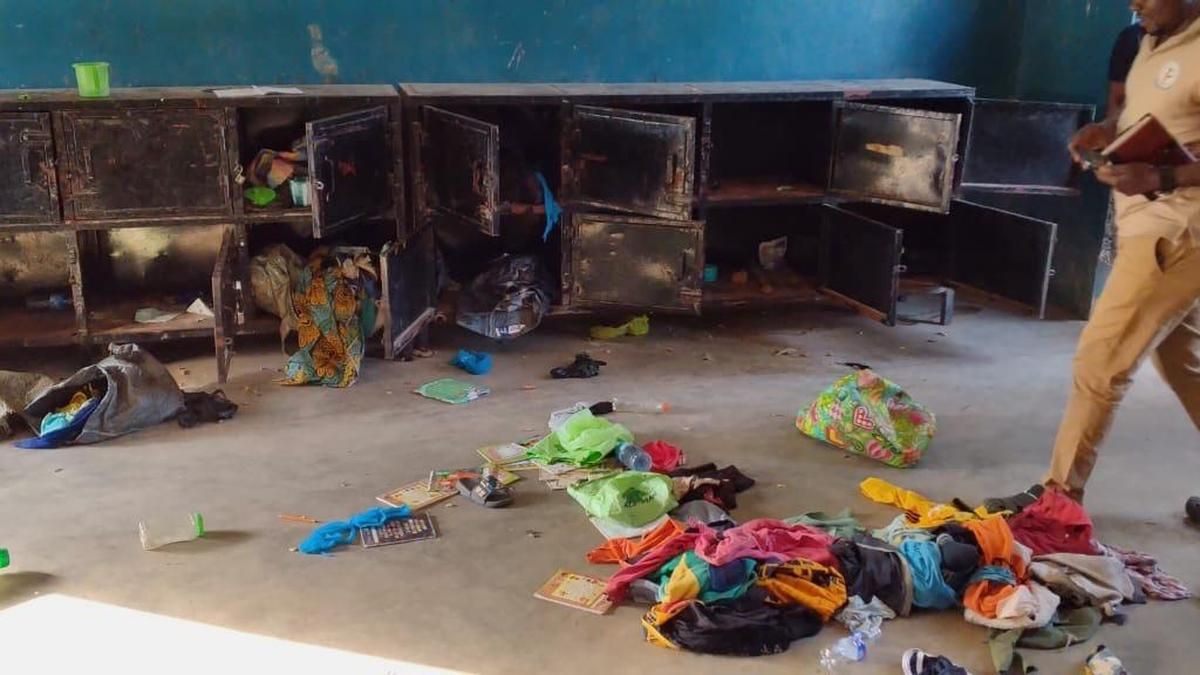
At least 50 of the more than 300 students abducted by gunmen
from a Catholic school in Nigeria have escaped their captors, a
Christian group tracking the incident says.
The gunmen raided Saint Mary’s Catholic School in north-central
Nigeria’s Niger Sta…
At least 50 of the more than 300 students abducted by gunmen
from a Catholic school in Nigeria have escaped their captors, a
Christian group tracking the incident says.
The gunmen raided Saint Mary’s Catholic School in north-central
Nigeria’s Niger State on Friday, taking 303 children and 12
teachers in one of the country’s largest mass kidnappings.
In a statement on Sunday, the Christian Association of Nigeria
(CAN) said the 50 pupils were safe and had been reunited with their
families after they escaped between Friday and Saturday.
“As much as we receive the return of these 50 children that
escaped with some sigh of relief, I urge you all to continue in
your prayers for the rescue and safe return of the remaining
victims,” CAN’s chairman in Niger State, Reverend Bulus Dauwa
Yohanna, said in the statement.
The Catholic school abduction came just four days after armed
men stormed a secondary school in northwestern Nigeria, kidnapping
25 schoolgirls and killing the school’s vice-principal.
Monday’s attack took place in similar circumstances in
neighbouring Kebbi State’s Maga town, some 170km (106 miles) away.
At least one girl has since escaped and returned safely, but 24
others are still missing.
The identity of the attackers remains unclear in both cases, and
no group has claimed responsibility so far.
Regional authorities and security agencies have launched
search-and-rescue operations in surrounding forests and along
escape routes, with police, military and even local hunters
deployed to help.
The Cross River State Commissioner of Police, Rasheed Afegbua has said that he had made giant strides within four months in office.
Speaking with journ…
The Cross River State Commissioner of Police, Rasheed Afegbua has said that he had made giant strides within four months in office.
Speaking with journalists in Calabar, the Commissioner said his command had been able to prosecute over 253 cases in various courts and secured conviction of 94 cases in court.
According to the Police Commissioner, out of 1,573 cases charged to court, only five cases were discharged and only six are on Appeal while 53 are pending.
Afegbua said: “I warmly welcome you all to my first media parley, which is focused on reviewing the state of security in Cross River State beginning from 7th July, 2025 when I took over the mantle of leadership of the Command to date, as we prepare for the Yuletide celebrations. My approach to policing this state has been guided by three core principles: visible presence, intelligence-led operations, and partnership-driven policing.”
Related News
He said that the Command has been collaborating to create a safe, stable, and law-abiding Cross River where criminal elements are denied the space to operate, and citizens feel protected, not just policed.
“To achieve this, we disrupted criminal networks through targeted intelligence-led operations. Increased police presence and response capacity in urban, rural, and border communities via visibility policing. Restored trust and accountability in police-community relations, strengthened inter-agency collaboration to ensure coordinated security efforts.
“Our immediate focus was on murder, armed robbery, kidnapping, and cultism as identified in hotspots. Securing rural communities, particularly those vulnerable to communal conflict. Protecting schools, markets, and key state assets. Reducing internal misconduct by enforcing discipline and public accountability.
“Let me take this opportunity to express my profound gratitude to the Inspector General of Police IGP Kayode Adeolu Egbetokun, for finding me worthy to be posted as the Commissioner of Police Cross River State. I also thank the Governor of Cross River State His Excellency, Senator Bassey Edet Otu, for his immeasurable support and commitment to the Nigeria Police Force in the state since my assumption of office.”
…Says they’ve not had it this good
Charles Uzondu, president general, Ikwuano Development Union (IDU), Abia State, has applauded Governor Alex Otti, ov…
…Says they’ve not had it this good
Charles Uzondu, president general, Ikwuano Development Union (IDU), Abia State, has applauded Governor Alex Otti, over his giant strides in governance, especially in Ikwuano Local Government Area (LGA).
Uzondu in an emotion-laden letter addressed to Governor Otti, on behalf of Azuiyi Oloko Community in Ikwuano Local Government, thanked the Governor, for establishing a modern Primary Healthcare Centre in the area, as well as equipping it with modern healthcare gadgets.
He explained that the medical centre is equipped with a consulting room, 4-bedroom wards each for male and female, 2-bed room Labour rooms, a pharmacy and a laboratory, with separate conveniences.
The President General of IDU, listed other features of the health centre to include, a kitchen, a store, laboratory equipment, suction pump, an oven, incubator, genotype machine, water bath, auto leaves, sterilizer, wheelchair, a functional borehole, 4.8kva standby generator and solar installation.
He declared that the facility is World Health Organisation (WHO) standard, noting that his people have never had this type of government gifting and dividend of democracy before”.
Related News
The PG disclosed that the new PHC was commissioned on October 28, 2025, barely two days after the Governor performed what he described as ” miracle on the Umuahia -Ikwuano-Ikot Ekpene Road and the Ariam Usaka Ring road.
While assuring the Governor that Azuiyi community, the project host community will effectively patronise, protect and secure it, he reminded the governor that he has written his name in gold.
According to him “You have written your name in gold in Azuiyi, the only community in Ikwuano that has to pass through Isiala Ngwa North and Umuahia South before accessing their LGA headquarters at Isiala Oboro.
“To show the luck you have brought to my community, a bouncing baby girl was delivered at the facility during the commissioning. Be assured Sir that from Azuiyi all the 2027 votes are secured. God bless you.”
It’s worthy of note that outside the over 200 Primary Health Centres being built across the 184 wards of the state, which are impacting the lives of Abians, especially rural dwellers positively, Governor Otti is also investing massively in road infrastructure, education, security, waste management and workers’ welfare.
A new continental study has found that military coups, not elections, have become the most common pathway for young Africans to attain national leaders…
A new continental study has found that military coups, not elections, have become the most common pathway for young Africans to attain national leadership, deepening concerns about democratic backsliding and instability across the region.
The Age & Governance in Africa: 2015–2025 report published by Column shows that almost all of Africa’s youngest leaders in the last decade rose to power through the barrel of a gun rather than the ballot box, a trend the authors describe as one of the continent’s most defining governance shifts.
“Younger African leaders mostly rose to power through coups between 2015 and 2025. Older leaders typically came through elections or party processes,” the report states.
The research examined 38 first-time heads of state and discovered that some of the continent’s most youthful leaders, such as Burkina Faso’s Ibrahim Traoré (34), Mali’s Assimi Goïta (38), Guinea’s Mamady Doumbouya (41), and Chad’s Mahamat Idriss Déby (37), gained power through military takeovers. In contrast, elected leaders tended to be significantly older, typically in their late fifties to seventies.
Related News
According to the authors, this sharp divide reflects a deeper structural problem within African political systems. They argue that traditional party structures “push entry into the late fifties or sixties,” leaving younger political hopefuls little room to rise legitimately. As the report warns, “The pathway to power explains age differences better than cultural preferences or demographics.”
The consequence, the analysis suggests, is that ambitious youth increasingly view democracy as a closed door. “When formal systems seem closed, ambition flows to informal or disruptive channels, protests, populist movements, and military interventions,” the document says, cautioning that this dynamic fuels unrest and weakens public faith in democratic governance.
The report also highlights that while coups tend to bring younger leaders to office, they often come with legitimacy challenges, international sanctions, and strained donor relations. Elected leaders, though older, typically enjoy greater constitutional recognition. This makes the “ballots versus barracks” divide an urgent governance puzzle for African states.
Ultimately, the study calls for deep party reforms, youth-inclusive political pipelines, and stronger civilian oversight of the military to ensure that young leaders can rise through constitutional means rather than force.
Donald Trump has slammed Ukraine’s leadership for not thanking
him for his efforts to end the war with Russia.
The US President has accused Ukraine of having ‘zero gratitude’
in a post on his Truth Social profile.
He wrote: ‘UKRAINE ‘LEADERSHIP’ HAS EX…
Donald Trump has slammed Ukraine’s leadership for not thanking
him for his efforts to end the war with Russia.
The US President has accused Ukraine of having ‘zero gratitude’
in a post on his Truth Social profile.
He wrote: ‘UKRAINE ‘LEADERSHIP’ HAS EXPRESSED ZERO GRATITUDE FOR
OUR EFFORTS, AND EUROPE CONTINUES TO BUY OIL FROM RUSSIA.’
‘I INHERITED A WAR THAT SHOULD HAVE NEVER HAPPENED, A WAR THAT
IS A LOSER FOR EVERYONE, ESPECIALLY THE MILLIONS OF PEOPLE THAT
HAVE SO NEEDLESSLY DIED.’
He repeated his accusation that Vladimir Putin seized his chance
to invade as ‘Sleepy Joe’ Biden was in the White House.
It came as a widely leaked 28-point US-backed peace plan
acquiesces to many Russian demands that Ukrainian President
Volodymyr Zelensky has categorically rejected on dozens of
occasions, including giving up large pieces of territory.
It prompted fears it was entirely drafted by the Kremlin but
Secretary of State Marco Rubio denied the accusation saying it took
a month of negotiation.
He wrote on X: ‘The peace proposal was authored by the US. It is
offered as a strong framework for ongoing negotiations. ‘It is based on input from the Russian side. But it is also based
on previous and ongoing input from Ukraine.’
Nevertheless, Trump says he wants Ukraine to accept the plan by
late next week.
Seemingly in response, Ukraine’s top security official, Rustem
Umerov said: ‘We appreciate our American partners working closely
with us to understand our concerns to reach this critical point and
we expect to make more progress today.’
Zelensky says there is now an understanding that the US-proposed
peace plan may take into account ‘a number of elements that are
based on the Ukrainian vision and are critical to Ukraine’s
national interests’.
He adds that further work is ongoing to ensure that ‘all
elements are truly effective in achieving the main goal – to
finally put an end to the bloodshed and war’.
Yangzhou morning tea is a must-try culinary experience for visitors.
In the eastern heartland of China lies Jiangsu Province — a region that captivates not only with its classical gardens, canals, and ancient towns, but also with a culinary heritage as refined as its culture. Jiangsu is home to thirteen cities, each boasting its own distinctive local delicacies that reveal the soul of the place. From the rich duck dishes of Nanjing to the delicate sweetness of Suzhou and the world-famous Yangzhou cuisine, this province invites travellers to savour its stories — one bite at a time.
Nanjing: A City of Ducks and Deep Flavors
As the capital of Jiangsu, Nanjing has been a crossroads of cultures and cuisines for centuries. Here, food is not just nourishment; it’s a reflection of the city’s long history and its people’s enduring love for hearty, comforting flavours.
A local saying captures it best: “No duck can fly out of Nanjing alive.” For over a thousand years, duck has reigned as the city’s culinary symbol. Whether simmered, roasted, or braised, it appears on almost every local menu — and in countless variations.
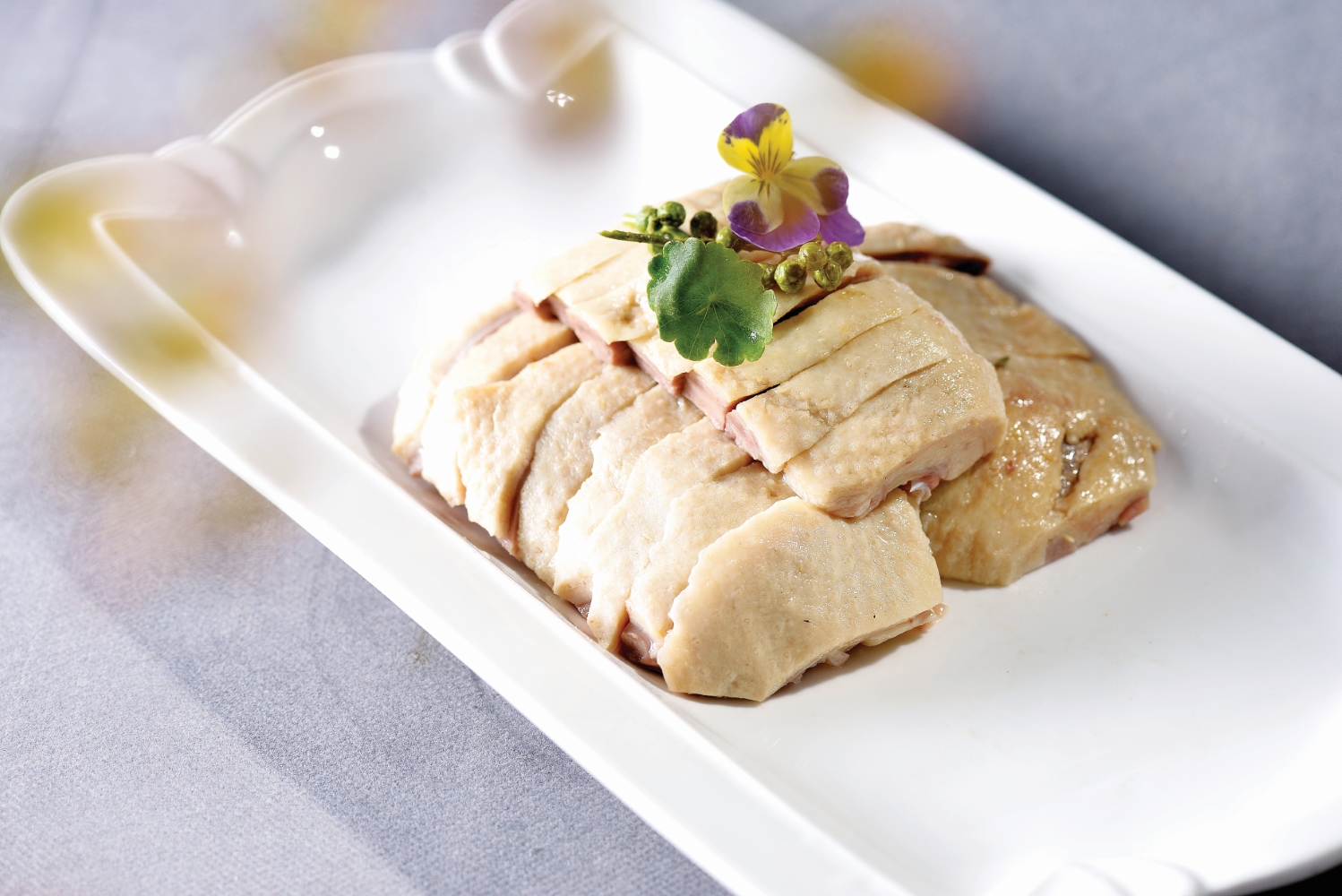
Among the must-tries is the famous Nanjing Salted Duck, tender and subtly spiced with a lingering fragrance that pairs perfectly with steamed rice. Another favourite is Nanjing Roast Duck, crisp on the outside and juicy within, often compared to its Beijing cousin but loved for its distinct regional twist. For a warming street-side experience, locals swear by a bowl of Duck Blood and Vermicelli Soup — a savoury broth filled with translucent rice noodles, duck offal, and cubes of congealed duck blood that somehow tastes far better than it sounds.
But Nanjing’s flavours don’t stop with ducks. At traditional eateries such as Nanjing Impressions or around the bustling Fujimiao (also known as Confucius Temple) area, you’ll find a mouthwatering array of small bites and desserts that speak of the city’s comfort food culture. Try the Beef Potstickers with their golden, crispy bottoms; the flower-shaped Plum Blossom Cake; or the Glutinous Rice Balls in Fermented Red Bean Wine — a sweet, fragrant dessert often enjoyed warm. And don’t leave without sampling Sweet Lotus Root with Sticky Rice, a glossy treat that embodies the elegance of Jiangsu desserts.
Salted duck with a subtle fragrance of osmanthus — best enjoyed in autumn.
Suzhou: The Poetry of Sweetness
If Nanjing’s cuisine is robust and bold, Suzhou, located at the heart of the Yangtze River Delta and the Taihu Plain, represents refinement and balance. Known since ancient times for its mastery of fish dishes, Suzhou cuisine celebrates subtlety — where sweetness enhances rather than overwhelms, and every ingredient is treated with delicate respect.
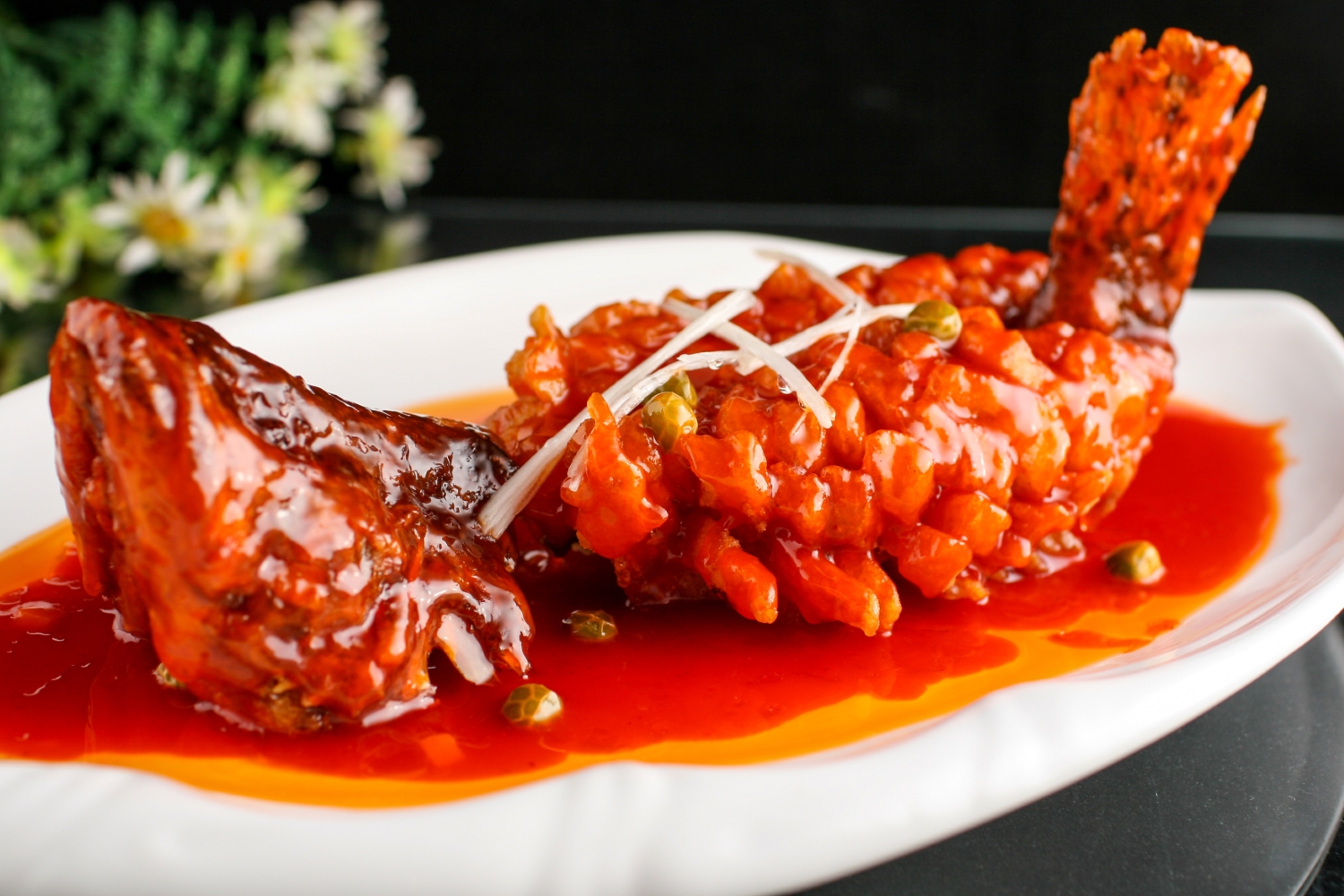
The city’s culinary crown jewel is Sweet and Sour Mandarin Fish (also known as Squirrel Fish), a dish as beautiful as it is delicious. The fish is expertly cut to resemble a squirrel’s tail, deep-fried to golden perfection, then topped with a tangy, sweet sauce that sizzles when poured over. Another Suzhou favourite is Eel in Hot Oil Sauce, rich and savoury with a satisfying fragrance, followed closely by Cangshu Mutton — a local speciality that warms the body during the chilly months.
Sweet and Sour Mandarin Fish, renowned for its intricate knife work.
When autumn comes, the city celebrates the arrival of Yangcheng Lake Hairy Crab, a seasonal delicacy prized across China for its golden roe and creamy texture. For those who prefer lighter bites, Suzhou’s dim sum selection is unparalleled: Crab Roe Soup Dumplings that burst with rich broth; Pan-Fried Buns with juicy pork filling; and Sweet Fermented Rice Cakes that carry the aroma of rice wine.
Don’t miss the charming Green Glutinous Rice Balls (also known as Qingtuan) during spring or the Three Whites of Taihu Lake — whitefish, white shrimp, and silver fish (or whitebait) — which showcase the lake’s bounty.
Suzhou’s food, much like its classical gardens, values harmony and precision. Every dish reflects the city’s pursuit of aesthetic perfection — from the choice of ingredients to the artful plating. For travellers, Guanqian Street is the perfect place to explore this culinary world, where traditional teahouses and modern eateries blend seamlessly to serve both nostalgia and innovation.
Yangcheng Lake Hairy Crab — a seasonal delicacy available only in autumn.
Yangzhou: The World’s Capital of Cuisine
In 2019, Yangzhou earned the title of “City of Gastronomy” from UNESCO — a well-deserved recognition for a place where culinary craftsmanship has flourished for centuries. If there’s one dish that has made Yangzhou famous across the globe, it’s undoubtedly Yangzhou Fried Rice.
Simple as it may seem, true Yangzhou fried rice is an art form. The premium long-grain rice is stir-fried with shrimp, diced chicken, ham, egg, sea cucumber, scallops, fresh bamboo shoots, and a touch of green peas — each grain perfectly separated, glistening, and full of aroma. It’s the kind of dish that has travelled far beyond China; wherever there’s a Chinese restaurant in the world, “Yangzhou Fried Rice” almost certainly appears on the menu.
But Yangzhou’s food story goes far deeper. The city’s rich culinary tradition includes sophisticated dishes such as Steamed Pork Meatballs (or Lion’s Head Meatball) with Crab Roe — tender “lion’s head” meatballs served in clear broth — and Shredded Tofu in Broth (Wensi Tofu), a masterpiece of knife skills where tofu is sliced into countless hair-thin strands floating like silk threads in soup.
No visit to Yangzhou would be complete without experiencing its morning tea culture, a cherished ritual that rivals Cantonese dim sum in variety and finesse. Locals call it “Yangzhou Morning Tea”, but it’s more like a leisurely feast. Must-tries include the Three-Diced Buns stuffed with pork, shrimp, and bamboo shoots; Jade Shaomai (Feicui Shaomai) wrapped in translucent green skins; Crab Roe Soup Dumplings ; and the signature Shrimp Roe Noodle Soup.
For many, sipping tea and sampling these delicate snacks in a traditional teahouse is as essential to understanding Yangzhou as visiting its gardens and canals. After all, in this city, dining is an art — and breakfast is where it all begins.
World-famous Yangzhou Fried Rice.
A Taste of Jiangsu’s Soul
Across Nanjing, Suzhou, and Yangzhou, Jiangsu’s cuisine tells a story of refinement, seasonality, and balance. It’s a cuisine that values texture and presentation as much as taste — where the goal is not intensity, but harmony.
From the savoury aroma of Nanjing’s duck dishes to the poetic sweetness of Suzhou’s seasonal fare and the world-renowned elegance of Yangzhou’s banquets, Jiangsu offers travellers a journey that lingers far beyond the plate.
In every city, a different flavour awaits — a reminder that food, like history and art, can be the most delicious way to remember a place.
…Vows to secure release of kidnapped school children
President Bola Tinubu has confirmed the rescue of all the 38 worshippers abducted in Eruku, …
…Vows to secure release of kidnapped school children
President Bola Tinubu has confirmed the rescue of all the 38 worshippers abducted in Eruku, Kwara State
The President stated this in a message to Nigerian on his X handle on Sunday.
The President also promised to leave no stone unturned in his current efforts to recover all the kidnapped school children in Kebbi and Niger states
Related News
He said ” You will recall that I cancelled my trip to the G20 summit in South Africa to enable me coordinate the security efforts at home.
“Thanks to the efforts of our security forces over the last few days, all the 38 worshippers abducted in Eruku, Kwara State have been rescued”
He also expressed his joy that 51 out of the missing students of the Catholic School in Niger State, have been recovered.
” I am closely monitoring the security situation nationwide and receiving continuous updates from the frontline.
“Let me be clear: I will not relent. Every Nigerian, in every state, has the right to safety — and under my watch, we will secure this nation and protect our people.” Details later