Sabotaging Peace: Voices in Yerevan prefer conflict to compromise

At a moment when Armenia and Azerbaijan are closer than ever to
signing a long-awaited peace treaty, some figures in Yerevan
continue to indulge in the dangerous fant…

Elnur Enveroglu

At a moment when Armenia and Azerbaijan are closer than ever to
signing a long-awaited peace treaty, some figures in Yerevan
continue to indulge in the dangerous fantasy that peace is a form
of surrender. Their claim that Armenia is being “pressured” into
peace is not only misleading; it is a reckless narrative that
exposes what they truly desire: perpetual confrontation, not
reconciliation.

Those who insist that Armenia cannot accept peace because of
supposed “humiliation” or “fear” offer no credible alternative.
What, then, is their preferred option? Renewed war? Further
aggression? The continued occupation or attempted re-occupation of
another country’s territory? By refusing to answer these questions
honestly, they reveal the hollowness of their rhetoric.

Real threat to peace comes from those who fear it
most

It is telling that their outrage is not directed at the prospect
of another conflict, but at the basic idea of dialogue between
societies. The mere fact that Armenian civil society
representatives travelled to Baku, openly, safely, and with state
support, is portrayed as betrayal rather than progress. Instead of
welcoming confidence-building measures, they twist them into
conspiracies, accusing their own government of “legitimising”
events they have already predetermined in their minds.

Such actors refuse to acknowledge that Armenia is not compelled
to make peace; it is choosing to, because peace is unquestionably
in the interest of its people. No international pressure is
required to recognise that stability, open borders, and regional
cooperation are preferable to another cycle of devastation.
Pretending otherwise is an insult to the public’s intelligence.

In truth, these voices are not safeguarding national dignity,
but they are sabotaging their country’s future. By attempting to
poison the atmosphere, delegitimise dialogue, and discredit any
Armenian who seeks contact across the border, they perpetuate the
very hostility they claim to oppose. Their position is not one of
principle, but of political opportunism dressed up as
patriotism.

The region has suffered enough. Those who now try to derail the
peace process should be honest: their objection is not to pressure,
but to peace itself.

WCD: UNICEF urges government to end child poverty through meaningful opportunities

The United Nation’s Children Fund (UNICEF) has urged government at various levels to end child poverty through effective evidence policy that will crea…

The United Nation’s Children Fund (UNICEF) has urged government at various levels to end child poverty through effective evidence policy that will create meaningful opportunity for them and their families.

Rafique Nuzhat, chief of UNICEF Field Office, Bauchi, made the call during the celebration of the World Children’s Day, held at Hazibal Hotel, along Yelwa, Tafawa-Balewa Road.

Nuzhat, who was represented by health specialist, Oluseyi Olusende, said that government of the day would create meaningful opportunity for them by educating them, provide conducive learning environment and with enough security for protection.

She said that if governments did, it will definitely help to make the future of Bauchi State children and Nigeria better.

She further said that government can also provide them with water for bathing and washing for the good of their health.

Related News

According to her, “Water is essential because when a mother delivers, we need water to clean the woman and the baby. We need water to clean the equipment used for the delivery.”

Nuzhat said that Bauchi State was one of the states with heavy lot of zero dose children which needs to be reduces because Immunization is the first right of every child from the day the child is born.

Zero dose means children that are not being vaccinated or children that have not received vaccination. She urged government, parents, community and religious leaders to ensure every child is reached with basic vaccine.

“We also need to expand access to education in order to reduce the number out-of-school children by addressing poverty, insecurity and structural barriers, because most of them will be local government chairmen, governors, presidents, lawyers, teachers and others.”

According to her, the future of the children depends on how leaders of today respect and protect their rights.

Bamidele calls for greater investment in digital technology for job creation

Leader of the Senate, Senator Opeyemi Bamidele has called for greater investment in digital technology and entrepreneurial training as measures to addr…

Leader of the Senate, Senator Opeyemi Bamidele has called for greater investment in digital technology and entrepreneurial training as measures to address youth unemployment in the country.

Bamidele made the call at the 37th convocation lecture of Yaba College of Technology, Lagos State, pointing out that across the globe, it was no longer realistic for governments to provide white-collar jobs for graduates from higher institutions.

In his lecture titled ‘Entrepreneurship Development in the Digital Age Leveraging Technology for Job Creation,’ Bamidele highlighted technological revolution and the emergence of digital economies worldwide.

He emphasised that countries seeking to survive should prioritise the importation of innovative knowledge and tech skills for the advantage of their people, especially the youth population.

Read also: Nigeria to gain 6,000 new jobs from ETG’s agricultural expansion — Shettima

He said: “All over the world, it is no more realistic for Governments to provide white collar jobs for all the young graduates from the universities, polytechnics, technical colleges and other tertiary institutions.

“The contemporary trend is that governments are seriously looking for ways to prune down the cost of governance and are taking bold measures to replace humans with high tech machines and artificial intelligence.

“The new wave of technological revolution and the attendant emergence of digital economies around the globe is a pointer to the fact that nations that are determined to survive must prioritise the impartation of innovative knowledge and technical skills in their young people.

Related News

“You will agree with me that this is the secret and the real strength of the Asian tigers for which the rest of the world have continued to adore them today.

“To attain a similar feat in Nigeria, nay Africa, our policy makers and state actors must prioritize entrepreneurship training by ensuring that our educational curricular from the primary to tertiary levels incorporate the development of technical skills, creative innovation, digital education, problem-solving skills, the impartation of managerial capacity as well as interpersonal relationship development.

“This is the future we all envisage, this is the future we look forward to, and Nigeria, the supposed giant of Africa, cannot afford to be left behind.”

Bamidele recalled that the essence of establishing Yaba College of Technology as the first tertiary institution in the country was to provide full time and part time training in technology, applied science, commerce and management, agricultural production and distribution; and research.

He stated that the priority, which the institution attached to the development of technology, creative innovation and entrepreneurship training, cannot be over emphasised.

Read also: Over 500,000 direct jobs at risk if sachet, pet bottle alcohol banned, FOBTOB warns

The senate leader added that it is an eloquent testimony to the depth of the vision of past leaders who played a vital role in its establishment.

He, therefore, called on the private sector to focus on mentorship and networking by pairing upcoming entrepreneurs with experienced ones; creating peer communities; facilitating access to markets.

Egusi Ijebu – Proudly Nigerian superfood that can gain UN cultural status

Egusi Ijebu is a proudly South Western Nigerian delightful stew – like soup that is relished across most Yoruba land, with focus on Ijebu, Ogun State.

Egusi Ijebu is a proudly South Western Nigerian delightful stew – like soup that is relished across most Yoruba land, with focus on Ijebu, Ogun State.

This community and cultural soup can comfortably pass as a unity and even a diaspora soup.

This is because the migration of Egusi Ijebu loved by Nigerians to other parts of the world has also knowingly or unknowingly prompted the movement of the soup to other countries like Ghana, Togo, Senegal, Cameroon, the United Kingdom, United States and Australia, among others.

With the way Egusi Ijebu has travelled from one generation to generation, this soup should be on track to gain recognition as part of UNESCO’s Intangible Cultural Heritage list.

Known for its rich flavour, nutritional value, health benefits, and cultural significance, Egusi Ijebu is more than just a meal, it is a culinary emblem of identity.

Egusi, the key ingredient for the preparation of the soup, comes from protein-rich melon seeds (Cucumeropsis mannii or Citrullus lanatus), commonly used as a thickening agent in many traditional soups.

In preparing this type of soup, the melon seeds are usually washed with water, with the likes of fresh tomatoes, onions, atarodo, tatashe and sumbo, all added to the egusi and blended into a thick puree. Most times, dried crayfish and shrimps are also washed and added to the pepper and wet egusi mix, before being blended. The final outcome always would like a new born baby’s fecal matter.

The uniqueness of the soup is that, it is prepared like any south western oily stew and can be used for not just swallows like eba, lafun, fufu, and amala, but for boiled yam, rice, or any other starchy Nigerian food that need stew or soup accompaniment.

Egusi Ijebu can therefore be described as a unique cultural and traditional soup that holds a central place at most Ijebu homes, and special occasions like traditional wedding ceremonies, funeral ceremonies, communal tables, villiage meetings and especially special cultural ceremonies.

The best and most commonly used leaves for this soup is efo – shoko or tete. Once the soup is fried in a stew-like form, it is really for serving.

Beyond its taste and texture, Egusi Ijebu offers impressive nutritional value. It is packed with protein, healthy fats, and essential vitamins like A, B1, B2, and E. It provides vital amino acids like arginine and lysine, making it a key food source in many South Western communities.

Egusi Ijebu, because of the use and frying of extra oil is pack with much edible oil and pure protein. Egusi seed as a great source of Arginine helps in regulating metabolism and improves the cardiovascular system while Lysine helps in the formation of collagen and connective tissues in the body. It is also low in calories.

The Egusi seed is an excellent source of nutritional minerals and vitamins such as carbohydrates, fat, zinc, vitamin B1 (Thiamine), dietary fibre, sulphur, magnesium, vitamins B2 (Riboflavin), niacin and manganese amongst others.

Through the voice of food journalism and tourism, efforts must now be made to list Egusi Ijebu part of the UNESCO Intangible Cultural Heritage list.

Its sociocultural value is undeniable. This is because, in many rural areas across the Nigerian landscape, especially Yoruba land, this soup is not just a delicacy, it is seen and relished as a therapy, tradition, and a means of identity, oneness and togetherness. Many women and food sellers also selling food across small restaurants, Bukkas, and eateries in the inter ior villages and towns are known for selling this soup to many lovers of swallow and soup.

Related News

Egusi Ijebu can go with different types of swallow – from eba to pounded yam, fufu, semo, cassava flour [lafu], amala, and so many other kinds of swallow.

Egusi Ijebu has fulfilled and met the following criteria: The cultural identity is deeply rooted in the life of various Nigerian communities, both locally, across the continent and in diaspora, as a unique soup and food, as well as a symbol of identity and celebration.

Oral traditions like recipes, techniques, and rituals around Egusi Ijebu have been passed down through Ijebu and Yoruba oral storytelling, family heritage, and communal teaching.

Traditional knowledge is still maintained in some indigenous Yoruba and Ijebu communities. These include the grinding of all ingredients and spices with the native stones until pureed. The use of charcoal stoves and clay pots as well as firewood is also factored in.

There is a need for the Nigerian government to take collaboration, documentation, preservation and recognition seriously.

The inclusion of Egusi Ijebu in Nigeria’s national heritage inventory will be a great accomplishment that could help preserve the culinary culture, and the traditional cooking methods of this soup.

The cultivation and sustainable agriculture of the melon seeds is equally helping to empower local farmers in Nigeria.

As Nigerians continue to celebrate our culinary diversity, Egusi Ijebu stands tall, as a symbol of culture, culinary heritage, tradition, health, and homeliness.

Let’s visit the kitchen:

Recipe for 4 servings

3 cups of egusi

10 fresh tomatoes
12 fresh atarodo peppers
12 fresh tatase peppers
10 fresh sumbo peppers
1 large onion [sliced]
2 cooking spoons palmoil
1 kilogram assorted meat
1 cup crayfish
1 cup shrimp
½ cup locust beans [iru woro or pete]
Salt and seasoning to taste
1 bunch fresh shoko or tete leaves [shredded]

Method

• Wash season and cook the meat and fish until tender.
• Set aside while you wash the tomatoes, peppers, crayfish and onions.
• Pour into a blender.
• Pick the egusi seeds neatly, wash thoroughly and add to the blender as well.
• Blend into into a puree and pour into a bowl.
• Set a pot on fire and pour in the palm oil.
• Add some sliced onions, stir before adding the egusi puree.
• Add some salt and seasoning to taste.
• Stir and cover to allow to cook until set or the oil floats atop the soup.
• Add the well cooked meat and fish, as well as the locust beans.
• Stir gently and remember to taste for salt and seasoning.
• Cover and simmer for about two minutes.
• Uncover the pot and add the shredded green vegetables as garnishing for the soup
• If shoko or tete is not available, use the likes of spinach, ugu, bitter leaves, or any other green veggies.
• Simmer for 60 seconds and remove from heat.
• Serve warm with that swallow of your choice.

Azerbaijan Defence Ministry presents weekly review

Azerbaijan’s Defence Ministry has presented a weekly review in a
video format, Azernews reports.
[embedded content]

Azerbaijan Defence Ministry presents weekly review [VIDEO]

Azerbaijan’s Defence Ministry has presented a weekly review in a
video format, Azernews reports.

Here we are to serve you with news right now. It does not cost much, but worth your attention.

Choose to support open, independent, quality journalism and subscribe on a monthly basis.

By subscribing to our online newspaper, you can have full digital access to all news, analysis, and much more.

Subscribe

You can also follow AzerNEWS on Twitter @AzerNewsAz or Facebook @AzerNewsNewspaper

Thank you!

Malta Guinness ignites social media frenzy with ‘Real in Every Way’ authenticity campaign

Malta Guinness has set social media buzzing with the launch of its newest movement, “Real in Every Way,” a nationwide celebration of authenticity, rela…

Malta Guinness has set social media buzzing with the launch of its newest movement, “Real in Every Way,” a nationwide celebration of authenticity, relatable stories, and the everyday Nigerians whose realness fuels the country’s vibrant spirit.

The campaign, unveiled on November 17, has already triggered a massive wave of online engagement across X, Instagram and other platforms, positioning the brand once again at the centre of Nigeria’s cultural conversation.

The movement gained early momentum when BBNaija Season 10 winner, Imisi, took to X to share heartfelt stories about the “Real People” in her life, including friends, family and mentors who have shaped her journey. Her openness struck a chord with her over one million followers, sparking a chain reaction of shared stories as fans posted their own tributes to those who inspire them to stay true to themselves.

The conversation surged even further when popular Instagram influencer Asherkine joined the campaign, lending his voice, humour and relatability to the movement. In a widely shared post, he reflected on his personal circle and the role Malta Guinness has played in moments of real connection. He urged his followers to celebrate the special people in their lives, amplifying the campaign’s message of embracing authenticity and positivity.

Related News

Speaking on the campaign’s rapid success, Yinka Bakare, marketing and innovations director at Guinness Nigeria, said the movement reflects the brand’s longstanding commitment to realness and optimism. “At Malta Guinness, realness isn’t just a message, it is our identity. Watching Imisi, Asherkine and millions of fans take ownership of this movement shows how deeply authenticity resonates. ‘Real in Every Way’ isn’t just a campaign; it’s a celebration of who we truly are,” she said.

Asherkine also described the campaign as a natural fit for him and his audience. “‘Real in Every Way’ felt personal because Malta Guinness has always been that brand that stays real with Nigerians. It is not pretending, it is not trying too hard, it is just pure, feel-good energy. Being part of a movement that encourages people to be themselves and honour the real ones in their lives? That’s the kind of vibe I love to lead,” he said.

With user-generated content pouring in and thousands of posts celebrating friendship, family, support and positivity, the “Real in Every Way” campaign continues to gain momentum nationwide. For Malta Guinness, it marks another bold step in championing originality, uplifting energy and the real-life connections that have made the brand a beloved staple for generations of Nigerians.

Royal Ibeh is a senior journalist with years of experience reporting on Nigeria’s technology and health sectors. She currently covers the Technology and Health beats for BusinessDay newspaper, where she writes in-depth stories on digital innovation, telecom infrastructure, healthcare systems, and public health policies.

More than 1,000 tourists stranded at Hat Yai airport, hotels

PUBLISHED : 23 Nov 2025 at 15:41

  …

Staff distribute necessary items to travellers stranded at Hat Yai airport, Songkhla, on Saturday night. (Photo: Hat Yai airport)

SONGKHLA: More than 1,000 tourists were stranded at Hat Yai airport and hotels in Hat Yai district on Sunday, with the government providing assistance and deploying large trucks to help with transport.

Tourism and Sports Minister Atthakorn Sirilatthayakorn, who inspected Hat Yai airport late Saturday night, said around 1,000 travellers were unable to leave the airport due to severe flooding that made travel to the city centre difficult.

Airport management has been providing stranded travellers with food, drinking water, toothpaste, toothbrushes, first-aid supplies and other necessities, he said.

Large trucks from the military and the Royal Irrigation Department were sent to transport people between the airport, hotels and temporary shelters. Mr Atthakorn said conditions could improve within a few days if the heavy rain eased.

Hat Yai airport remained open on Sunday.

Natthriya Thaweevong, permanent secretary for tourism and sports, said many tourists were stuck at hotels, the airport and other flooded areas because numerous roads were impassable. Officials were delivering food, drinking water and essential supplies to affected hotels.

She said staff at about 30 hotels had requested more than 3,700 food boxes on Sunday.

Songkhla governor Rathasat Cherdchu said the local Red Cross was preparing 20,000 food boxes a day for residents in all affected districts.

Floods have severely affected 637 villages in 10 districts, with about 465,000 people impacted. Hat Yai district accounts for roughly 243,000 of them. Other badly flooded districts include Na Mom and Rattaphum.

MTN Group CEO sees Nigeria as true African success story

Nigeria is rapidly becoming a major turning point for investors as Ralph Mupita, Group CEO of MTN described the West African nation as a “true African …

Nigeria is rapidly becoming a major turning point for investors as Ralph Mupita, Group CEO of MTN described the West African nation as a “true African success story”.

Mupita, who spoke on the sidelines of the G20 Investment Breakfast Dialogue in Johannesburg, said Nigeria accounts for 35 to 40 percent of MTN’s business and serves 85 million customers.

He said MTN continues to support a strengthened Nigeria–South Africa business partnership through the bi-national commission, while encouraging South African investors to leverage Nigeria’s reform momentum.

Africa’s top oil producer has since May 2023 embarked on bold reforms that have begun to stabilise markets, improve investor sentiment and lay the groundwork for stronger growth.

Read also: Edun courts South African investors at G20

Related News

In his remarks, Wale Edun, Nigeria’s minister of finance and coordinating minister of the economy urged South African corporates and fund managers to deepen their commitments into Africa’s most populous economy, stressing that the ongoing reforms are embarked upon to build a competitive, private-sector-led economy with a stable macroeconomic environment.

The minister said early indicators show the reforms are gaining traction. GDP grew 4.23 percent in the second quarter of 2025, up from 3.1 percent a year earlier, marking the fastest growth in at least four years.

Inflation has slowed for seven straight months to 16.05 percent in October, while foreign reserves have risen to $46.3 billion. Growth is becoming more broad-based, driven by telecoms, trade, construction, rail expansion, electricity improvements and increased refining capacity.

“These indicators carry a simple message: Nigeria is more stable, more predictable and more investable than it has been in many years,” he said.

Edun noted that Nigeria had “laid the foundation for a modern, resilient economy,” targeting medium-term growth of at least 7 percent powered by private investment.

On ‘Christ the King’ feast, Advincula urges faithful to bring Christ to others

Ian Laqui – Philstar.comNovember 23, 2025 | 4:25pm

MANILA, Philippines — Cardinal Jose Advincula called on the faithful to be a sign of hope t…

Ian Laqui – Philstar.com

November 23, 2025 | 4:25pm

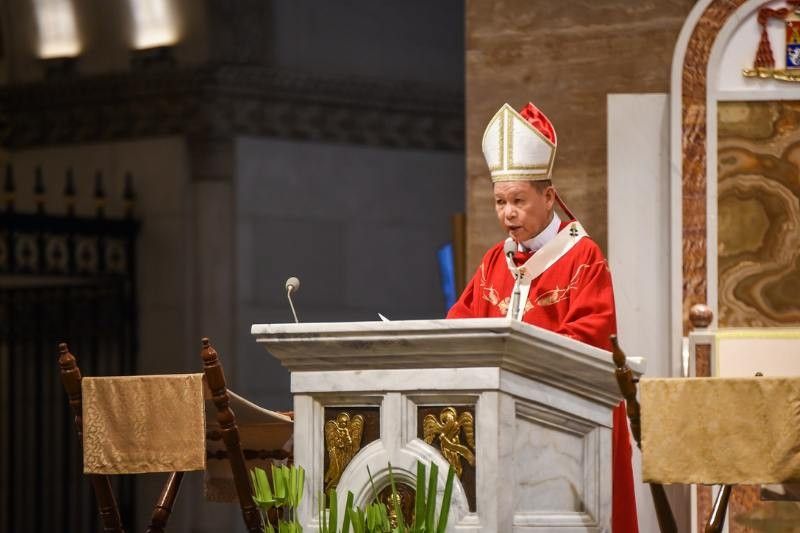
MANILA, Philippines — Cardinal Jose Advincula called on the faithful to be a sign of hope to others, following the example of Christ.

During his homily on Sunday, November 23, for the Feast of Christ the King, Advincula encouraged the faithful to be “bearers of life” for those who are struggling.

“Let us also bring life to one another like Christ our King. Let us help and encourage one another. Let us be signs of hope for one another. Let us bear Christ to one another, especially those among us who are forlorn, discouraged, and distressed,” Advincula said during his homily at the Manila Cathedral.

“Let us seek his grace so that we too may become agents of solidarity, bearers of life, and missionaries of mercy for one another,” he added. 

He also urged, “Let solidarity overcome political and economic divisions,” adding that “there should be no solo Christian among us, for we are always in communion.”

“Let no one think that they are struggling with difficulties by themselves or striving for Christian perfection merely by their own faculties,” Advincula said. 

“In our families and communities, let us reach out our hands and open our hearts to welcome and accompany those persons and groups who feel alone, abandoned, or alienated,” he added.

What is the Feast Day of Christ the King? The Feast of Christ the King falls on the last Sunday of the Roman Catholic Church’s liturgical calendar.

It occurs on the Sunday before the first Sunday of Advent, the season of preparation for Christmas.

The celebration was established in 1925 by Pope Pius XI through his encyclical “Quas Primas.” 

On ‘Christ the King’ feast, Advincula urges faithful to bring Christ to others

Ian Laqui – Philstar.comNovember 23, 2025 | 4:25pm

MANILA, Philippines — Cardinal Jose Advincula called on the faithful to be a sign of hope t…

Ian Laqui – Philstar.com

November 23, 2025 | 4:25pm

MANILA, Philippines — Cardinal Jose Advincula called on the faithful to be a sign of hope to others, following the example of Christ.

During his homily on Sunday, November 23, for the Feast of Christ the King, Advincula encouraged the faithful to be “bearers of life” for those who are struggling.

“Let us also bring life to one another like Christ our King. Let us help and encourage one another. Let us be signs of hope for one another. Let us bear Christ to one another, especially those among us who are forlorn, discouraged, and distressed,” Advincula said during his homily at the Manila Cathedral.

“Let us seek his grace so that we too may become agents of solidarity, bearers of life, and missionaries of mercy for one another,” he added. 

He also urged, “Let solidarity overcome political and economic divisions,” adding that “there should be no solo Christian among us, for we are always in communion.”

“Let no one think that they are struggling with difficulties by themselves or striving for Christian perfection merely by their own faculties,” Advincula said. 

“In our families and communities, let us reach out our hands and open our hearts to welcome and accompany those persons and groups who feel alone, abandoned, or alienated,” he added.

What is the Feast Day of Christ the King? The Feast of Christ the King falls on the last Sunday of the Roman Catholic Church’s liturgical calendar.

It occurs on the Sunday before the first Sunday of Advent, the season of preparation for Christmas.

The celebration was established in 1925 by Pope Pius XI through his encyclical “Quas Primas.”