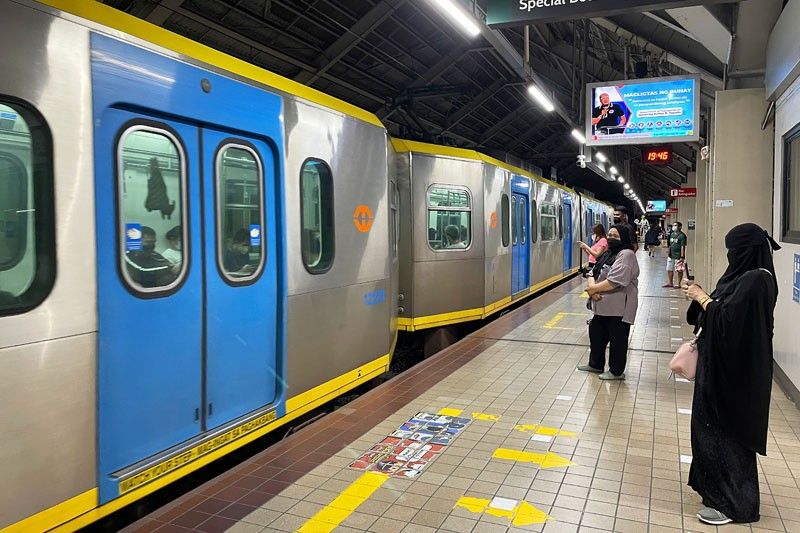
MANILA, Philippines — Citing losses in profitability, business tycoon Manuel V. Panglilinan said that he was considering pulling the Metro Pacific Group out of the LRT-1.
In an interview with reporters, Pangilinan said that the Light Rail Manila Corp. (LRMC) has not recovered its ridership since the COVID-19 pandemic. The firm is losing hundreds of millions annually.
“We continue to lose money on LRT-1 and I think we are considering selling it,” Pangilinan said on Tuesday.
The Metro Pacific Investments Corp. currently has a 35.8% stake in the LRT-1. The LRMC, the train’s operator, has sought fare hikes multiple times over the years.
However, the Department of Transportation (DOTR) has only approved these increases sparingly, with fare hike proposals consistently being met with public outcry.
The LRT-1 is used by more than 400,000 people daily, with ridership hitting more than 115 million commuters for the entirety of 2024.
Philstar.com has reached out to the DOTR for a comment and will update the story as soon as they respond.
MANILA, Philippines — The Quezon Huskers thwarted the Gensan Warriors’ repeated rallies and prevailed, 95-8…
Philstar.com
November 12, 2025 | 10:47am
MANILA, Philippines — The Quezon Huskers thwarted the Gensan Warriors’ repeated rallies and prevailed, 95-85, on Tuesday to advance to the South Division Finals of the 747 Live presents Maharlika Pilipinas Basketball League 2025 Season at the people-packed, steamy Batangas City Coliseum.
LJay Gonzales, Gab Banal and Alfrancis Tamsi provided the sustaining firepower for the Huskers, who swept the Warriors, 2-0, in the best-of-three semifinal series and would be defending their division crown.
Gonzales fired eight of his 14 points in the fourth quarter, where the Warriors moved to within 82-85 following back-to-back triples by Kyle Tolentino and Jack Corpuz.
Tamsi knocked in a triple and homegrown Emman Tagle drove in, however, to quell Gensan’s final assault.
Unlike in Game 1, which Quezon handily won, 103-75, Gensan came up ready this time, even taking a 20-12 lead in the first quarter through the efforts of Corpuz, Tolentino and Nico Elorde.
Quezon, however, tied the halftime count at 46 behind Will Gozum, Judel Fuentes and RJ Minerva, to the delight of the thousands of fans who endured the heat as the air conditioning system broke down.
The cumulative effect of the warm bodies and the lack of ventilation made the playing court very slippery, prompting Binan to request that its game against Batangas be postponed. Binan was ahead, 13-7, when the game was halted.
MPBL Commissioner Kenneth Duremdes decided that the Binan-Batangas tussle will be held on Friday at a venue yet to be announced. Under FIBA rules, the game will start anew at 0-0.
Gonzales also finished with five rebounds and five assists to clinch Best Player honors over Banal, with 12 points, all from triples, three rebounds and two assists, and Judel Fuentes with 12 points, three rebounds and two assists.
Ximone Sandagon and Vince Magbuhos contributed nine points each for the Huskers, who were cheered on by Quezon Governor and Huskers co-owner Helen Tan.
Gensan got 14 points, five assists and four rebounds from Corpuz; 14 points, six rebounds and three assists from Tolentino; 12 points from Elorde; and 10 points each from Larry Rodriguez and Mark Cruz.
The semifinal round continues on Thursday, with San Juan and Pangasinan disputing the second finals slot in the North Division at the FilOil EcoOil Centre in San Juan.
Pangasinan stunned San Juan, 67-57, in Game 1, while San Juan won Game Two, 83-66, to force the sudden-death. The winner advances to the best-of-five finals against Abra Solid North.
Direct flights to Phuket have helped the province maintain a stable inbound market during this year’s high season. (Photo: Molpasorn Shoowong)
A mix of Asian and European markets has helped Phuket outpace the rest of the country in terms of tourism recovery, with arrivals during the first 10 months up year-on-year, while hotels have maintained room rates and occupancy during the current high season.
As of October, the number of tourists flying direct to Phuket tallied 4.16 million, increasing from 4.09 million year-on-year and reaching 97.5% of the total recorded in 2019.
Russia led the top 10 source markets with 832,976 visitors, almost doubling the numbers from India and China in second and third place, which recorded 488,387 and 476,743 arrivals, respectively. Rounding out the top 10 were Australia, the UK, Germany, Malaysia, South Korea, France and Kazakhstan.
The Tourism and Sports Ministry reported on Tuesday nationwide arrivals as of Nov 10 decreased by 7.14% year-on-year to 27.6 million tourists, generating 1.27 trillion baht, down 4.5%.
The top five markets nationwide were Malaysia with 3.9 million, followed by China (3.8 million), India (2 million), Russia (1.4 million), and South Korea (1.3 million). Sixth through tenth were Japan, the UK, the US, Taiwan and Singapore.
Regionally, the Asia-Pacific market contracted by 13.8% during the first three quarters this year, in sharp contrast to Europe, which recorded 12% growth.
Suksit Suvunditkul, president of the southern chapter of the Thai Hotels Association, said the average occupancy in Phuket last month was 75% with the average room rate standing at 3,049 baht, up from 71% and 2,681 baht, respectively, year-on-year.
In November and December, the average occupancy rate on hand stands at 77%, while the room rate has surged by 50% compared with October, driven by high tourism demand, particularly from long-haul markets.
“The average room rate during this high season is expected to remain stable or experience a slight decrease compared to a very solid record in 2024. However, any reduction would be far less severe than the low season, which saw a significant drop from last year,” said Mr Suksit.
He said the Chinese market in Phuket remained weak, aligning with the trend nationwide which saw a sharp fall of 33% in the first three quarters. Direct flights to Phuket from second-tier cities in China were significantly reduced, resulting in a plunge in mass Chinese tour groups, said Mr Suksit.
According to the hotel business operator sentiment index in October, the average occupancy of hotels nationwide closed at 63%, while it is anticipated to reach 67% in November.
Thienprasit Chaiyapatranun, president of the Thai Hotels Association, said hotels in the South and East are still expected to gain stronger long-haul markets than other parts of the country. He said 74% of hotel operators reported a drop in the Chinese market, and 45% saw a reduction in short-haul markets, while only 37% were affected by a decrease in long-haul markets in the fourth quarter.
The devastation from the apocalyptic deluge unleashed by Typhoon Tino, while highlighting the failur…
The Philippine Star
November 12, 2025 | 12:00am
The devastation from the apocalyptic deluge unleashed by Typhoon Tino, while highlighting the failure of flood control projects, also emphasized the need to quickly put proper interventions in place, not just in Cebu and Negros Island but all over the country.
This urgent need will have to be balanced with the ongoing effort to hold crooks accountable while implementing measures to stop the country’s degeneration into a looter’s paradise.
Certain quarters have expressed concern that in the absence of the necessary structural reforms, even President Marcos’ declaration of a year-long state of national calamity could open new floodgates for corruption, as procurement laws are sidestepped in the name of speedy disaster response.
Considering the track record of public officials at all levels of government, the President cannot simply brush aside such concerns.
The COVID-19 emergency that prompted the passage of a law allowing negotiated procurement during the Duterte administration, for example, gave the country the Pharmally Pharmaceuticals corruption scandal, which to this day is unresolved.
While putting anti-corruption safeguards in place, the government must also move decisively in confronting another disaster on the scale of the extreme flooding during Tino or, in October last year, during Typhoon Kristine, which submerged much of Camarines Sur including Naga City.
A looming La Niña threatens to bring more rains and cause more killer floods and landslides.
There is less than a year before the next typhoon season to upgrade substandard flood control projects, correct those that actually cause or aggravate flooding, and install proper interventions in areas where non-existent or ghost projects have been identified.
Watersheds and floodplains will take a long time to rehabilitate, and some may never be restored to their natural state before they were converted for residential, commercial and industrial uses.
Where possible, the government must show political will in casting out illegal encroachments on vital natural rainfall catchments. Or else it must implement science-based interventions in such areas to prevent deaths and the destruction of entire communities. All this, while keeping a tight watch on fund disbursements and implementing flood mitigation projects with deliberate speed.
MANILA, Philippines — Fifty-nine commercial and cargo flights were delayed yesterday after a false fire alarm at the air traffic management center of the Civil Aviation Authority of the Philippines in Pasay.
CAAP spokesman Eric Apolonio said an internal investigation is underway after the false alarm disrupted air traffic operations for about 45 minutes before being cleared for departure.
The alarm was triggered at around 1:24 a.m., prompting activation of safety protocols.
After discovering the false alarm, CAAP resumed operations at 2:50 a.m., with all restrictions lifted at 3:16 a.m.
In a statement, CAAP director general Raul del Rosario commended air traffic controllers for their quick response.
MANILA, Philippines — Fifty-nine commercial and cargo flights were delayed yesterday after a false fire alarm at the air traffic management center of the Civil Aviation Authority of the Philippines in Pasay.
CAAP spokesman Eric Apolonio said an internal investigation is underway after the false alarm disrupted air traffic operations for about 45 minutes before being cleared for departure.
The alarm was triggered at around 1:24 a.m., prompting activation of safety protocols.
After discovering the false alarm, CAAP resumed operations at 2:50 a.m., with all restrictions lifted at 3:16 a.m.
In a statement, CAAP director general Raul del Rosario commended air traffic controllers for their quick response.
A view of Bangkok from the roof park at Dusit Central Park. Land prices in Bangkok’s central business district continued to rise despite a sluggish overall market. (Photo: Wisuttipong Rodpai)
Despite a 41% plunge in the total value of land transactions nationwide — the lowest in 15 years and occurring during an economic slowdown — land prices in Bangkok’s central business district (CBD) continued to climb, with Sukhumvit recording the sharpest increase at 10%.
According to property consultancy Colliers Thailand, while the economy lost momentum, land values in Bangkok keep rising, reflecting owners’ confidence in the long-term appreciation of their assets.
“Landlords in the capital, particularly in CBD areas, still view their land as highly valuable,” said Phattarachai Taweewong, research and communication director at Colliers Thailand. “We have not seen any indication of price reductions.”
He said some plots in prime downtown locations are now priced at more than 4 million baht per square wah, yet they continue to draw strong interest from developers eager to secure rare freehold sites within the city’s core.
SOUGHT-AFTER AREAS
A record-breaking transaction recently occurred on Sarasin Road, where SET-listed developer Sansiri acquired a plot for 3.9 million baht per sq w — the highest price recorded in Thailand.
Following that deal, asking prices in nearby areas such as Wireless Road climbed to 4 million baht per sq w, highlighting renewed confidence in Bangkok’s most coveted zones.
Chidlom has become the second-most expensive area, with asking prices at around 3.2 million baht per sq w after a transaction took place last year priced at 3 million baht per sq w.
The neighbouring Ploenchit area also remains in demand, with offers nearing 3 million baht per sq w, supported by limited supply and sustained interest from luxury developers.
In the Sukhumvit area, land prices have been rising by around 10% annually, with most plots along the main road offered at 2.5-2.9 million baht per sq w. The latest record was set by a Thong Lor plot that recently changed ownership at 2.86 million baht per sq w.
Property consultancy CBRE Thailand recently reported the average asking prices of freehold, off-plan condo units in the high-end segments in Central Lumpini and Sukhumvit converged once again in the second quarter of 2025 after a five-year period during which prices in Central Lumpini significantly outpaced those in Sukhumvit.
In 2014, prices in the two areas were relatively close, at 210,000 and 175,000 baht per sq metre, respectively.
Between 2020 and 2022, Central Lumpini surged ahead to 480,000 baht per sq m, while Sukhumvit trailed at 250,000 baht per sq m.
However, by the second quarter of 2025 prices had realigned, averaging 368,571 baht per sq m in Central Lumpini and 366,000 baht per sq m in Sukhumvit.
“Sukhumvit remains Bangkok’s most sought-after address among expatriates, accounting for 65% of total demand, compared with 18% in Silom-Sathon and just 9% in Central Lumpini and Siam,” said Artitaya Kasemlawan, head of residential sales-project at CBRE Thailand.
Mr Phattarachai of Colliers added that although some developers have offloaded undeveloped plots in various locations, these sites have still drawn strong interest from other developers.
“Several deals were successfully closed last year at relatively high prices,” he said.
Prime land in Bangkok’s CBD continues to attract major developers, though most high-value deals take time to conclude due to complex negotiations and due diligence, said Mr Phattarachai.
The more active transactions this year have shifted towards the city fringe and along extended mass transit lines, where land costs are lower and development focuses on affordable condos and low-rise projects.
According to the Bank of Thailand, the total value of land and building transfers nationwide in the first seven months of 2025 tallied 404 billion baht, down 41% from 689 billion year-on-year.
This marks the lowest level of national land transactions since 2010, as sluggish economic conditions and weak purchasing power weigh heavily on both developers and buyers.
In the Sathon area, land prices also climbed significantly following high-profile sales. The sale of the Australian Embassy compound averaged 1.45 million baht per sq w, but later transactions pushed prices above 2 million baht.
As a result, asking prices in Sathon have reached around 2.5 million baht per sq w, reflecting the ongoing scarcity of prime development land.
CHALLENGES AHEAD
Mr Phattarachai warned that persistently high land costs could pose a challenge for developers, as land remains the largest component of total project expenses.
“If land prices continue to rise without moderation, it will inevitably push up housing prices,” he said. “This could make new units increasingly unaffordable for consumers.”
Soaring land values have also lengthened the negotiation and decision-making process for buyers, said Mr Phattarachai.
Many landlords now recognise that prime plots can continue to appreciate, prompting them to delay sales.
As a result, more landlords are turning to new income-generating models instead of outright sales.
Many have begun exploring leasehold arrangements or joint venture partnerships with developers to monetise land while retaining ownership, he said.
“For genuine prime land, owners now expect prices to rise by more than 10% annually,” said Mr Phattarachai. “This has led to growing hesitation among landlords to sell.”
Colliers expects asking prices for land in Bangkok’s CBD to continue climbing through 2026, as prime landowners show no sign of lowering prices.
“When land prices rise, they tend to increase across the board,” he said. “There has never been a period when we saw a broad-based decline in CBD land values.”
The sustained surge in land prices will continue to pressure developers’ margins and consumer affordability, a situation that warrants close monitoring, said Mr Phattarachai.
“Developers will have to absorb higher costs, which directly affect project prices,” he said. “Ultimately, consumers will face higher home prices that may exceed what the market can bear.”
SIMPLY IRRESISTABLE
Colliers observed that many prime plots remain unsold, as potential buyers take longer to evaluate deals they perceive as overpriced.
However, some developers have resumed buying, confident that well-located land will still generate strong returns after development.
“Even when asking prices appear high, certain developers see long-term potential,” Mr Phattarachai said. “They are willing to buy because they anticipate robust profitability once the projects are completed.”
He said developer interest in land acquisition remains strong this year, particularly for sites suitable for mixed-use and residential projects.
Meanwhile, some developers continue to list non-core land holdings for sale, reflecting a more selective and strategic approach to land banking.
Mr Phattarachai said this dual trend — selective purchases of prime plots and divestment of non-strategic sites — will define the Bangkok land market in the near term.
“Land will remain a critical asset class,” he said. “Even with fewer overall transactions, the appetite for high-potential plots in Bangkok is unlikely to fade.”