Austrian arrested at Phuket airport for forged stamps, long overstay

Immigration officers at Phuket Inter…

Immigration officers at Phuket International Airport arrest a 41-year-old Austrian with forged stamps in his passport and a long overstay. (Photo supplied / Achadthaya Chuenniran)

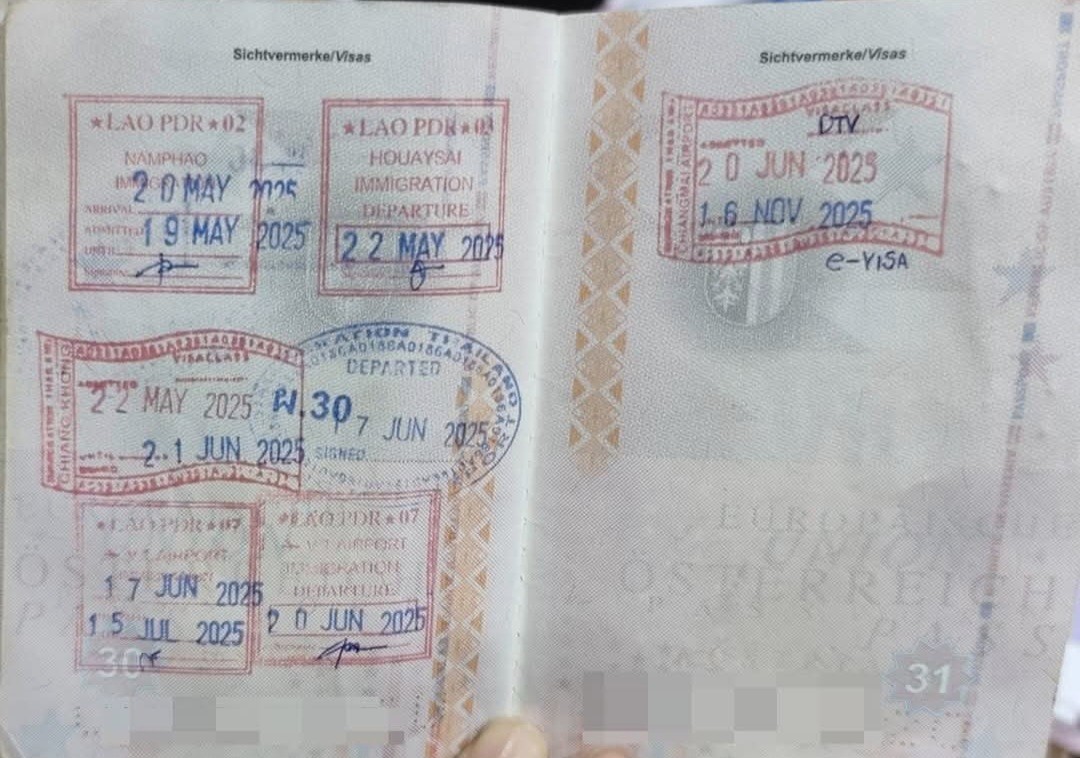
Immigration officers at Phuket International Airport arrested a 41-year-old Austrian with forged entry and exit stamps in his passport who had overstayed his visa by 578 days.

He was detained about 5.20pm on Nov 15 in the international departure hall, police said.

The suspect, whose name was not released, faces charges of using forged official seals or stamps and remaining in Thailand without permission.

He was transferred to Sakhu police station for legal proceedings.

His detention was ordered by the airport’s Immigration chief.

It followed an investigation led by officers from Investigation and Suppression Division 2, the announcement said.

The suspect's passport with <a href=forged stamps. (Photo: Achadthaya Chuennirn) ” border=”1″ hspace=”3″ vspace=”3″>

The suspect’s passport with forged stamps. (Photo: Achadthaya Chuennirn)

Sentiment among Bangkok developers improves in Q3

[unable to retrieve full-text content]The sentiment index of Greater Bangkok housing developers edged up in the third quarter of 2025 from the previous quarter, buoyed largely by an extension of property incentives, but confidence remained weak as the …

[unable to retrieve full-text content]

The sentiment index of Greater Bangkok housing developers edged up in the third quarter of 2025 from the previous quarter, buoyed largely by an extension of property incentives, but confidence remained weak as the index stayed below the median level.

Climate key to development cash

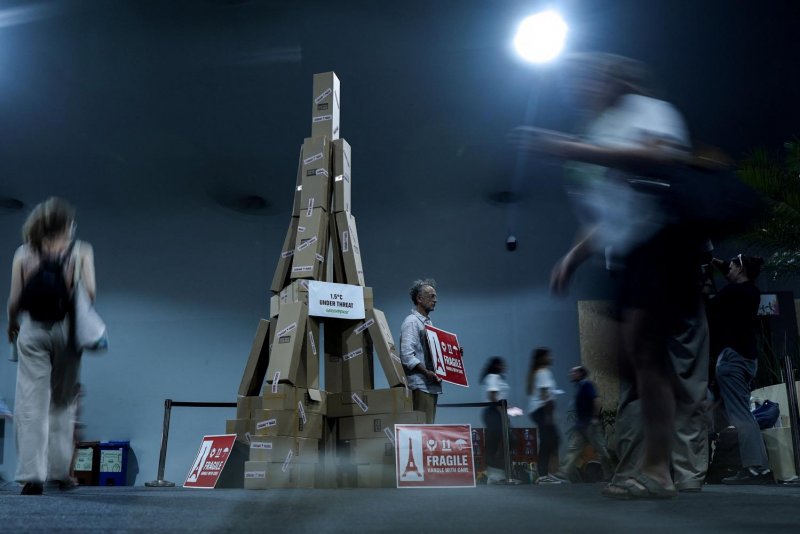
A cardboard Eiffel Tower highlights …

A cardboard Eiffel Tower highlights the fragility of the Paris Agreement at COP30, in Belem, Brazil. (Photo: Reuters)

For decades, the international community has operated under the illusion that climate action and development are different pursuits, each with its own goals, institutions, and funding mechanisms. This approach has hindered progress on both agendas.

The world leaders gathered in Belém, Brazil, for the United Nations Climate Change Conference (COP30) must recognise this and begin transforming the fragmented, underperforming climate-finance system into an integrated framework that delivers on both climate and development objectives. As they embark on this process, it is worth considering the main takeaways from “Policy-Driven Climate and Development Finance: Strategies for Equitable Solutions”, the forthcoming volume of essays that I edited.

While making the global financial architecture more equitable and efficient is a long-term project, delegates at COP30 can take important steps forward. First, they must deliver a replicable and scalable model for climate finance that translates pledges into predictable flows, provides measurable results, and allows for country ownership. This is necessary to narrow the climate-finance gap, especially because developing countries will require between US$5.1-6.8 trillion through 2030 to meet their contributions, while their adaptation needs are 10-18 times greater than international public-finance flows.

COP30 must also focus on efficiency. The climate-finance system is not only underfunded but also fragmented. Developing countries are forced to navigate an ever-growing number of funds, each with its own procedures and reporting requirements. This bureaucratic thicket, coupled with co-financing conditions and weak coordination among institutions, can delay projects for years, while too much money is wasted on transaction costs.

At the heart of this inefficiency lies the cost of capital. Green investments often come with high interest rates for developing economies. According to the International Energy Agency, the cost of financing green energy in developing countries can be 2-3 times higher than in advanced economies, constraining the pace of the low-carbon transition. This disparity is less about risk and more about structural biases.

The G20 has recognised the problem and recently hosted a high-level dialogue with the African Union on debt sustainability, the cost of capital, and financing reforms. The group must now deliver viable solutions: more dynamic and liquid local capital markets, financial instruments that reduce currency risk, and de-risking mechanisms that attract private investors on fair terms. Multilateral development banks should reform mandates and risk frameworks to provide more cheap capital.

But increasing efficiency also requires injecting a new sense of urgency into the process. For communities at risk of being displaced by floods and droughts, a year-long approval cycle for climate financing can turn a disaster into a catastrophe. COP30 must push for accelerated disbursement standards, simplified access procedures, and other measures to streamline operations.

Lastly, there is the question of fairness. The majority of climate-finance flows are concentrated within the G20 and focused on mitigation. At the same time, developing countries are grappling with unsustainable debt burdens, which have crowded out climate and development spending.

The 11 recommendations by the UN Secretary-General’s Expert Group on Debt offer a roadmap for addressing this silent debt crisis. The proposed reforms cover three broad areas: restructuring and modernising the multilateral financial system; providing borrowing countries with technical and capacity-building assistance; and encouraging borrowers to adopt more effective strategies for debt management. Implementing these recommendations would help low- and middle-income countries redirect resources towards investment in sustainable growth.

Instruments such as debt-for-climate and debt-for-nature swaps can complement these efforts by ensuring that financial relief is linked to climate and environmental protection and creating fiscal space for spending on development goals.

Integrated finance is the only viable path forward, because a government that invests in climate action such as resilient agriculture or green transport is also advancing development goals. The global financial architecture must reflect that reality.

COP30 can bring about a move in this direction. Governments can commit to incorporating climate and development finance into their budgets. International institutions can begin to streamline rules, align metrics, and ensure transparency. And both public and private actors can expand the use of innovative tools — from voluntary carbon markets to regional project platforms — that support local transformation.

No country should have to choose between fighting poverty and fighting climate change. The shortcomings of the climate-finance architecture must be addressed. Public financial flows remain indispensable not only for equity, but also for leverage — every dollar spent effectively can mobilise many more in private capital. Whether COP30 is considered a success largely depends on its ability to maximise the impact of these flows on climate and development outcomes. ©2025 Project Syndicate

Tokyu promises long-term commitment

Tokyu promises long-term commitment

Japan’s Tokyu Corporation remains committed to investment in Thailand, underscoring its focus on long-term urban development despite the country’s sluggish economic growth and ongoing political uncertainty.

Takashi Yasue, general manager of Tokyu Corporation, a major conglomerate active in Thailand’s property sector, said Bangkok’s expansion has slowed outside the central business district (CBD), yet residential projects near the CBD continue to perform well and attract demand.

“If you choose the right project at the right time and price, there are still good opportunities in this market,” he said.

Mr Yasue said Tokyu’s strategy prioritises developing integrated urban complexes rather than isolated projects. By leveraging its extensive land holdings, the company can generate revenue across multiple dimensions of city development, an advantage smaller developers with limited land and resources often lack.

Tokyu collaborates with local property developers such as Sansiri and Saha Group on luxury residential and mixed-use developments in Bangkok and Si Racha, Chon Buri.

He acknowledged Thailand’s political climate can influence investment decisions but stressed that Tokyu’s relationships with local authorities remain strong.

“It affects us a little bit, but our cooperation and local relationships continue to develop well,” said Mr Yasue.

Despite global headwinds, including trade challenges affecting Thailand, Tokyu maintains a steady long-term outlook.

“We’re not doing a one-day or two-day business — we operate with a long-term view. There are always ups and downs, but we continue as usual. Nothing to be afraid of,” he said.

The company also emphasises sustainable development, incorporating solar power and recycling systems where feasible, while taking a cautious approach to newer technologies such as electric vehicles until they become more efficient and cost-effective.

While acknowledging the challenges, Mr Yasue expressed confidence in Thailand’s long-term potential, contingent on political stability and consistent policy direction.

“Real estate is a difficult business. It’s timing, location and future potential. But with stable politics and the right projects, Thailand still offers strong prospects,” he said.

Thai influencer sparks backlash dancing shirtless on car roof in Japan

The Thai influencer dancing shirtles…

The Thai influencer dancing shirtless on the roof of a car in Japan, in front of a Lawson convenience store. (Photo: Social media)

A Thai influencer with 6.4 million Facebook followers has been accused of inappropriate behaviour after he posted a video of himself dancing shirtless on the roof of a car at a popular tourist viewpoint in Japan on Monday.

The video was taken front of a Lawson convenience store with a highly popular view of Mount Fuji as a backdrop. 

The clip quickly went viral, drawing heavy criticism from Thai netizens who deemed it disrespectful and inappropriate.

The one-minute video featured the influencer dancing on a car roof, along with the caption, “No matter who looks down on me, I don’t care about their words.”

The location, Kawaguchiko, is a Japanese resort town in the northern foothills of Mount Fuji and a very popular spot for photographing the iconic mountain.

Japan has recently tightened rules for foreign tourists, leading some netizens to warn that such behaviour could damage the reputation of Thai tourists and negatively affect future visits.

Many commenters urged the influencer to respect local customs and cultural norms.

In response, he wrote, “How would they know I’m Thai?” – a comment that further fuelled the online debate.

The incident has sparked a broader conversation about cultural sensitivity and responsible social media behaviour by travellers, highlighting the need for influencers to consider the impact of their content internationally.

Elderly man found dead after threesome

Photo by 123RF

Photo by 123RF
Photo by 123RF

A 70-year-old man was found dead at the house of a 52-year-old man after they and a third man, 38, enjoyed a threesome, possibly under the influence of drugs, in Lop Buri on Sunday night.

According to media reports, Es, the 52-year-old owner of the house in Khok Lampan, invited the 70-year-old, from Ayutthaya province, and the younger man, from Saraburi, to his home for group sex on Sunday.

Es told police that after a round with the youngest man in the shower room, he called out to the eldest man. When there was no reply he checked on him, and found the man dead with ants crawling over his naked body.

He called police and they arrived at the house about 10.30pm.

Investigators reported that a security camera recording seemed to show the three men injecting drugs. A search then found crystal methamphetamine and syringes in the house, along with used condoms.

The investigation was continuing.

Phuket targets dodgy cabs

Fake taxi registrations are a g…

Phuket targets dodgy cabs

Fake taxi registrations are a growing problem on ride-hailing applications, putting Phuket’s tourism reputation at risk, officials say.

Governor Saransak Srikruanet recently led a discussion on the issue, highlighting cases where people use fake IDs during the registration process.

The meeting also addressed “black-plate” taxis — vehicles registered for personal use but illegally operating as taxis — which have been competing with licensed taxis in tourist areas.

As of Oct 2, the Phuket Provincial Land Transportation Office had caught at least 100 illegal taxi drivers operating through ride-hailing applications. Mr Saransak said authorities would take legal action against violators and start a public awareness campaign.

“The provincial administration will address these issues, prioritising visitor safety and the island’s reputation, while ensuring fairness for all legitimate operators,” he said.

Breakdown of value system fuelling social challenges – Lagos deputy governor

The Lagos State Deputy Governor, Dr Obafemi Hamzat, has blamed social challenges on breakdown of value system and neglect of morality, urging Nigerians…

The Lagos State Deputy Governor, Dr Obafemi Hamzat, has blamed social challenges on breakdown of value system and neglect of morality, urging Nigerians to renew commitment to good parenting.

Hamzat made the call at the Criterion, Association of Women in Businesses and Professions International Conference at the Orchid Hotel, Lekki, Lagos, on Thursday.

The conference had the theme: “Breaking the Glass Ceiling: Muslim Women Overcoming Economic and Social Challenges”.

The deputy governor said that moral decline in Nigeria was a direct reflection of poor parenting and erosion of discipline in homes.

He said that values such as respect, honesty and hard work must become the foundation of family life.

The deputy governor emphasised the need to take care of the family unit.

He said: “No nation can rise above the moral quality of its citizens.

“The future of any nation depends on the youth, because they are the future leaders.

“If we don’t make conscious efforts to develop and train them on our culture, beliefs and value system, then the nation will run into trouble.

“The most important unit in any society is the family, and if that is broken, then everything is lost.”

Citing examples of young people involved in criminal and ritual activities, Hamzat said that it was no longer about breaking glass ceilings but about holding the family together.

According to him, every strong society is built on good homes and responsible parenting.

He urged organisations such as the Criterion to continue to partner with the state government in initiatives that would strengthen families, uplift women and nurture the next generation of leaders.

Hamzat said that through its Ministry of Women Affairs and the Employment Trust Fund, Lagos State Government was addressing challenges facing micro, small and medium enterprises.

He said that while the initiative supported all entrepreneurs, the resilience of women-owned enterprises had inspired the government’s contribution to development and finding lasting solutions.

According to Hamzat, data shows that 79 per cent of successful businesses are owned by women.

He said it prompted the state to focus on supporting and strengthening women-led enterprises.

Related News

He added that the government provided not only grants but also essential training on bookkeeping, employee management and access to capital.

According to him, this ensures entrepreneurs will understand how to sustain and expand their businesses.

Olayinka Karim, Vice-Chancellor, Fountain University, Oshogbo, said that the conference challenged Muslim women to transcend societal, economic and cultural barriers.

According to her, the conference would help women to increase in knowledge, faith and resilience, as well as lead with dignity and purpose.

Karim, who was represented by the immediate past World Women Affairs Secretary of Nasfat, Alhaja Suwebat Kupolati, said that education was the foundation of empowerment.

She said: “Through technology, women can learn, innovate and lead from anywhere.

“Empowering women, especially Muslim women in agriculture and fisheries, as Islam explains, means empowering families, communities and the nation.

“Digital literacy for women is not optional; it is a religious responsibility and a national necessity.

“We must bridge the gap by investing in affordable internet, digital tools and STEM education for women and girls.

“When a woman learns, she lifts a generation.”

On economic instability, unemployment and moral decline in Nigeria, the don said that women must revive faith-driven cultural models promoting community, charity, hard work and modesty.

She said that breaking the glass ceiling should not be rebellion, but a revelation.

“It is about rediscovering the purpose Allah placed within every woman – to nurture, to lead, to enlighten and to build.”

Earlier, the International Ameerah of the Criterion, Alhaja Medinat Akanni, said that the theme of the conference was apt and resonated with the present economic situation facing women all over the world,

Akanni said that the aim of the association was to encourage, promote and foster the spirit of Islamic sisterhood, peace, development and economic stability.

“The theme of the event illustrates the economic situation facing women not only in Nigeria but the world at large,” she said.

Bulldogs go for twice-to-beat semis incentive

John Bryan Ulanday – Philstar.comNovember 14, 2025 | 3:50pm

Games Saturday

(Smart Araneta Coliseum) 

7:30 a.m. – UST vs Ateneo (U16) 

John Bryan Ulanday – Philstar.com

November 14, 2025 | 3:50pm

Games Saturday

(Smart Araneta Coliseum) 

7:30 a.m. – UST vs Ateneo (U16) 

9:30 a.m. – UE vs NUNS (U16) 

11:30 a.m. – UE vs NU (women) 

1:30 p.m. – UE vs NU (men) 

4:30 p.m. – UST vs ADMU (men) 

7 p.m. – UST vs ADMU (women) 

MANILA, Philippines — League-leader National University guns for an outright twice-to-beat bonus against the winless University of the East in the UAAP Season 88 men’s basketball Saturday at the Smart Araneta Coliseum. 

Already the first semifinalist with still a few games to spare, the Bulldogs (10-2) also shoot for the first bonus without any possible complications against the also-ran Red Warriors (0-11) at 1:30 p.m. before the crucial duel between Final Four hopefuls University Santo Tomas (6-5) and Ateneo (5-5) at 4:30 p.m. 

NU holds its own fate for the said bonus, having created enough separation from title holder University of the Philippines (8-3) and La Salle (6-4) in a three-way race for the Top Two seeds that comes with a win-once incentive in the Final Four. 

As it stands, NU, with 10 wins, is already assured of at least a playoff for one of the coveted spots given a possible tie but want no less than an official stamp to it here and now, especially against the UE unit already out of contention. 

And coach Jeff Napa can count on the Bulldogs’ unwavering hunger in spite of a comfortable spot. 

“Wala pa kaming napapatunayan. Hindi pa kami satisfied,” said Napa, warning against any complacency from his charges even against the listless Red Warriors, who already have nothing to lose. 

NU will bank on a 70-64 win against Far Eastern University for its fourth in a row since starting the second round with another defeat to UP, 78-74. 

The Bulldogs have taken care of business against all UAAP squads save for the Fighting Maroons, who also beat them in the first round, 66-59. 

NU’s rampage included a 72-57 win over UE in their first encounter, making the Jake Figueroa-led squad the heavy favorite to prevail anew for a complete turnaround of its 5-9 campaign last season.

The Bulldogs, owing to the early injury of Malian reinforcement Mo Diassana, paraded an all-Filipino squad to miss the Final Four before coming back with a vengeance this season on top of everybody starring Gambian anchor Omar John.


Tobacco conference to weigh up stubbing out cigarette butts

An estimated 4.5 trillion cigarette b…

An estimated 4.5 trillion cigarette butts are littered every year.

An estimated 4.5 trillion cigarette butts are littered every year.

GENEVA – Next week’s global conference on tobacco control will consider what to do about the sheer volume of cigarette butts trashing the planet, with some recommending banning them completely.

“The best thing that we could see for the environment is getting rid of filters altogether,” Andrew Black, acting head of the secretariat of the World Health Organization Framework Convention on Tobacco Control (FCTC), said Thursday.

Plastic cigarette filters are the world’s most littered item, leaching toxic chemicals into the environment and breaking down into microplastics — while doing very little for the smoker, the secretariat said.

The 11th conference of the parties to the FCTC is being held in Geneva from Nov 17-22.

The WHO warned Wednesday that the tobacco industry was trying to infiltrate and undermine the conference.

– Litter and pollution –

Black said that, among other topics, the gathering would look at the environmental damage wrought by the tobacco industry and its products.

“An estimated 4.5 trillion cigarette butts are littered each year worldwide, making them the most common form of litter on the planet,” he told reporters.

“These discarded butts are toxic and a significant source of plastic pollution, due to their filters, which do not biodegrade.”

Furthermore, plastic filters “don’t provide any meaningful increase in the safety of cigarettes”, he said.

Rudiger Krech, the WHO’s environment and climate change chief, said it was “high time to ban those plastics… because they are the highest pollutants in waters” and are “contaminated also with toxicants”, he told a press conference.

Ultimately, it will be down to countries what measures they want to take.

To date, around 180 states have ratified the FCTC, which came into effect in 2005.

The landmark treaty brought in a package of tobacco control measures, including picture warnings on cigarette packets, smoke-free laws and increased taxes.

– Death toll –

The conference will take decisions that will set the trajectory of the global tobacco epidemic for future generations, said Black.

He said more than seven million deaths a year were down to tobacco — an “entirely preventable” body count.

Other major agenda items include the “aggressive marketing” of tobacco products, as well as widespread concerns about the numbers of children being lured in to a life of addiction via new means of getting kids hooked.

More than 100 million people are vaping, including at least 15 million teens aged 13 to 15, according to the WHO’s first global estimate of e-cigarette use.

WHO chief Tedros Adhanom Ghrebreyesus said: “Although e-cigarettes are often promoted as safer alternatives to conventional tobacco products, there is no evidence of their net benefit for public health — but mounting evidence of their harm.”

– Infiltration attempts –

Tedros claimed Wednesday that the tobacco industry was motivated by “one thing only: generating profit”.

“We are aware of attempts by the tobacco industry to infiltrate and undermine” next week’s conference, he told journalists.

Benn McGrady, head of the WHO’s public health law and policies unit, said the tobacco industry was “lobbying like crazy” and “trying to sow division”.

He said their new products were being marketed as consumer products of harm reduction, but in fact bore characteristics that are “specifically attractive to children”, such as bright colours and sweet flavours.

Highlighting the “alarming rise in use among children” of e-cigarettes, he said the industry was launching new products on social media — “spaces in which children and young people shape their identities”.

WHO wants comprehensive bans on tobacco advertising, promotion and sponsorship, including for e-cigarettes and nicotine pouches.