By Alimat Aliyeva
Fuel reserves in Bulgaria are running low, with gasoline
expected to last only about 35 days and diesel about 50 days,
according to a statement from the Bulgarian Agency for State
Reserves, Azernews reports, citing Reuters.
The situat…
By Alimat Aliyeva
Fuel reserves in Bulgaria are running low, with gasoline
expected to last only about 35 days and diesel about 50 days,
according to a statement from the Bulgarian Agency for State
Reserves, Azernews reports, citing Reuters.
The situation worsened after the United States imposed sanctions
at the end of October 2025 on two major Russian oil corporations,
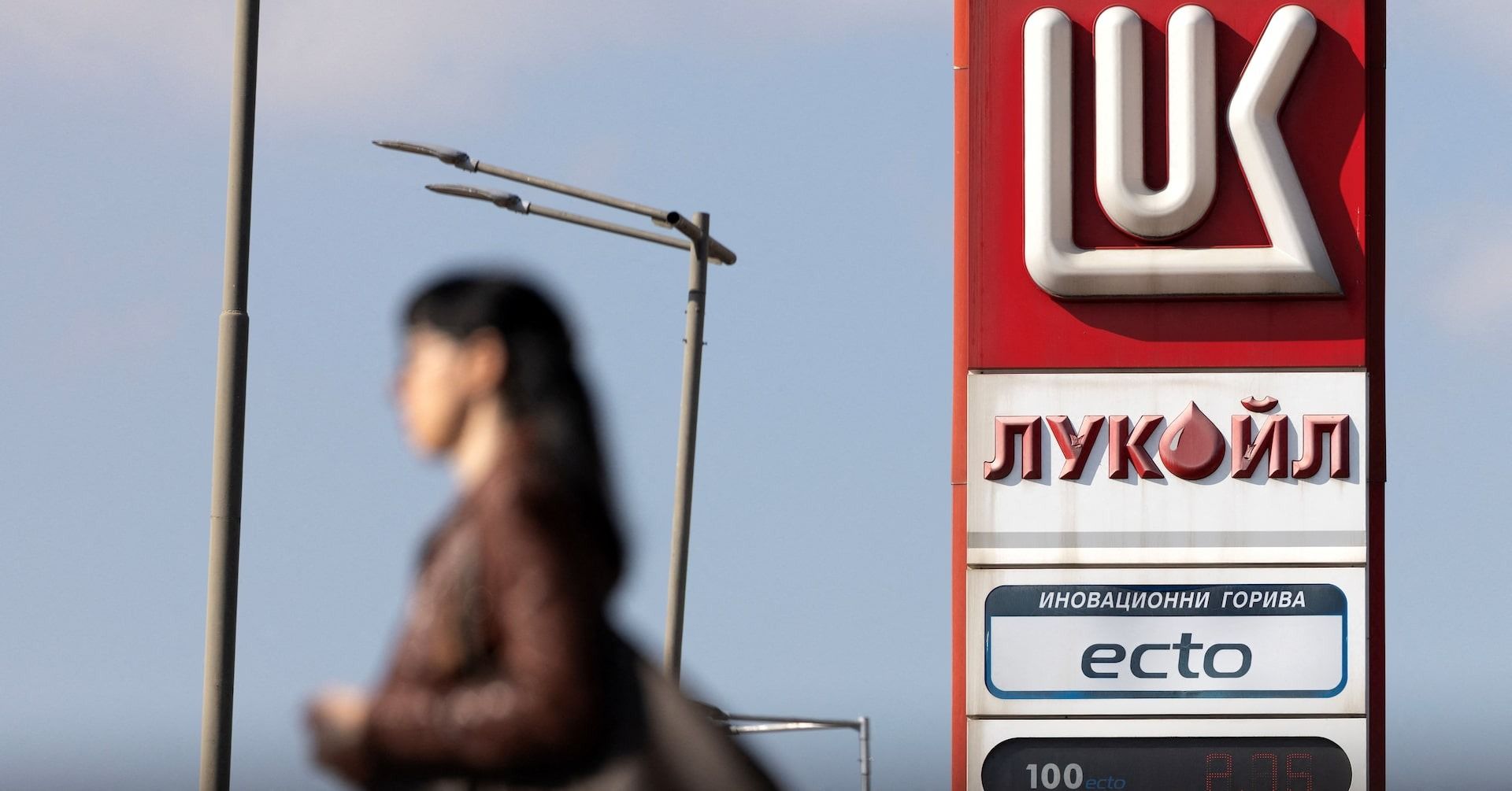
Lukoil and Rosneft. Lukoil operated the country’s largest oil
refinery in Burgas and owns hundreds of gas stations across
Bulgaria, making the sanctions particularly disruptive.
Experts warn that the sanctions are causing concern within the
Bulgarian government, especially with winter approaching. Although
Bulgaria maintains reserves of crude oil and petroleum products
abroad, importing them will take time, potentially leaving the
country vulnerable in the short term.
In response, the Bulgarian government has taken several measures
to ensure energy security. Fuel exports, primarily diesel and
aviation fuel, have been temporarily banned to other EU countries.
Additionally, last week the Bulgarian parliament passed a law
allowing the Burgas refinery to be temporarily placed under state
control for transfer to a new owner, protecting it from the impact
of American sanctions.
Analysts note that Bulgaria’s swift actions could serve as a
model for other European nations heavily reliant on Russian energy,
highlighting how geopolitical moves can have immediate effects on
local energy markets.
With the United Nations climate summit, COP30, now in full swing in the humid jungle city of Belém, Brazil, Microsoft co-founder and philanthropist Bill Gates has cut through the noise with a blunt truth: these UN climate gatherings must zero in on lif…
With the United Nations climate summit, COP30, now in full swing in the humid jungle city of Belém, Brazil, Microsoft co-founder and philanthropist Bill Gates has cut through the noise with a blunt truth: these UN climate gatherings must zero in on lifting human lives, rather than fixating solely on slashing emissions or dialling down global temperatures. It’s a perspective that’s long overdue yet seems so obvious.
For billions of people in the developing world, tackling immediate challenges like poverty and disease outweighs chasing distant temperature goals. My think-tank, Copenhagen Consensus, has long argued that the real question for policy-makers is: what is the smartest way to do the most good with limited resources?
Every year, more than 7.5 million people in poorer countries die from illnesses that can be very cheaply prevented or managed. Smart investments in health, nutrition, and education could every year save over 4 million people, while also building growth and resilience for the future. In much of the world, parents are not kept awake by concern about achieving a 0.1°C temperature reduction in a century. They worry whether their children will survive a bout with malaria or get a decent education. As Mr Gates points out, “the biggest problems are poverty and disease, just as they always have been”.
This common-sense message is at the crest of a growing global shift in thinking. For years, no difference could be tolerated from dogmatic climate conformism. Making drastic emissions cuts at any cost was the paramount policy goal. This extremist message was repeated ad nauseum by the United Nations secretary-general, endless politicians, and an army of hectoring celebrities. Anyone questioning the supremacy of the climate threat or expressing scepticism at the costly policies was derided as a “climate denier”.
Suddenly, pragmatism and nuanced thinking are back in fashion. Democrat Senator Chris Coons of Delaware declared that climate is “not a top three issue right now”. Prime Minister of Canada Mark Carney who warned a decade ago that potential climate catastrophe meant fossil fuel reserves could be “unburnable”, is fast-tracking the construction of an LNG export terminal and promising to “transform our country into an energy superpower”.
It is time to move beyond the doomsday narratives that have dominated the climate discussion. Climate change is a real problem, but it is not the end of the world. Unaddressed, climate economics shows that it might shave 2-3% off global GDP by 2100 — meaning we’ll be 435% richer instead of 450%.
Still, the same old activists are repeating their well-trodden arguments. First, the notion that climate spending is not crowding out efforts to tackle poverty. This idea is being pushed by climate professor Michael Oppenheimer, who claims Mr Gates sets up a “false dichotomy”.
Yet, anyone living in the real world knows that money can’t be spent twice. By their own proud admission, the world’s multilateral development banks devoted an astonishing US$137 billion (4.4 trillion baht) to climate financing in 2024. That is money spent on climate that won’t be spent on preventing disease and hunger.
Globally, we have spent over $14 trillion on climate policies. Last year alone, the cost exceeded $2 trillion. Again, it is money spent on climate policy that cannot be spent on basic education and maternal healthcare.
Then there is the alarmist claim from climate professor Michael Mann that “there is no greater threat to developing nations than the climate crisis”. This patronising argument suggests that climate campaigners in ivory towers know far better than those from the Global South.
In real life, Africans from 39 nations rank climate as their 31st most important problem of 34 — far behind education, jobs, health, and roads. The greatest challenges are pretty obvious if you live in poverty, where disease and hunger claim lives daily.
A welfare-first climate summit would see prosperity as a top defence against climate impacts, building resilience. For maximum impact, policy-makers should drop the fixation on expensive, ineffective net-zero targets. Instead, they should emphasise adaptation and invest in R&D to drive green-energy breakthroughs.
As the COP30 climate summit winds on in Belém, the real path forward lies in the common-sense idea of directing limited funds to ending today’s preventable deaths and fuelling growth, making societies stronger, also against future warming. That’s how this talkfest could truly put people first.
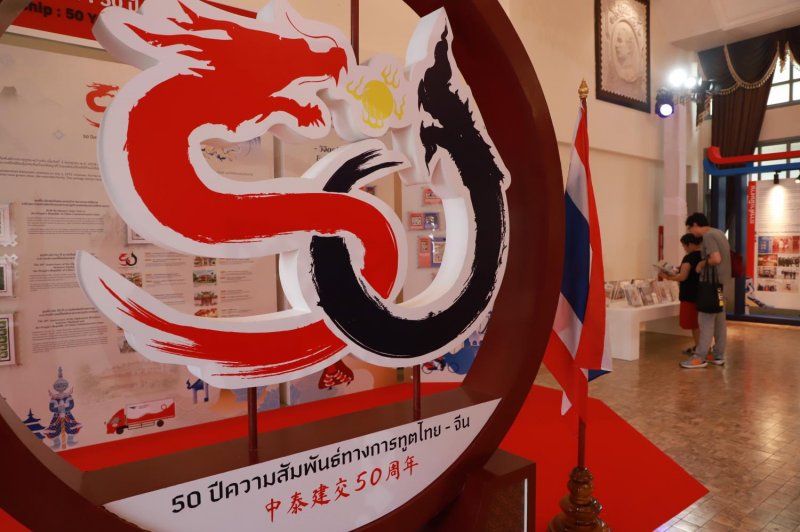
Thailand Post joins hands with the Philatelists Association of Thailand to present ‘Letters of Friendship — From Bangkok to Beijing’, to mark 50 years of diplomatic ties. (Photo: Somchai Poomlard)
In China’s diplomacy with neighbouring countries, the friendly relations between China and Thailand have always sparkled. The many “firsts” created in this relationship have vividly demonstrated the special bond of “China and Thailand are as close as one family” as well as a firm belief of the two countries in working hand in hand for common development, bringing great benefits to the people, and setting a shining example of regional cooperation.
His Majesty King Maha Vajiralongkorn Phra Vajiraklaochaoyuhua and Her Majesty Queen Suthida Bajrasudhabimalalakshana will pay a historic state visit to China. In a spirit of pioneering shown by the inspiration of first-ever accomplishments jointly achieved in the bilateral relationship, China and Thailand will continue to inspire enthusiasm for deepening the friendship and practical cooperation.
Thailand was the first country in the Association of Southeast Asian Nations (Asean) to engage in strategic cooperation with China, as well as to establish a comprehensive strategic cooperative partnership with China. In 2022, President Xi Jinping visited Thailand and attended the Apec Economic Leaders’ Meeting. Both leaders reached important consensus on building a more prosperous, stable, and sustainable China-Thailand community with a shared future, ushering bilateral relations into a new era.
Indeed, Thailand was the first Asean country to implement a free trade arrangement with China. In October 2003, China and Thailand implemented a zero-tariff arrangement for 188 types of vegetables and fruits. Thailand is the country with the most varieties of fresh fruits granted access to China, with 23 types of fresh fruits approved for import, ranking first globally. China’s agricultural imports from Thailand ranked first among Asean countries, with the total value reaching US$11.6 billion in 2024. Thailand established the first wholly foreign-owned enterprise in China. Thailand’s Charoen Pokphand Group established its presence in the Shenzhen Special Economic Zone, holding the approval document “Shen Wai Zi Zheng Zi (1981) No. 0001” in 1979.
Thailand hosts the largest overseas production capacity of Chinese new energy vehicles. Eight Chinese automakers, including SAIC and BYD, have invested here, with an annual production capacity of nearly 600,000 new energy vehicles and a total investment of over 20 billion yuan (91.3 billion baht). Thailand is the first Asean country where China’s 5G technology has been fully implemented for commercial use. Thai telecommunications operators launched 5G mobile services to the public in 2020, with Chinese companies like Huawei and ZTE as key partners. China is the largest source of MICE (Meetings, Incentives, Conferences, and Exhibitions) tourists to Thailand, with 250,000 Chinese MICE visitors in 2024, ranking first with the proportion of 34% of the total.
Thailand is the first country to conduct joint military exercises and training with China across all branches of the military, featuring the regular training and exercises of “Strike”, “Blue Strike” and “FalconStrike”. Seven “Strike” joint exercises have been conducted since 2007. Thailand was the first Asean country where China stationed drug liaison officers and signed an extradition treaty with China.
Thailand is the first country to collaborate with China in building a VGOS radio telescope. In 2025, a 13-metre diameter Very Long Baseline Interferometry Global Observing System (VGOS) radio telescope, jointly developed by China and Thailand, was inaugurated in Chiang Mai. Thailand is the first country to receive a Chinese nuclear fusion experimental device (Tokamak). In 2017, the Chinese Academy of Sciences gifted the Tokamak device to the Thailand Institute of Nuclear Technology, marking the first such device in Asean.
Thailand is the first country to host an overseas exhibition of China’s lunar samples. In 2024, precious samples brought back by China’s Chang’e-5 mission were displayed in Thailand. China will be the first country to send a Thai research instrument into deep space, as the Chang’e-7 mission has selected Thailand’s “Space Weather Monitoring” device for deployment. Thailand is also the first Southeast Asian country to engage in polar cooperation with China, establishing a joint laboratory at a Chinese Antarctic research station, and the first Asian country visited by the Xuelong 2,China’s polar research icebreaker.
Thailand hosts the world’s longest-running, largest and highest-level celebrations of the Happy Chinese New Year. The Happy Chinese New Year, a flagship project of China-Thailand cultural cooperation, has been held in Thailand for years with great success. Her Royal Highness Princess Sirindhorn attended celebrations in Chinatown for many years. The China Cultural Center in Bangkok is the first of its kind set up by China in Southeast Asia and the largest China Cultural Center in the world. Meanwhile, China has been the largest source of tourists for Thailand. Chinese tourists to Thailand exceeded 10 million person-times in 2018 and 2019, respectively. Thailand is the first country to declare traditional Chinese medicine legal like China.
Thailand is home to the world’s first Confucius Classroom and the first Development Alliance of Confucius Institutes. In 2006, the Confucius Classroom at Bangkok’s Traimit Wittayalai Secondary School was established. Now, there are 17 Confucius Institutes and 11 Confucius Classrooms. China and Thailand jointly built the world’s first Luban Workshop, creating an integrated education model of “Chinese language + vocational skills” that has trained 1,804 Thai students.
Thailand is one of the first countries to incorporate Chinese into its national education system, and it ranks first in the world in the number of Chinese exam takers. Since Chinese was included in foreign language education in 1992, over 3,000 schools in Thailand have offered Chinese courses. The scale of two-way student exchanges between China and Thailand ranks the top of Asean countries, with over 30,000 students studying in each other’s countries. Thailand hosts the largest number of international Chinese language teacher volunteers in the world. More than 20,000 volunteers in 23 groups have worked in Thailand. Thailand has the largest number of International Chinese Language Scholarship recipients as well. As close partners building a community with a shared future, China is confident the visit by Their Majesties to China will bring new vitality and vigour to our relations and a better future for our peoples.
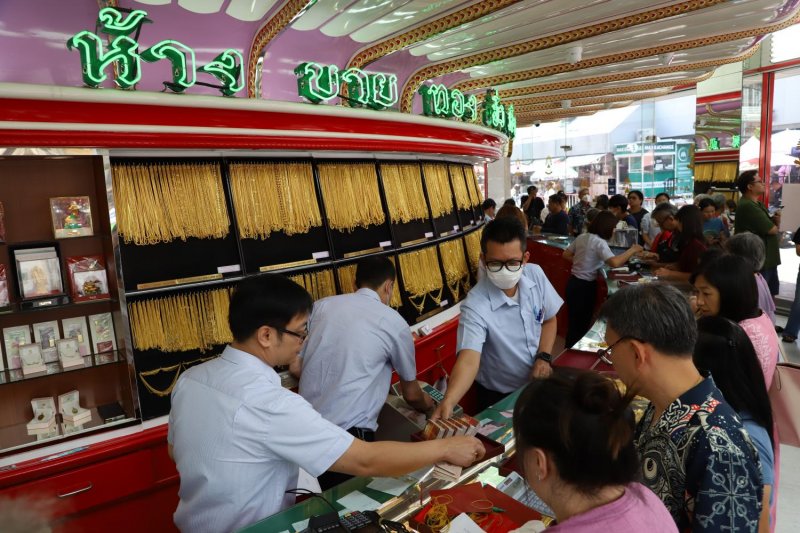
File photo dated March 4 shows people rushing to trade gold at a gold shop on Yaowarat Road in Bangkok. (Photo: Somchai Poomlard)
After reading my previous article, “Thailand has become the sick man of Asean”, a good friend asked me what would happen to the Thai economy after becoming the sick man?
My reply was that it would be like your body. After getting very sick with no proper and timely treatment, you die. Many economists will offer solutions, but none have credible action plans for getting there, either in terms of time or cost.
Everything is abstract, like efficiency improvements, as if it could be done with a wave of a magic wand. We then changed the subject to something less depressing: gold.
This week, I have decided not to write about the economy, even though the recent release of September economic data has disturbed me. I’m writing about gold and its economic intrinsic or fundamental value. However, I must point out the article is meant to be educational, not for investment purposes.
The title of today’s article, “Why gold matters in a changing world”, will surely catch readers’ eyes as gold prices have been going up and down like a roller coaster. When the price was rising, analysts said it could rise much further. Some even mentioned US$10,000 (324,720 baht) per ounce. But when the price dropped, the same analysts said it could fall further to $2,500 per ounce. Are they professional analysts or con artists who lure investors into buying or selling gold for a commission?
The accuracy of the gold price projection was similar to the case of oil. If one went back to the end of March 2022, expert analysts said the Brent crude price would break $100 per barrel and could reach over $200 per barrel, citing disruptions to Russian oil production. Well, Russian oil output did decline by 3.2% but instead of a price increase, the price has now dropped to $65 per barrel. Would expert analysts make similar mistakes in predicting the price of gold?
Prediction mistakes do not come from the analyst’s naivety, but from overlooking the demand factor. When one makes a price projection, one needs to consider both supply and demand factors. Oil analysts focused solely on the supply factor — ie, the Russian production cut — yet failed to account for future global oil demand. This is economics 101. If demand should fall faster than supply, the price of the product will drop.
This experience could be applied to gold. The maddening rise in gold prices is due solely to demand expectations, but no analyst mentions the supply factor. Gold, like any mineral, can be mined more if the market price is attractive. Apart from new mining, a significant amount of gold supply also comes from “recycled” gold, which means people sell gold from existing stock for profit. In Q3/2025, 42.6% of the gold supply was from “recycled” gold. It is a mistake to think that the gold supply is limited to the underground reserve.
What is the gold supply situation now?
As of the end of 2024, there were 216,265 tonnes of above-ground gold stock. Central banks hold 17% of the stock, 45% is in gold shops/jewellers, and 22% is in the hands of investors. These last two stocks are sources of “recycled” gold. Suppose the current above-ground stock is not enough to satisfy gold buyers’ appetite. In that case, there is an additional 54,800 tonnes of gold readily available for mining and 132,100 tonnes for deeper mining. These two numbers are called “reserves” and “resources”. Each year, about 4,000 tonnes of new gold enter the market.
What is the current gold demand situation?
Current demand is about 5,000 tonnes per year, resulting in a 1,000-tonne demand-supply gap. This demand-supply gap has been pushing gold prices higher and higher. Any good economist will tell readers that, with price upward adjustment, demand will fall and supply will rise, narrowing the demand-supply gap. Or even turns negative, like in the case of oil.
When will the demand-supply gap turn around? This is the $1 trillion question. If I knew that I would be Mr Goldfinger and would not waste time writing articles, but enjoy my enormous wealth and the singing of Shirley Bassey. One thing is always true, though. Gold is the safest asset on this planet. Whenever there is uncertainty, demand for gold never fails to rise.
Economic uncertainty occurred in 2011 amid the threat of a Eurozone debt crisis. Gold demand rose 17.5% pushing the price up 28.2%. Then the fear subsided, and the gold price dropped 30% to the pre-crisis level. The 30% gold price hike happened again in 2022 when Russia invaded Ukraine. The possibility of a larger war triggered investors into rushing to gold.
The uncertainty in the global economy, particularly the stability of the US dollar as the world’s reserve currency, prompted central banks worldwide to increase their gold holdings. The World Uncertainty Index (WUI) consistently rose from a low of 14,606 in June 2024 to a high of 30,376 in December 2024. Gold demand then reached an all-time high of 4,974 tonnes that year, pushing the gold price up by 22.8%.
For curious readers, the WUI peaked at 122,422 in September 2025 and dropped about 10,000 points in October. There seems to be a strong relationship between the WUI and the gold price.
Central banks appear to want to buy more gold in 2025, but not at the pace they did in 2024. It is projected that the gold demand this year will drop slightly to 4,950 tonnes, which is still 1,256 tonnes higher than the projected mining supply of 3,694 tonnes. But does such a gap warrant the 52.7% price rise over the year? If one considers the economic theory of the demand-supply gap, the answer is no. But if one considers the WUI, the answer would be yes.
If the market is reasonable, the price of gold now should be $2,928.5 per ounce. This price is in line with the fundamental gold price calculation by a reputable research house, which estimates the fundamental gold price at $2,800 per ounce.
My goal is neither to convince readers to believe in any specific price projection nor to suggest that readers hold or unload current gold holdings. Please, please read the disclaimer below. My goal is to explain the demand-supply gap factor that affects the economic price and the “panic” factor that affects the market price.
After finishing this article, I realised that the issue of gold price is much bigger than the gold itself. It might be the beginning of a world economic paradigm shift. What if the world is moving away from the flawed “paper” standard and wants to move back to the gold standard? The paradigm shift encourages central banks to hold more gold and fewer US dollars. The National Bank of Poland, currently the world’s top gold buyer, plans to hold gold totalling up to 30% of its reserves.
My next article will then be “From gold to paper, and from paper back to gold?”.
Disclaimer
This article is for educational purposes, not for investment purposes. Those who wish to engage in gold buying/selling must do so at their own risk. The writer holds no responsibility for the data/projection accuracy of this article.
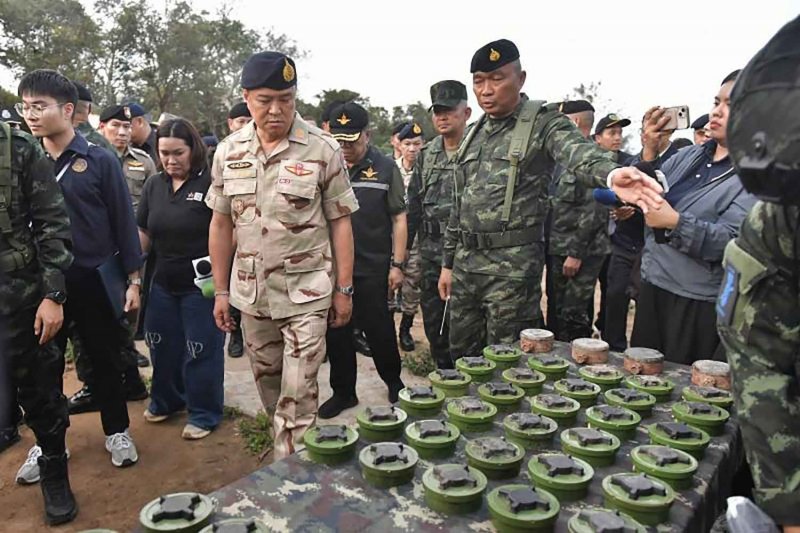
Prime Minister Anutin Charnvirakul inspects PMN-2 mines recovered along the border with Cambodia in Si Sa Ket’s Kantharalak district, which are believed to have been planted by Cambodian soldiers. (Photo courtesy of Government House)
The latest landmine explosion, which injured four soldiers and left one without a foot, not only undermines attempts at peace between Thailand and Cambodia but also sparks fears of an all-out war as Thailand faces pressure to retaliate and teach its neighbour a lesson.
Sgt 1st Class Therdsak Samaphong is the seventh soldier to lose a limb while patrolling the Si Sa Ket border since the confrontation began in mid-year.
The Anutin Charnvirakul government reacted swiftly to calls for reprisals.
It suspended the US-brokered accord, signed in Kuala Lumpur last October, and authorised “full military operations” against Cambodia. It is the term “full military operations” that is problematic.
Several security experts warn that another armed conflict with Thailand’s immediate neighbour — even if framed as “limited retaliations” — might be an unwise move.
Such action, they say, would allow Cambodia to portray itself as the victim of a larger neighbour, thereby winning unjustified global sympathy.
Some observers view Monday’s blast as a familiar tactic by Phnom Penh to divert attention from its failure to tackle online scam networks and other grey businesses.
Renewed armed conflict, they argue, would shore up the Hun family’s declining image at home.
So what options remain for Thailand?
First, the Anutin government must maintain a diplomacy-led policy, even though such a stance will anger hawkish voices.
In a crisis like this, a cool head prevails while keeping long-term national interests firmly in view.
Second, those involved must gather all the evidence that will expose Cambodia’s wrongdoing — particularly the continuing use of landmines, which violates the Ottawa Convention, and the online scam networks that financially support the regime.
The Foreign Affairs Ministry, in particular, should use every available mechanism to secure international condemnation and punitive measures, such as cuts in assistance, against Phnom Penh.
Meanwhile, it is not necessary to abandon the peace accord entirely.
Instead, keep the options open and ensure the accord serves Thailand’s interests.
At the same time, the Anutin government has grounds to reconsider plans to return the 18 Cambodian soldiers currently in custody.
Doing so would only intensify Cambodian citizens’ anger at the Hun regime — a price the Cambodian leadership must pay for the latest transgression.
More importantly, the army should consider using technology to monitor border movements — drone cameras and other devices — instead of putting soldiers at unnecessary risk.
Such technology would help save lives and provide recorded evidence of hostile activity along the border.
Of course, by avoiding all-out war, the government must communicate clearly with the public about its actions.
Absent a convincing explanation, jingoistic elements will exploit the situation for malicious gains.
Finally, while steering clear of war, Bangkok must continue to wage a fierce campaign against scam networks.
That effort, more than military action, will strike at the heart of the regime’s support.
Neilson Hays Library on Surawong Road brings back its bi-annual Book Sale featuring hundreds of pre-loved and ex-library books in English and Thai, starting this Saturday until Nov 23, daily from 9.30am to 5pm (except Nov 17). Visitors will fin…
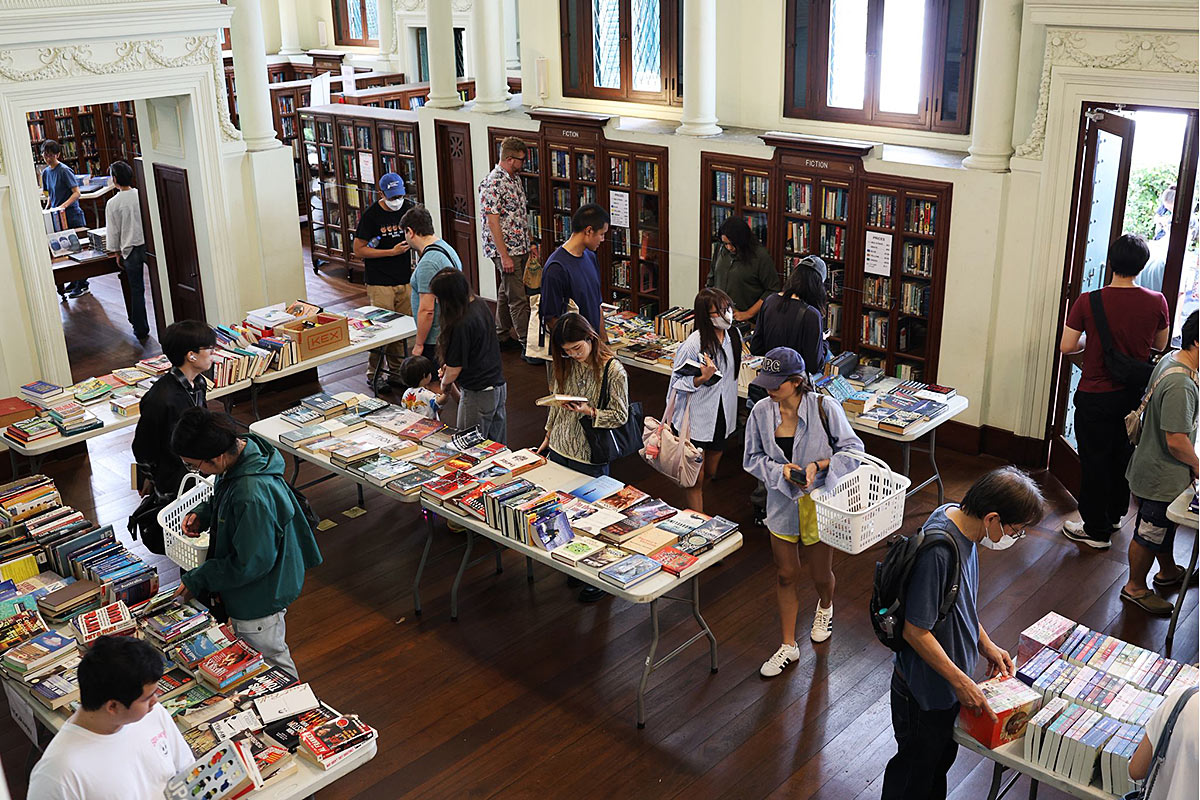
Neilson Hays Library on Surawong Road brings back its bi-annual Book Sale featuring hundreds of pre-loved and ex-library books in English and Thai, starting this Saturday until Nov 23, daily from 9.30am to 5pm (except Nov 17).
Visitors will find something for everyone from recent thrillers and history hardbacks to children’s books, cookbooks, magazines, CDs and DVDs, all housed within one of Bangkok’s most iconic and architecturally stunning buildings. Prices start at 20 baht.
Due to limited space, stock will be rotated throughout the sale so multiple visits are encouraged for the best finds. Visitors should bring their own bag to help reduce waste. However, limited edition Neilson Hays Library tote bags will be available for purchase.
The library is open to non-members during the sale. It is the perfect chance to explore the space, browse hundreds of pre-loved and ex-library books and experience the charm of this unique venue.
Exclusively on Nov 22, the library will host its first-ever Neilson Hays Market alongside the book sale, with local vendors in the garden and books inside the library.
All proceeds from the book sale will go to support preservation and maintenance of the historic library, hailed as a cultural and architectural gem in the heart of Bangkok, and ongoing community programming including children’s activities, literary events, exhibitions and outreach programmes that foster learning and creativity.
Siam Piwat invites everyone to commemorate the boundless and immeasurable royal grace of Queen Sirikit The Queen Mother during “From Royal Resolve… To The Heritage Of The Land”, which is running at Art Jewel, 5th floor of Siam Paragon, Rama I Road, u…
Siam Piwat invites everyone to commemorate the boundless and immeasurable royal grace of Queen Sirikit The Queen Mother during “From Royal Resolve… To The Heritage Of The Land”, which is running at Art Jewel, 5th floor of Siam Paragon, Rama I Road, until Nov 20.
The exhibition presents the royal duties in various fields the late Queen Mother performed for Thai people throughout her life. Many of them reflect her foresight concerning sustainability, namely her initiating and promoting the conservation of forests and wildlife, emphasising the concept of people living with forests sustainably. This reflects her genius as the true “pioneer of sustainability concepts” in Thailand.
On display are a compilation of images and stories of Queen Sirikit visiting the people in all regions of the country alongside King Bhumibol Adulyadej The Great. The exhibition is divided into three parts.
Chut Thai Phra Ratcha Niyom.
“A Collection Of Images Of Royal Duties: A Lifetime Dedication To The Benefit And Happiness Of The Thai People In All Aspects” showcases her considerable dedication to arts and culture, the environment, humanitarianism, strengthening friendships with allied nations, supporting Thai handicrafts, conserving Thai textiles and giving new life to khon, which is Thailand’s high art of performance.
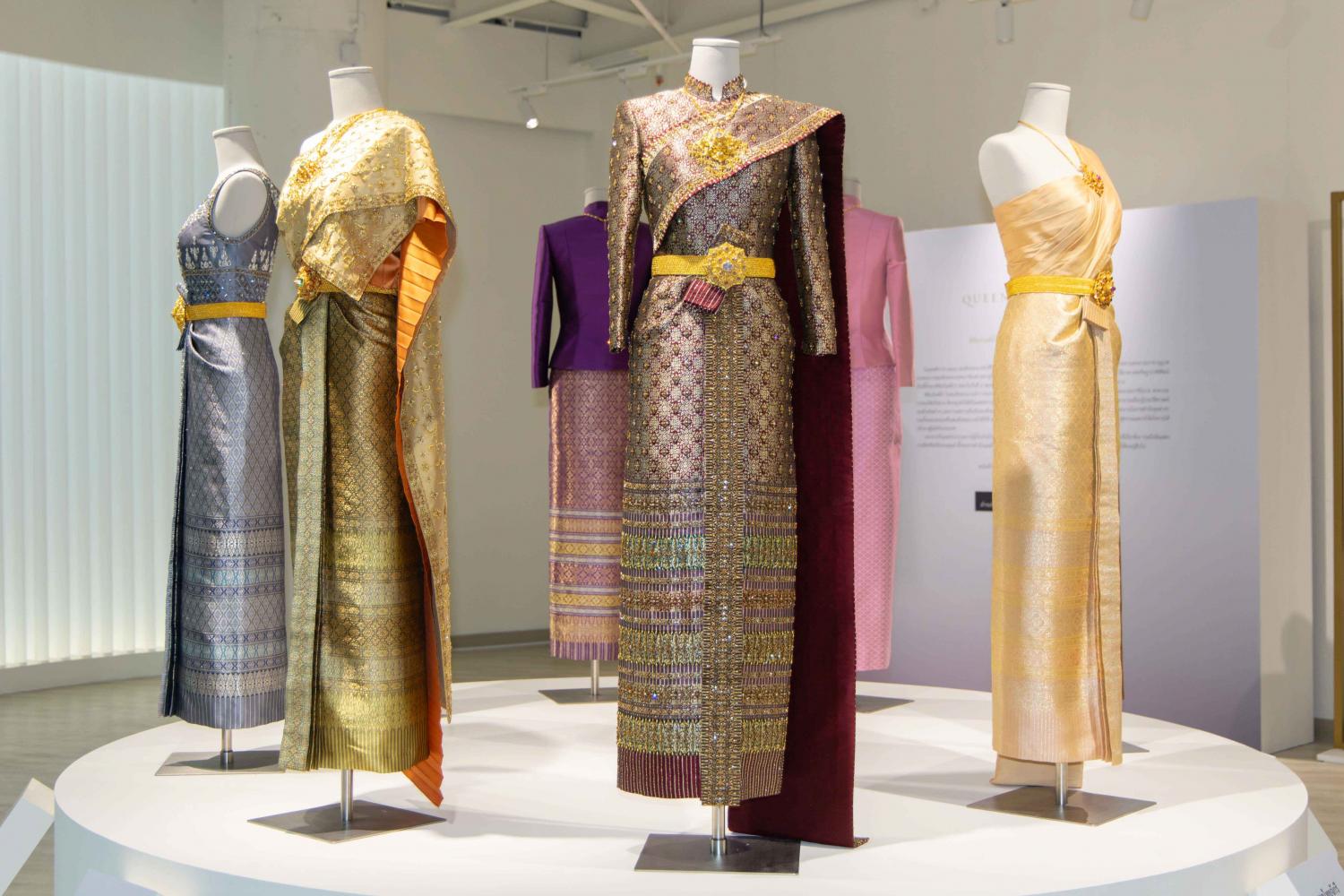
“Chut Thai Phra Ratcha Niyom (Thai National Dress): Reflecting The Vision Of Her Majesty The Queen Mother” focuses on the conservation of the eight types of traditional Thai costumes, which originated from her royal initiative to express Thainess through attire for the world to witness.
She graciously ordered the study, research, restoration and design of Thai outfits for women, which she wore during the official state visits with King Bhumibol to the US and European countries in 1960.
The exquisite collection of eight formal dresses on show includes Thai Ruean Ton suitable for semi-formal functions; Thai Chitlada for formal functions; Thai Amarin for evening ceremonies; Thai Borom Phiman for high-level formal ceremonies; Thai Dusit for evening ceremonies; Thai Chakkri for weddings or evening functions; Thai Siwalai for royal ceremonies or religious ceremonies; and Thai Chakkraphat for important royal ceremonies.
Khon masks.
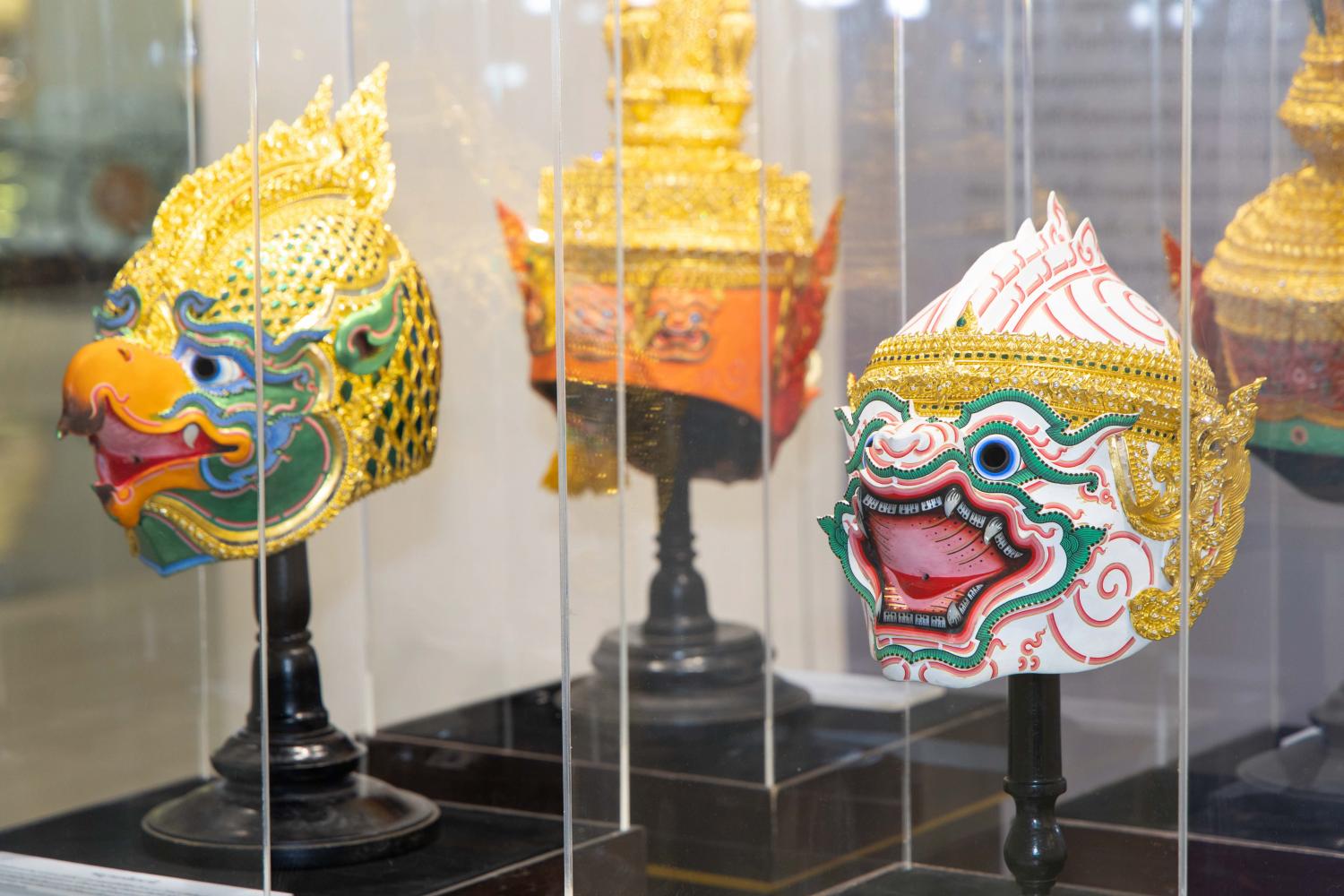
“Khon Masks: From Royal Khon Performances To The World’s Intangible Cultural Heritage” recounts the Queen Mother’s important role in reviving khon masked dance. Queen Sirikit graciously granted personal funds to the Fine Arts Department to improve khon costumes in 2003 and continuously supported the performing art.
This part also exhibits four rare khon masks. They include Phipek, the younger brother of Thotsakan with a green body, crocodile eyes and a snarling mouth; Hanuman, the great simian warrior and chief soldier of Phra Ram; Akastalai, a giant guardian with wide-open eyes and a snarling mouth of the city gate of Krung Longka; and Phaya Nok Samphathi, the elder brother of Nok Sadayu.
There are also craft workshops and a sale of souvenirs from the Queen Sirikit Museum Of Textiles and the Support Foundation.
England manager Thomas Tuchel has warned that Jude Bellingham faces a battle to secure a place in England’s starting line-up at the 2026 FIFA World Cup…
England manager Thomas Tuchel has warned that Jude Bellingham faces a battle to secure a place in England’s starting line-up at the 2026 FIFA World Cup.
Bellingham returns to Tuchel’s squad for the final World Cup qualifiers against Serbia and Albania this week after missing the October internationals due to a shoulder injury.
The 22-year-old had only just recovered from surgery when Tuchel decided not to include him for the matches against Wales and Latvia, a decision that allowed Aston Villa’s Morgan Rogers to impress in the No.10 role.
Rogers’ strong performances have now created a selection dilemma for Tuchel as he prepares for next year’s tournament in the United States, Canada, and Mexico.
Related News
“Rather than finding a position for the best players just to have them on the field, it’s maybe better to put everyone in their best position and let competition decide,” Tuchel told reporters on Wednesday.
“At the moment, the competition is between the two of them. They are friends, so it’s a friendly competition. They don’t have to be enemies; they respect each other and fight for the same spot.
“Can they play together? Yes, but in a different structure, and now is not the moment to change the structure.”
Bellingham’s recall comes after Tuchel had earlier apologised this season for controversial comments suggesting that the midfielder’s mother found some of his on-pitch antics “repulsive.” = == = = ==
Head of Sports at BusinessDay Media, a seasoned Digital Content Producer, and FIFA/CAF Accredited Journalist with over a decade of sports reporting.Has a deep understanding of the Nigerian and global sports landscape and skills in delivering comprehensive and insightful sports content.
The UK government has announced a 15% reduction in financial support for the Global Fund to Fight AIDS, Tuberculosis, and Malaria, bringing its c…
The UK government has announced a 15% reduction in financial support for the Global Fund to Fight AIDS, Tuberculosis, and Malaria, bringing its contribution down to £850 million, Azernews reports.
Access to paid information is limited
Find the plan that suits you best.
1 month subscription
Full digital access to all news for 1 month
3 months subscription
Full digital access to all news for 3 months
2.00₼
Select
-33%
6 months subscription
Full digital access to all news for 6 months
3.84₼
Select
-36%
1 year subscription
Full digital access to all news for 1 year
7.10₼
Select
-41%
Here we are to serve you with news right now. It does not cost much, but worth your attention.
Choose to support open, independent, quality journalism and subscribe on a monthly basis.
By subscribing to our online newspaper, you can have full digital access to all news, analysis, and much more.