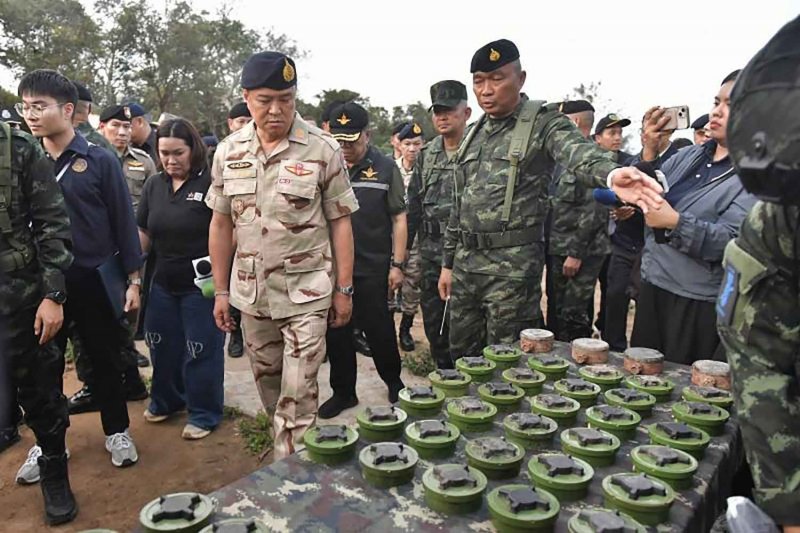
The latest landmine explosion, which injured four soldiers and left one without a foot, not only undermines attempts at peace between Thailand and Cambodia but also sparks fears of an all-out war as Thailand faces pressure to retaliate and teach its neighbour a lesson.
Sgt 1st Class Therdsak Samaphong is the seventh soldier to lose a limb while patrolling the Si Sa Ket border since the confrontation began in mid-year.
The Anutin Charnvirakul government reacted swiftly to calls for reprisals.
It suspended the US-brokered accord, signed in Kuala Lumpur last October, and authorised “full military operations” against Cambodia. It is the term “full military operations” that is problematic.
Several security experts warn that another armed conflict with Thailand’s immediate neighbour — even if framed as “limited retaliations” — might be an unwise move.
Such action, they say, would allow Cambodia to portray itself as the victim of a larger neighbour, thereby winning unjustified global sympathy.
Some observers view Monday’s blast as a familiar tactic by Phnom Penh to divert attention from its failure to tackle online scam networks and other grey businesses.
Renewed armed conflict, they argue, would shore up the Hun family’s declining image at home.
So what options remain for Thailand?
First, the Anutin government must maintain a diplomacy-led policy, even though such a stance will anger hawkish voices.
In a crisis like this, a cool head prevails while keeping long-term national interests firmly in view.
Second, those involved must gather all the evidence that will expose Cambodia’s wrongdoing — particularly the continuing use of landmines, which violates the Ottawa Convention, and the online scam networks that financially support the regime.
The Foreign Affairs Ministry, in particular, should use every available mechanism to secure international condemnation and punitive measures, such as cuts in assistance, against Phnom Penh.
Meanwhile, it is not necessary to abandon the peace accord entirely.
Instead, keep the options open and ensure the accord serves Thailand’s interests.
At the same time, the Anutin government has grounds to reconsider plans to return the 18 Cambodian soldiers currently in custody.
Doing so would only intensify Cambodian citizens’ anger at the Hun regime — a price the Cambodian leadership must pay for the latest transgression.
More importantly, the army should consider using technology to monitor border movements — drone cameras and other devices — instead of putting soldiers at unnecessary risk.
Such technology would help save lives and provide recorded evidence of hostile activity along the border.
Of course, by avoiding all-out war, the government must communicate clearly with the public about its actions.
Absent a convincing explanation, jingoistic elements will exploit the situation for malicious gains.
Finally, while steering clear of war, Bangkok must continue to wage a fierce campaign against scam networks.
That effort, more than military action, will strike at the heart of the regime’s support.