Cheers for the absurd rules

The amended alcohol contr…

Cheers for the absurd rules

The amended alcohol control legislation that imposes fines on individuals who continue drinking alcoholic beverages during restricted hours — particularly between 2pm and 5pm — has left the government in hot water.

Under Section 32 of the amended law, which took effect this week, those who make their last order at 1.55pm are required to empty their glasses within five minutes or less. If not, they face a maximum fine of 10,000 baht. It is the first time the law has begun targeting individuals, including tourists — previously, it punished only shop or restaurant owners who sold alcohol during prohibited hours — and the details of the law go into such minuscule detail that it borders on the nonsensical.

Opposing the law is the Thai Restaurant Association, which is concerned about the adverse impact on businesses already experiencing hardship due to the economic slowdown.

Taopiphop Limjittrakorn, an MP from the opposition People’s Party — which advocates easing alcohol control — has warned that the amended rule is likely to confuse foreign tourists, particularly if they order drinks before the restricted hours but do not finish by the 2pm lunchtime deadline.

As the amendment also involves advertising rules, several agencies have said the provisions remain confusing and difficult to explain with the short scope offered by a print or television advert.

With regard to punishment against slow drinkers, critics argue that the penalty is not proportionate. Needless to say, the 10,000-baht fine is too harsh. A senior health officer, in a bid to calm public concern, ominously stated that the fine is not entirely fixed, but down to the individual discretion of local law enforcement officers.

This does not bode at all well in a country known for its high corruption rates.

The immediate question is how the new law will be properly enforced. Will there be ethics police doing the rounds, checking every glass? More importantly, some netizens have voiced concerns that, as mentioned above, the law could provide an opportunity for authorities to line their pockets by demanding kickbacks.

The original legislation, based on a 1972 junta order, has never enjoyed strong public support. Often referred to as anachronistic and inconsequential, the law bans alcohol sales between 2pm and 5pm and again from midnight until 11am the following morning for most retail outlets, supermarkets and food shops.

A round-the-clock ban applies on major religious days such as Makha Bucha, Visakha Bucha, Lent and the end of Lent. Exempted from the rule are airports serving international flights, licensed entertainment venues, hotels and some tourist outlets — as well as wholesale traders purchasing in bulk.

Strict alcohol control advocates, including the Centre for Alcohol Studies (CAS), often cite drink-driving fatalities to support the ban and other tough measures. However, if they were willing to reconsider, they might recognise that such blanket restrictions do little to make Thailand’s roads safer, as traffic-related deaths remain high. It is reported that this year’s accumulated fatalities have surpassed 10,200 — almost the same as last year.

Indeed, what is needed is efficient enforcement of traffic laws, including robust action against reckless and drink-driving behaviour. Social drinkers who do not drive should not be subjected to impractical measures that serve only as a nuisance.

Nittaya Kai Yang in B30m renovation

Mr Phadej poses with Mrs Raweewan in front of a Nittaya Kai Yang restaurant in Bangkok. He said Thai-Isan cuisine has always been popular, but the market is now more competitive than ever.

Amid economic volatility, maintaining quality at each branch and keeping the essence of the brand are the keys to dealing with fierce competition in the restaurant sector, according to Nittaya Kai Yang, the renowned Thai-Isan restaurant brand.

Raweewan Laksanavisit, founder of Nittaya Kai Yang, said what has driven the brand for 25 years is the desire to share the taste of home and the warmth of Thai hospitality.

The brand’s enduring success, according to Phadej Kantajinda, executive director of Nittaya Kai Yang Group, lies in its ability to evolve without losing its essence.

“Isan cuisine has always been popular, but the market is now more competitive than ever,” he said. “Our strategy is to maintain the soul of our food while modernising the customer experience, from restaurant design to service innovation and delivery channels.”

Mr Phadej said Nittaya Kai Yang’s growth is guided by four core strategies. The first is its winning zone, focusing on everyday comfort food with a universal taste that appeals to all.

The second is craftsmanship and quality, where great taste begins with great ingredients, supported by a central kitchen that ensures consistent flavours across every branch.

The third, building a bond business, emphasises creating strong emotional connections with staff and customers through warm service and memorable dining experiences.

Lastly, its location strategy prioritises selective expansion in high-potential areas to strengthen accessibility and sustain long-term growth.

Mr Phadej said increasing competition has prompted major restaurant chains to diversify their brands and focus on using high-quality ingredients to stand out.

“Maintaining stable prices during economic uncertainty is a key strategy for customer satisfaction. Internal management also plays a crucial role in cost control, allowing us to preserve both quality and reasonable pricing, even as costs climb,” he said.

This year, the company is allocating an investment budget of over 30 million baht to renovate three existing branches, Soi Sailom (Phahon Yothin Soi 8), Rangsit Khlong 2 and Pinklao, to create a more modern and contemporary atmosphere.

Nittaya Kai Yang has expanded beyond Bangkok for the first time this year, with a new branch at Lotus’s Saraburi, with investment of 8 million baht.

The company operates 31 branches, primarily located in Bangkok.

Over the past four years, Nittaya Kai Yang’s revenue has grown steadily, from 628 million baht in 2021 to 986 million baht in 2024.

The company expects to achieve sales of 1 billion baht in 2025.

He said for the next 3-5 years, the economy is expected not to perform well. The key challenge is to maintain the growth of existing branches rather than focus on expansion.

Centre calls on entrepreneurs to develop core competencies

Centre calls on entrepreneurs to develop core competencies

The University of the Thai Chamber of Commerce’s (UTCC) Competitiveness Center is calling on Thai entrepreneurs to build core competencies to ensure sustainable growth and adapt to the rapidly evolving platform economy structure.

This is also required to overcome the challenges stemming from the increase in commission fees being charged by digital platforms.

The recommendation follows the centre’s in-depth analysis in a white paper titled “Thailand’s Platform Economy in the Age of Creative Destruction: Pathways toward Sustainable Entrepreneurship and a Resilient Digital Ecosystem”.

The report connects Thai digital dynamics with two theoretical frameworks that gained recognition by receiving the 2025 Nobel Prize in Economic Sciences, which identify factors for sustainable growth through technological advancement. One is the “creative destruction” theory of Philippe Aghion from Collège de France and Peter Howitt from Brown University, who developed mathematical models explaining the creative destruction process. The model notes when new technologies and business structures replace old models, companies clinging to outdated technologies and business models cannot compete. Innovation thus simultaneously creates new possibilities while destroying existing structures.

Theerakorn Udomratanamanee, vice-dean for administrative affairs at UTCC’s Creative Entrepreneurship School, said the trend of raising fees among the digital platforms reflects a natural transition known as creative destruction. Platforms are moving from the market creation phase focused on massive investment to attract users to value creation, focusing on revenue generation for business sustainability.

With the value of online transactions projected to exceed 1.2 trillion baht in 2024, accounting for 6.5% of GDP, digital platforms have become a core economic infrastructure that entrepreneurs must utilise to full efficiency.

Supasan Preedawiphat, dean of the UTCC’s Creative Entrepreneurship School, said the 2025 “E-Commerce at the Crossroads” report by Blackbox Research indicates that Southeast Asian countries are transitioning from quantitative to qualitative growth.

To thrive in this new environment, entrepreneurs must build four technical competencies described as the “PACE” acronym.

The first competency (P) refers to “platform literacy and digital operations”. This competence requires a deep understanding of platform systems, efficient use of digital tools, and the ability to make data-driven strategic decisions. For instance, a coffee shop might use customer analytics to adjust advertising according to peak ordering times, which increases sales while reducing costs.

The second competency (A) refers to “added-value innovation and service excellence”. Entrepreneurs must have the ability to create product differentiation through innovation that adds value to products and the customer experience.

The third competency (C) refers to “collaborative brand trust with smart data use”, while (E) refers to “expansion readiness and regional integration” or the ability to connect to regional and cross-border markets.

Mr Supasan also cited another theoretical framework honoured with the 2025 Nobel Prize in Economic Sciences, which is the work of Joel Mokyr from Northwestern University. His work demonstrates through historical evidence that technology creates truly sustainable growth only when society has three foundations: advanced knowledge and science; technical proficiency of labour and the business sector; and institutions and rules that facilitate innovation emergence and widespread dissemination.

Mr Supasan said the government therefore has a crucial role in creating a new economic infrastructure. The state must progress from “regulator” to “co-designer of ecosystems”.

For a sustainable positive impact on all stakeholders in the platform ecosystem, the government’s regulatory role should comprise four main dimensions that refer to the “LEAD” acronym, Mr Supasan noted.

L refers to Linkage Creation, an investment in infrastructure and the fostering of linkages between various sectors. Thailand has starting points such as the Personal Data Protection Act but can build further, such as requiring platforms to notify sellers in advance when changing policies affecting stores in order to create transparency and fairness in the platform ecosystem.

E refers to empowerment through competence or continuously developing entrepreneurial skills using integrated training, tools, and tax incentives, while A refers to adaptive governance, creating flexible rules that upgrade product standards, link trade agreements, and build the “Thailand Trusted Source” image.

D represents distributed trust by building confidence through transparent mechanisms. Kittipong Sakornsathien, the centre’s director, said successful implementation of these measures could reverse the declining trajectory of Thailand’s competitiveness ranking.

Ramathibodi Foundation and Jaspal Group join for charity collection

Ramathibodi Foundation under the Royal Patronage of Her Royal Highness Princess Maha Chakri Sirindhorn has joined hands with Jaspal Group to create a special charity collection titled “The Power Of Sharing”. The collection features commemorativ…

Ramathibodi Foundation under the Royal Patronage of Her Royal Highness Princess Maha Chakri Sirindhorn has joined hands with Jaspal Group to create a special charity collection titled “The Power Of Sharing”.

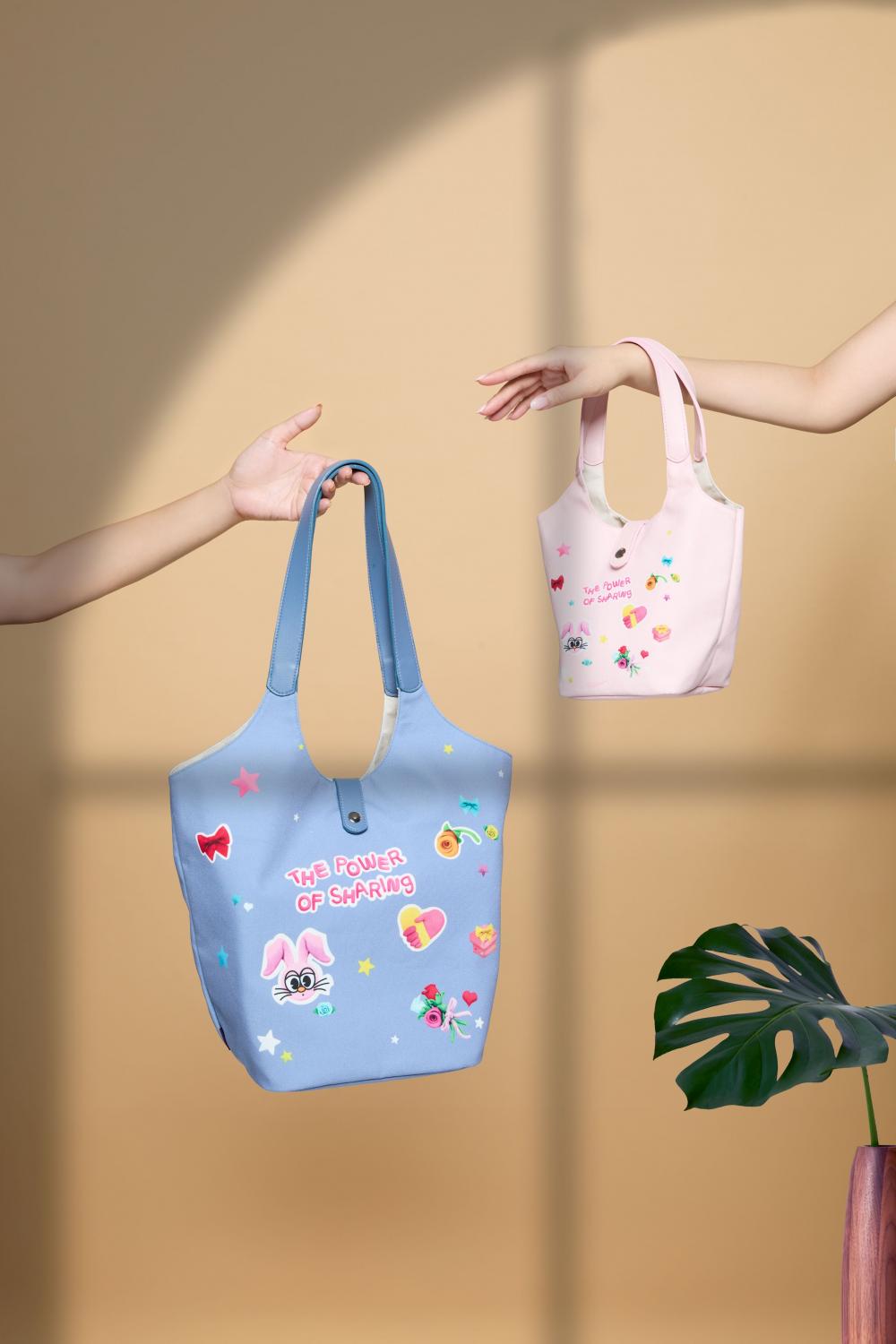
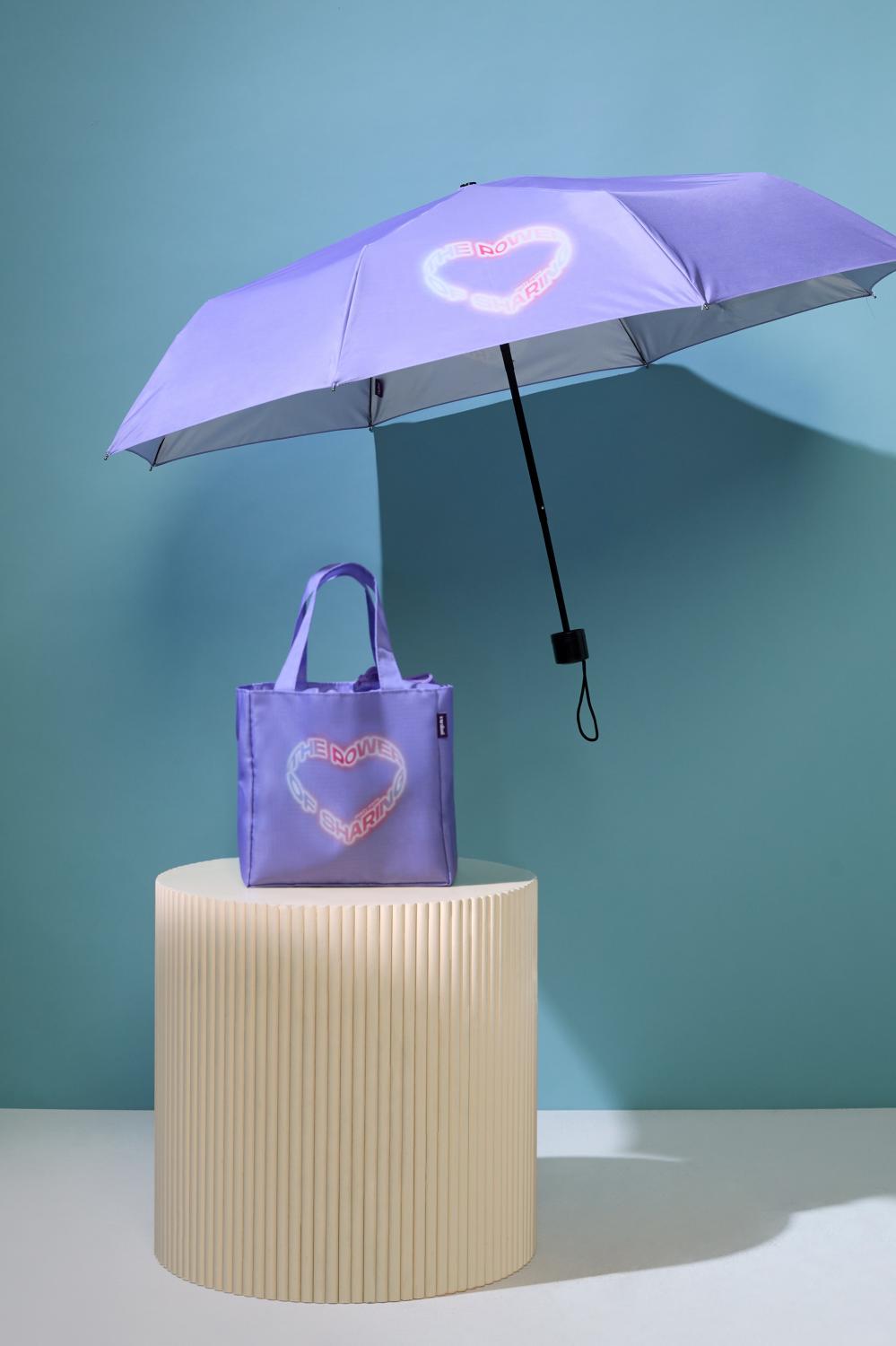
The collection features commemorative items collaboratively designed by nine emerging fashion designers from Jaspal Group’s renowned brands — Jaspal, Misty Mynx, CPS CHAPS, CC Double O, Royal Ivy Regatta, LYN, Lyn Around, Jelly Bunny and Quinn.

Jelly Bunny.

Jelly Bunny.

  • Jaspal, designed by Napassorn Lostapornpipit, takes inspiration from the values of sharing, love and togetherness. The design features a graceful line illustration of people holding hands on T-shirts and water bottles, conveying a sense of warmth, understanding and joy that radiates.
  • Misty Mynx, designed by Kalaya Nark-on, reinterprets the power of sharing through the lens of modern, confident women who embrace individuality. The design appears on folding umbrellas and canvas bags.
  • CPS CHAPS, designed by Narakorn Semachim, expresses the uplifting energy that comes from sharing. The design features a hand motif intertwined with a guitar pick, the brand’s signature symbol, representing cooperation, unity and mutual support. The design is featured on T-shirts, polo shirts and caps.
  • CC Double O, designed by Kasama Chawuthai, conveys the small yet powerful impact that arises when one person extends a helping hand to another. This idea is captured through the image of a hand cradling a heart, ingeniously formed from the brand’s initials C and O. The motif appears on T-shirts and canvas bags.
  • Royal Ivy Regatta, designed by Nutnicha Thamwarin, presents a chic scarf design inspired by the concept “Bloom”. Illustrated with a blossoming lily, the design symbolises rejuvenation and graceful growth, representing new life that springs from the kindness of giving. The scarf serves as a symbol of collective hope and vitality that breathes life into the society.
  • LYN, designed by Benya Kantipsakul, presents the Infinite Love pattern on a shoulder bag, inspired by the idea that the heart serves as a bridge connecting givers and receivers through the sharing of happiness.
  • Lyn Around, designed by Apirati Malisorn, conveys themes of love, support and collaboration within society through its designs on T-shirts, folding umbrellas and caps.
  • Quinn, designed by Guarboon Chuanboon, reinterprets the meaning of giving through a uniquely shaped tank-shaped bucket bag.

All proceeds from the collection will go towards supporting underprivileged patients and procuring medical equipment for the Faculty of Medicine, Ramathibodi Hospital.

Misty Mynx.

Misty Mynx.

The art of optimism

Artist Watoosiri Jansin, aka Artsaveworld, reflects on poor construction throughout Bangkok with her sculpture titled Maa Cherry Tid Tor Prapaa (Cherry The Dog Stuck In A Water Pipe). The long body of the dog reflects persistent issues.
Napats…

Artist Watoosiri Jansin, aka Artsaveworld, reflects on poor construction throughout Bangkok with her sculpture titled Maa Cherry Tid Tor Prapaa (Cherry The Dog Stuck In A Water Pipe). The long body of the dog reflects persistent issues.

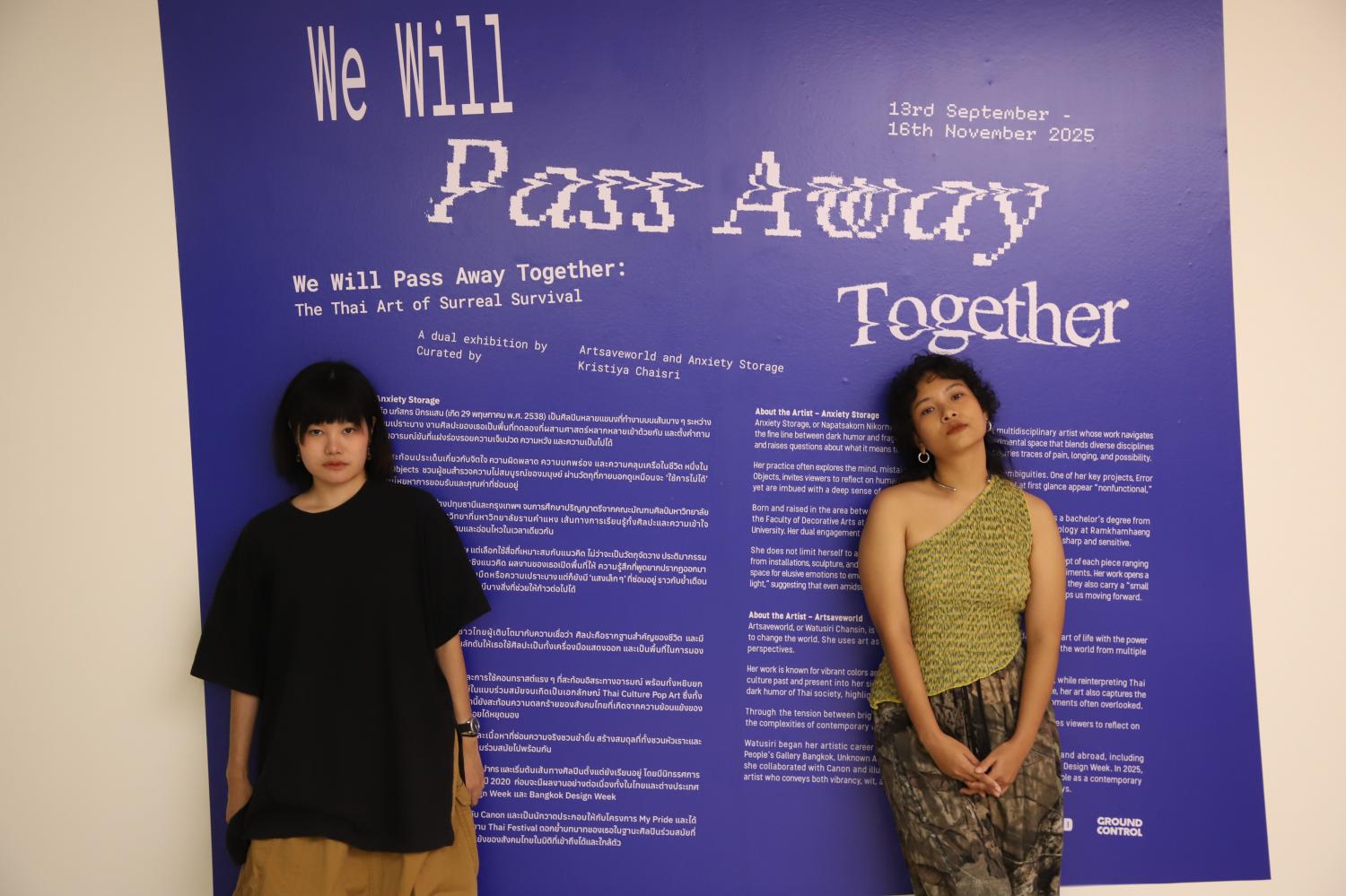
Napatsakorn Nikornsaen, left, and Watoosiri Jansin. (Photo: Varuth Hirunyatheb)

Napatsakorn Nikornsaen, left, and Watoosiri Jansin. (Photos: Varuth Hirunyatheb)

Meanwhile, artist Napatsakorn Nikornsaen, aka Anxiety Storage, created a readymade installation in the form of Bangkok’s damaged sidewalks. There are puzzle pieces in the middle of the gap in the installation. The puzzle pieces sarcastically show that walking on Bangkok’s footpaths is similar to playing a game where people do not know what they will encounter.

Art pieces created by Watoosiri and Napatsakorn are displayed at the exhibition “We Will Pass Away Together: The Thai Art Of Surreal Survival”. Though these two artists are students at the Faculty of Decorative Arts, Silpakorn University, they had never worked together. They teamed up for this exhibition because the curator felt they share a similar humour.

Napatsakorn confessed that she was initially worried about showcasing together because their styles are totally different. While Watoosiri focuses on illustrations, Napatsakorn’s works are objects and installations. After working together, they became comfortable. They could express their own ideas and still maintain harmony between their works.
System 2.

System 2.

Maa Cherry Tid Tor Prapaa (Cherry The Dog Stuck In A Water Pipe).

Maa Cherry Tid Tor Prapaa (Cherry The Dog Stuck In A Water Pipe).

The exhibition “We Will Pass Away Together” was inspired by a meme during Covid-19.

“The exhibition title came about during the pandemic. At that time, people sent phrases to encourage each other such as ‘getting through this together’. However, someone came up with the phrase ‘we will pass away together’. This made us realise that even though we have to live in a country with structural flaws, Thai people still have a sense of humour for negative things they experience,” explained Napatsakorn.

“In this exhibition, we picked things that we found funny in everyday life. Actually, if everyone carefully looks at the root cause, we would not laugh. Instead, we would feel stressed every day. As citizens, we can only try to be optimistic. The exhibition curator Kristiya Chaisri also told us that on TikTok, foreigners call this kind of humour ‘Thai core’. For example, they were amazed at a clip of a man riding a motorcycle with a dog sitting on the back seat behind him.

“When we worked on the concept of Thai core, we thought that artwork does not have to be traditional or relate to temples. It should be contemporary and relevant to the daily lives of Thai people.”
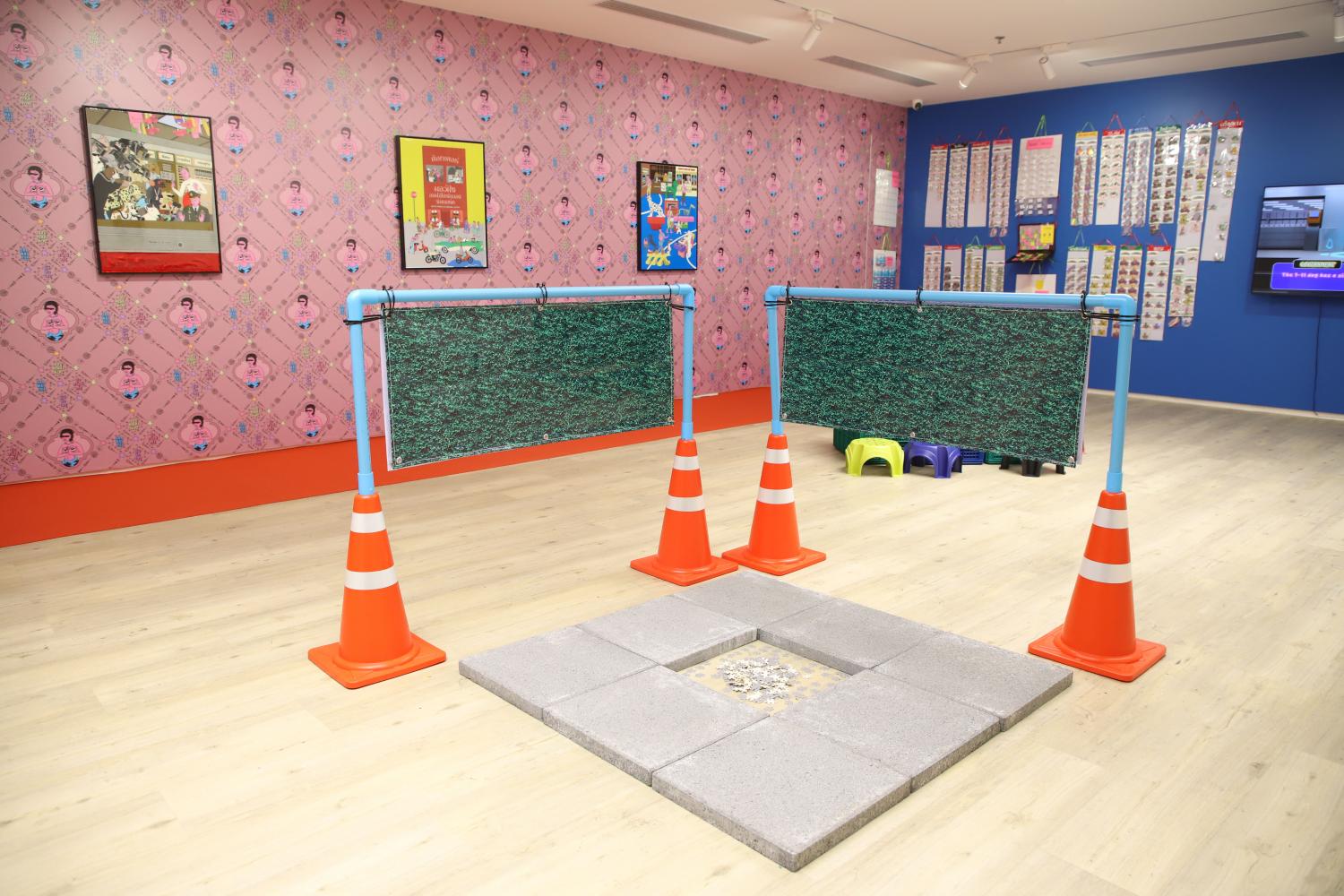
The footpath installation by Napatsakorn Nikornsaen.
The footpath installation by Napatsakorn Nikornsaen.

Life Is Easy 1.

Life Is Easy 1.

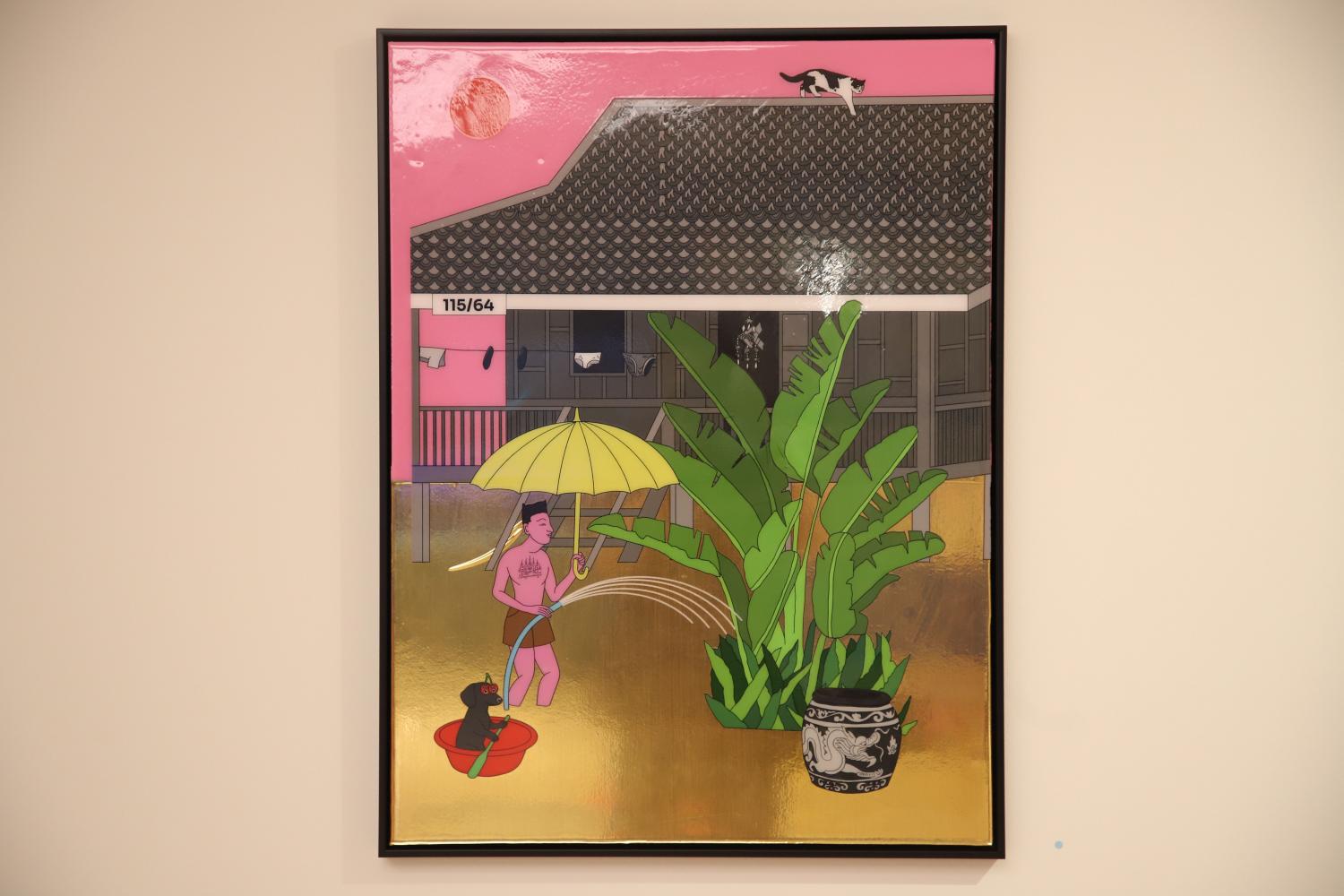
Watoosiri Jansin, aka Artsaveworld, has gained recognition for using tua kak, which refers to human characters in traditional Thai paintings and literature. Unlike the main characters, tua kak do not appear in beautiful clothes since they represent ordinary people. Watoosiri makes her characters unique by painting them pink.

In “We Will Pass Away Together”, Watoosiri created illustrations and sculptures inspired by memes that she saw on the internet. Life Is Easy 1 and Life Is Easy 2 were inspired by floods.

Both illustrations depict local people enjoying their lives during the floods.

“I saw a meme of a man standing and watering plants in the middle of the flood. He seemed to have no idea what to do, so he came out to water the plants. Also during the floods, people used their motorcycles to surf and went out to drink. Another meme depicts two hairdressers washing a customer’s hair while everyone is chest-deep in the water,” Watoosiri explained.

System 1 was inspired by an odd experience when she once drove through a police checkpoint.
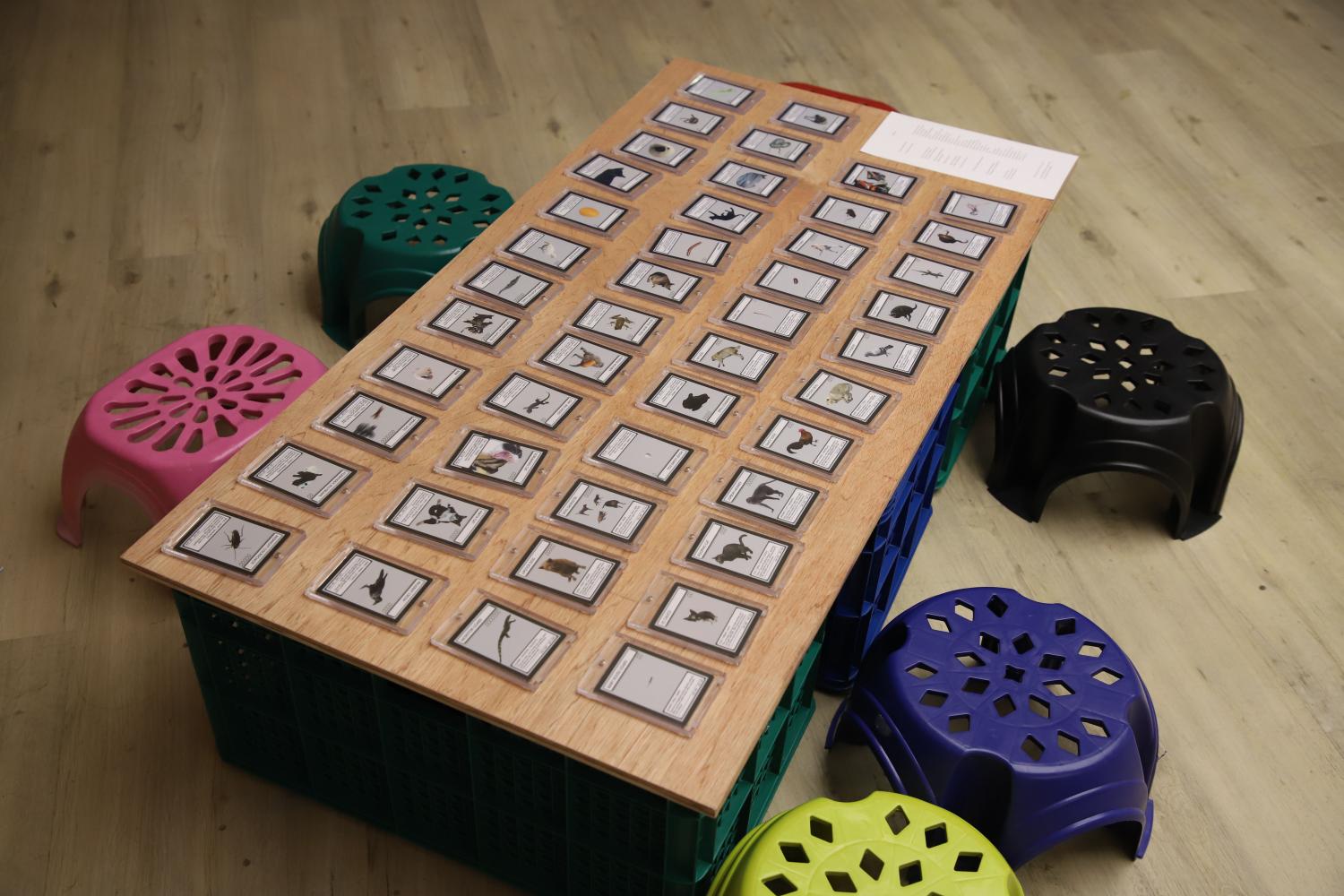
Animal game cards.

Animal game cards.

“That night I ate out, but did not drink any alcohol. I encountered a breathalyser checkpoint on Aksorn Road. When I pulled the car over, a police officer told me that the breathalyser mouthpieces had run out. He told me to blow directly on his face. I did so and he allowed me to go. I had no idea why they decided to do that, but it was a hilarious experience for me,” said Watoosiri.

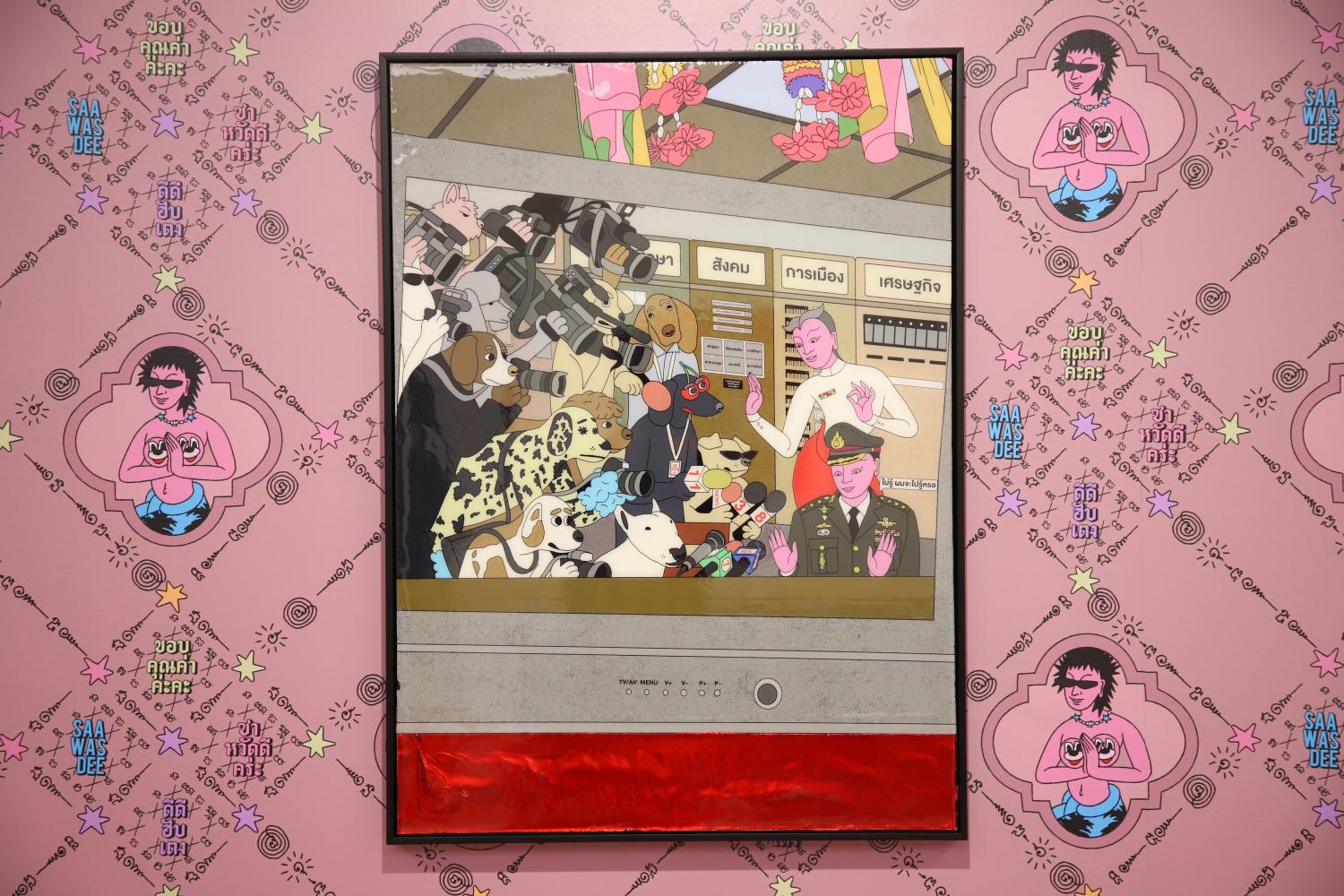
Watoosiri felt inspired to illustrate System 2 which depicts a high-ranking military politician repeatedly saying “I don’t know” during his interview with reporters. Although the situation was serious and people felt stressed, that politician just responded “I don’t know” to all the questions.

The two artists also reflect the superstitious belief of Thais in the exhibition. Watoosiri’s Itsara Thaang Khwaam Chuea 1 (Freedom Of Faith 1) and Itsara Thaang Khwaam Chuea 2 (Freedom Of Faith 2) depict making offerings to fulfil one’s vows and making merit for a birthday. These two illustrations are displayed above zebra statues created by Napatsakorn to be used as offerings.

Napatsakorn is recognised for her solo exhibition “808080 Error Objects”, in which she designed everyday objects to look different, such as a knife with a sharp handle, crutches with wheels and a hairbrush with hard steel bristles. Napatsakorn explained that her concept was inspired by depression which was caused her to feel like an outsider among her family and society for years.

“If we cannot meet others’ expectations, will we become worthless? For example, if I am not a very nice friend, sibling or daughter, does it mean I am worthless? I created everyday objects with flaws, displayed them and let people judge whether these objects still have value,” explained Napatsakorn.

In this exhibition, Napatsakorn created a video which features a 3D model dog inspired by stray dogs at 7-Eleven stores.

“I created a video which looks like an online game. I am a dog lover who notices strays can be often found in front of convenience stores. If we take a look closer, stray dogs are another issue that have not been managed properly,” she said.

Sticker panels and postcards created by Napatsakorn hang on the wall to create an ambience like that of a local grocery store. One of the most interesting and hilarious stickers are of mosquitos.

Next to the sticker panels, there is a table displaying cards inspired by Pokémon. The cards feature several kinds of animal species in Thailand such as a city pigeon, a fat dog, a house lizard, a pooping cat, a cockroach egg and a worm.

Toilet Cube And The Mysterious Bugs is a sculpture inspired by public restrooms. On the white cube made from bathroom tiles, there are drain or moth flies often found in public restrooms. According to entomologists, these flies do not harm humans, but in large numbers they can be a nuisance and unsanitary.

“Going to public restrooms in Thailand is like trying your luck at a Japanese gachapon game. You do not know whether a tissue roll or a bidet spray will be available or not. I created this piece because I noticed many flies in public restrooms, but nobody mentions it, so I put them in the spotlight as the main character of the artwork.”

As an artist who creates sculptures and installations, Napatsakorn hopes that Thai people will appreciate other kinds of art rather than paintings. She believes everything is art depending on the perspective.

Watoosiri hopes that the exhibition will bring happiness to the viewers.

“If visitors smile, that will make me happy. They do not have to laugh at our artwork. I hope they can forget their stress and enjoy the art. That’s enough for me,” she said.

Trump warns reversing tariffs could cost US over $2 trillion

US President Donald Trump intensified his defense of his tariff policies on Monday, warning that repealing or reversing them could result in more…

Trump warns reversing tariffs could cost US over $2 trillion

US President Donald Trump intensified his defense of his tariff policies on Monday, warning that repealing or reversing them could result in more than $2 trillion in lost revenue and investment, Azernews reports.

Find the plan that suits you best.

1 month subscription

Full digital access to all news for 1 month

3 months subscription

Full digital access to all news for 3 months

2.00

Select

-33%

6 months subscription

Full digital access to all news for 6 months

3.84

Select

-36%

1 year subscription

Full digital access to all news for 1 year

7.10

Select

-41%

Here we are to serve you with news right now. It does not cost much, but worth your attention.

Choose to support open, independent, quality journalism and subscribe on a monthly basis.

By subscribing to our online newspaper, you can have full digital access to all news, analysis, and much more.

Subscribe

You can also follow AzerNEWS on Twitter @AzerNewsAz or Facebook @AzerNewsNewspaper

Thank you!

Edun reassures investors, pledges balanced Capital Gains Tax outcomes as NGX lists MREIF

Nigerian Exchange (NGX) on Tuesday hosted the Minister of Finance and Coordinating Minister for the Economy, Wale Edun, at the Closing Gong Ceremony to…

Nigerian Exchange (NGX) on Tuesday hosted the Minister of Finance and Coordinating Minister for the Economy, Wale Edun, at the Closing Gong Ceremony to commemorate the listing of the Ministry of Finance Incorporated (MOFI) Real Estate Investment Fund (MREIF) Series 2.

The event underscored the capital market’s pivotal role in national development, particularly in addressing Nigeria’s housing deficit.

The listing took place against the backdrop of cautious trading in the equities market, as investors recalibrate portfolios in response to geopolitical tensions arising from the US–Nigeria diplomatic standoff, the proposed Capital Gains Tax (CGT), year-end portfolio rebalancing, and expectations of window-dressing by institutional players. While liquidity remains robust, analysts emphasize that aligning fiscal policy with investor expectations is critical to sustaining confidence and deepening long-term market participation.

Temi Popoola, Group Managing Director/Chief Executive Officer, NGX Group, reaffirmed the capital market’s role as a catalyst for inclusive growth and called on the Federal Government to ensure balanced outcomes in the implementation of the Capital Gains Tax.

“The capital market is not only a platform for attracting investment but also a tool for creating wealth for Nigerians. Policies such as the capital gains tax must be carefully designed to balance government revenue objectives with investor confidence and market growth. NGX Group remains committed to supporting the Renewed Hope Agenda by channeling private capital into initiatives that deliver sustainable, long-term impact.”

Read also: Buy opportunities beckon as market correction deepens on CGT fears

Responding, Wale Edun assured stakeholders that the Federal Government has noted the concerns around Capital Gains Tax and remains committed to ongoing consultation with the market. “We have noted the concerns around Capital Gains Tax and will continue to engage with the capital market to ensure any decisions deliver optimal outcomes for both Nigerians and the market.

Related News

At N100 per unit, MREIF allows ordinary Nigerians to participate in savings and investment, leveraging local resources to grow our economy, especially in the housing sector.”

The ceremony also highlighted the strength of collaboration between the Federal Government, MOFI, and the private sector in mobilising innovative financing for housing.

Ahonsi Unuigbe, Chairman, NGX, described the listing as a “defining step toward transforming Nigeria into a leading economy that ensures shared prosperity for all Nigerians.”

In his remarks, Jude Chiemeka, CEO, NGX, said MREIF demonstrates how the capital market can deliver practical solutions to national challenges: “By channeling private capital into housing, we are creating opportunities for long-term investment and wealth creation while addressing Nigeria’s housing deficit.”

Armstrong Ume Takang, Managing Director/CEO, MOFI, added: “MREIF provides long-term, low-cost mortgage financing to make homeownership a reality for millions of Nigerians, stimulating local economies across the housing value chain.”

The Closing Gong Ceremony positioned MREIF as a model for inclusive economic growth, illustrating how institutional capital can drive both financial stability and social impact. With over 1,000 mortgages already disbursed, the initiative continues to expand middle-class wealth and deepen Nigeria’s capital market.

Iheanyi Nwachukwu, is a creative content writer with over 18 years journalism experience writing on banking, finance and capital markets. The multiple awards winning journalist is Assistant Editor, BusinessDay. Iheanyi holds BSc Degree in Economics from Imo State University; Master of Science (MSc) Degree in Management from University of Lagos.
Iheanyi has attended several work-related trainings including (i) Advanced Writing and Reporting Skills (Pan African University, Lagos); (ii) News Agency Journalism (Indian Institute of Mass Communication {IIMC}, New Delhi, India); and (iii) Capital Markets Development and Regulations (International Law Institute {ILI} of Georgetown University, Washington DC, USA).

Edun reassures investors, pledges balanced Capital Gains Tax outcomes as NGX lists MREIF

Nigerian Exchange (NGX) on Tuesday hosted the Minister of Finance and Coordinating Minister for the Economy, Wale Edun, at the Closing Gong Ceremony to…

Nigerian Exchange (NGX) on Tuesday hosted the Minister of Finance and Coordinating Minister for the Economy, Wale Edun, at the Closing Gong Ceremony to commemorate the listing of the Ministry of Finance Incorporated (MOFI) Real Estate Investment Fund (MREIF) Series 2.

The event underscored the capital market’s pivotal role in national development, particularly in addressing Nigeria’s housing deficit.

The listing took place against the backdrop of cautious trading in the equities market, as investors recalibrate portfolios in response to geopolitical tensions arising from the US–Nigeria diplomatic standoff, the proposed Capital Gains Tax (CGT), year-end portfolio rebalancing, and expectations of window-dressing by institutional players. While liquidity remains robust, analysts emphasize that aligning fiscal policy with investor expectations is critical to sustaining confidence and deepening long-term market participation.

Temi Popoola, Group Managing Director/Chief Executive Officer, NGX Group, reaffirmed the capital market’s role as a catalyst for inclusive growth and called on the Federal Government to ensure balanced outcomes in the implementation of the Capital Gains Tax.

“The capital market is not only a platform for attracting investment but also a tool for creating wealth for Nigerians. Policies such as the capital gains tax must be carefully designed to balance government revenue objectives with investor confidence and market growth. NGX Group remains committed to supporting the Renewed Hope Agenda by channeling private capital into initiatives that deliver sustainable, long-term impact.”

Read also: Buy opportunities beckon as market correction deepens on CGT fears

Responding, Wale Edun assured stakeholders that the Federal Government has noted the concerns around Capital Gains Tax and remains committed to ongoing consultation with the market. “We have noted the concerns around Capital Gains Tax and will continue to engage with the capital market to ensure any decisions deliver optimal outcomes for both Nigerians and the market.

Related News

At N100 per unit, MREIF allows ordinary Nigerians to participate in savings and investment, leveraging local resources to grow our economy, especially in the housing sector.”

The ceremony also highlighted the strength of collaboration between the Federal Government, MOFI, and the private sector in mobilising innovative financing for housing.

Ahonsi Unuigbe, Chairman, NGX, described the listing as a “defining step toward transforming Nigeria into a leading economy that ensures shared prosperity for all Nigerians.”

In his remarks, Jude Chiemeka, CEO, NGX, said MREIF demonstrates how the capital market can deliver practical solutions to national challenges: “By channeling private capital into housing, we are creating opportunities for long-term investment and wealth creation while addressing Nigeria’s housing deficit.”

Armstrong Ume Takang, Managing Director/CEO, MOFI, added: “MREIF provides long-term, low-cost mortgage financing to make homeownership a reality for millions of Nigerians, stimulating local economies across the housing value chain.”

The Closing Gong Ceremony positioned MREIF as a model for inclusive economic growth, illustrating how institutional capital can drive both financial stability and social impact. With over 1,000 mortgages already disbursed, the initiative continues to expand middle-class wealth and deepen Nigeria’s capital market.

Iheanyi Nwachukwu, is a creative content writer with over 18 years journalism experience writing on banking, finance and capital markets. The multiple awards winning journalist is Assistant Editor, BusinessDay. Iheanyi holds BSc Degree in Economics from Imo State University; Master of Science (MSc) Degree in Management from University of Lagos.
Iheanyi has attended several work-related trainings including (i) Advanced Writing and Reporting Skills (Pan African University, Lagos); (ii) News Agency Journalism (Indian Institute of Mass Communication {IIMC}, New Delhi, India); and (iii) Capital Markets Development and Regulations (International Law Institute {ILI} of Georgetown University, Washington DC, USA).

Nigeria, UK pledge stronger ties on trade, security, investment

Nigeria and the United Kingdom have reaffirmed their commitment to deepening bilateral relations across multiple fronts following a meeting between Yus…

Nigeria and the United Kingdom have reaffirmed their commitment to deepening bilateral relations across multiple fronts following a meeting between Yusuf Tuggar, Nigeria’s Minister of Foreign Affairs, and the British Foreign Secretary in London.

The meeting, held at the Foreign, Commonwealth and Development Office (FCDO), focused on strengthening cooperation in key areas such as trade, investment, security, education, migration, and climate action.

Both countries described the engagement as a renewed effort to consolidate their historical ties and expand their partnership in line with evolving global and regional priorities.

Tuggar, who led Nigeria’s delegation, described the discussion as “constructive and forward-looking,” noting that it underscored the “long-standing friendship and shared democratic values” that have defined relations between both nations.

“Our dialogue reflected mutual respect and a shared vision for sustainable growth, peace, and prosperity,” Tuggar said, emphasising that both governments are determined to translate diplomatic cooperation into concrete gains for their citizens.

According to a statement from the Nigerian Foreign Ministry, the talks also provided a platform for the two sides to exchange views on international and regional developments, including peace and security in West Africa, global economic trends, and collaborative approaches to addressing climate challenges.

It noted that both ministers explored new avenues for economic and technological collaboration, reaffirming the UK’s support for Nigeria’s reform agenda and economic diversification efforts.

Related News

Read also: UK issues fresh travel advisory over rising insecurity in Nigeria

They further discussed ongoing cooperation in defence and governance, including the need to strengthen democratic institutions, improve security coordination, and enhance capacity-building initiatives between their respective agencies.

Acknowledging the strong cultural and human links that underpin the relationship, both sides commended the contributions of the Nigerian diaspora community in the UK.

Tuggar noted that Nigerians living abroad remain “a vital bridge between both countries,” playing an increasingly important role in trade, innovation, and diplomacy.

Both ministers pledging to maintain regular dialogue and follow up on agreed frameworks of cooperation.