Nigeria’s push to attract private capital into its solid minerals sector is set to face critical scrutiny as the Ore Reserves Development Forum (ORDF) …
Nigeria’s push to attract private capital into its solid minerals sector is set to face critical scrutiny as the Ore Reserves Development Forum (ORDF) and the Solid Minerals Development Fund (SMDF) move to draft what could become the country’s first coordinated mining finance framework.
The two institutions will host a technical workshop on December 9 in Abuja, bringing together miners, lenders, regulators and policy actors to assess why mining projects continue to struggle with financing despite expanded government interest in diversification.
In a statement signed by Abdulmajeed Amussah, technical adviser to the executive secretary, SMDF, it stated that a major concern among investors remains the credibility of geological and project data, which funders say undermines due-diligence processes and raises risk premiums on Nigerian mining ventures.
ORDF officials say the absence of consistent reporting standards and transparent reserve classifications has contributed to stalled investment across the value chain.
The workshop is expected to examine issues such as mineral reporting rules, financing structures from exploration to production, and regulatory incentives that could lower entry risks for both banks and private equity.
Related News
Participants will also identify structural constraints, including weak technical capacity and gaps in project preparation—factors that continue to push Nigerian mining deals outside mainstream capital markets.
At the end of the session, stakeholders are expected to produce a draft Mining Finance Framework, which will undergo further review by a multi-agency technical working group. The framework aims to provide clearer guidance for investors, outline reporting expectations for miners, and strengthen transparency across the sector.
The ORDF emerged from the Geological Society of Nigeria’s Roundtable 2.0 initiative, which highlighted systemic weaknesses in ore-reserve classification and the lack of structured financing instruments tailored to mining.
Stàkeholders say a credible finance framework could help position mining as a more bankable component of Nigeria’s industrial strategy, though the extent of its adoption and will depend on government alignment and regulatory follow-through.
Mr Vitai says the central bank wants to take on a more prominent role in revitalising the Thai economy.
The new governor of the Bank of Thailand wants to get more involved with the country’s structural challenges and real sector issues, expanding the bank’s role beyond its traditional focus on economic stability.
Given the slower growth of the Thai economy and persistent structural problems, particularly declining productivity and competitiveness as well as high household debt, the central bank plans to take a more hands-on approach in addressing these challenges to support Thais and local businesses, governor Vitai Ratanakorn said at a seminar hosted by the Bank of Thailand’s Northeastern Office on Friday.
Mr Vitai, who assumed office on Oct 1 for a five-year term, said he would cooperate with all relevant stakeholders and engage more closely with economic problems to help address the country’s structural weaknesses.
The central bank’s core mandate traditionally covers three pillars: inflation, economic growth and financial stability.
While inflation is slightly below the regulator’s target range due to pressure from fuel and food prices, it is expected to return to the target in the medium term.
The financial system remains relatively strong, leaving no significant concerns in these two areas, he said.
“However, the slowdown in Thailand’s economy and its structural issues require collaboration from all parties to support recovery. The central bank wants to take on a more prominent role in revitalising the economy and supporting Thai people and businesses,” Mr Vitai said.
New SME loan scheme
He said the central bank plans to introduce a new loan scheme for small and medium-sized enterprises (SMEs) using a loan guarantee mechanism. Scheduled for early 2026, the programme aims to expand SME lending by about 100 billion baht, or roughly 5% of the sector’s existing loan portfolio.
With slow economic growth, weak domestic demand, subdued investment and rising credit risks, bank loan growth has contracted for 15 consecutive months, said Mr Vitai.
Total outstanding loans in the banking sector fell by 1% year-on-year in the third quarter, marking the fifth straight quarter of decline, according to the regulator.
The SME segment recorded the sharpest decline, with loans contracting by 4% in the third quarter, worsening from a 3% drop in the previous quarter.
Economic headwinds and structural problems such as slower long-term growth, weaker competitiveness and productivity, an ageing population and high household debt continue to weigh on lending, especially to SMEs.
“Higher credit risk amid slow economic growth is a major factor dampening SME loan expansion. Targeted measures to support this segment are therefore essential,” Mr Vitai said.
The central bank collaborated with the Finance Ministry, Thai Bankers’ Association, asset management companies (AMCs) and other stakeholders to recently launch a new debt resolution programme using AMCs.
The initiative targets small non-performing loan (NPL) borrowers with total debt of less than 100,000 baht per person, taking effect on Jan 1 next year.
Isan income
Amidst the broader economic slowdown, the northeastern region faces particular challenges, with household incomes significantly lower than in other regions.
During 2017-2023, average annual income in the Northeast grew by just 0.6%, while household expenses increased by 2%.
Income per person in the Northeast remained lower than in other regions, while the uptick in expenses was linked to the region’s growing household debt burden.
Over the same period, Thailand’s total household debt rose by 24%, whereas household debt in the Northeast surged by 55%.
Although the region accounts for one-third of the country’s population, it contributes only 10% of national GDP.
In addition, Mr Vitai said farmers make up about half of the workforce in the Northeast. However, falling agricultural prices have weakened household incomes and exacerbated debt pressures.
The government’s new debt resolution scheme is expected to offer partial relief to NPL borrowers and indebted households in the Northeast.
The central bank expects some borrowers to exit the NPL cycle and return to performing-loan status under the programme, he said.
The Securities and Exchange Commission (SEC) is stepping up enforcement and expanding proactive safeguards to ensure Thailand’s capital market and digital asset ecosystem do not become channels for money laundering or technology-driven crimes.Through p…
The Securities and Exchange Commission (SEC) is stepping up enforcement and expanding proactive safeguards to ensure Thailand’s capital market and digital asset ecosystem do not become channels for money laundering or technology-driven crimes.
Through partnerships with domestic and international agencies, the regulator sealed loopholes and blocked scam networks as financial crime risks rise, the SEC said in a statement.
“Investigations into suspicious transactions are moving ahead at a faster pace, supported by deeper data sharing with the Anti-Money Laundering Office [Amlo] and law enforcement authorities under the ‘connecting the dots’ framework,” the statement noted.
The initiative is designed to close structural loopholes and strengthen cross-agency surveillance.
At the operational level, all licensed market participants must strictly follow anti-money laundering requirements, including know-your-customer, customer due diligence (CDD), and mandatory reporting of suspicious activities.
The SEC reiterated that penalties will be enforced in cases of non-compliance, ranging from failure to report securities transactions to breaches involving tender offers or shareholder disclosures.
In the digital asset sector, standards were tightened to align with those applied to commercial banks. Exchanges and intermediaries are prohibited from opening accounts linked to blacklisted mule accounts and are required to conduct enhanced CDD for high-risk clients. They must also classify customers based on risk profiles.
Alongside Amlo, the SEC is progressing towards full implementation of the global travel rule. These combined efforts have already blocked 44,382 mule accounts, preventing illicit activity valued at more than 200 million baht.
The regulator prioritises proactive protection aimed at reducing public losses from investment scams, according to the statement. The SEC partnered with online platforms to shut down fraudulent investment channels, achieving a 100% takedown rate in 7 to 48 hours.
For the first 10 months this year, the regulator closed 3,134 scam-related accounts and URLs. Requests for consultation have doubled, suggesting increased public vigilance.
The agency is also working with the Digital Economy and Society Ministry to block unauthorised foreign digital asset platforms that are often used as laundering conduits.
These initiatives fall under the SEC’s “Preventive Anti-Scam for All” strategy, utilising consultation, communication and collaboration. The programme offers pre-transaction advisory services, consolidates information about investment fraud into a central knowledge hub, and drives the nationwide “Think Before You Transfer” campaign.
The programme also enhances cooperation with domestic and cross-border partners to remove fake business pages and strengthen identity verification standards across major digital platforms.
To reinforce structural supervision, the SEC signed a cybercrime prevention memorandum of understanding with 15 public and private organisations, and participates in a national subcommittee overseeing financial data integration under the connecting-the-dots framework.
The regulator said it will continue to deploy every legal and preventive tool available to safeguard the integrity of Thailand’s capital markets and digital asset system, enhancing transparency, closing vulnerabilities, and building investor confidence.
Mr Anutin speaks with Trump following a special dinner for leaders of Apec nations in South Korea. Maintaining tariff talks with the US while also addressing the border dispute is a balancing act for the Anutin administration. Government House
Separating US tariffs from the Thai-Cambodian border dispute is like “rainfall without flash floods in Bangkok”.
Chulalongkorn University political science Prof Siripan Nogsuan Sawasdee fashioned the simile when she was asked during a Thai PBS TV programme whether it is possible to treat the two issues separately, as the US Trade Representative vowed not to proceed with tariff negotiations with Thailand after Prime Minister Anutin Charnvirakul announced the suspension of the Thai-Cambodian peace accord, brokered by Washington and Kuala Lumpur on Oct 26.
Mr Anutin suspended the agreement on Nov 10 after four Thai soldiers were injured by a new landmine allegedly planted by the Cambodian side, saying it was an act of hostility.
US President Donald Trump later suggested he would not link suspension of the joint declaration to ongoing tariff talks, but Prof Siripan said she believes tariffs will remain Trump’s key tool to address geopolitical conflicts, trade, drug smuggling and immigration.
“Tariffs are like paracetamol for Trump,” said Prof Siripan.
If trade and security cannot be disentangled, she said it will be an uphill task for the Anutin government to make progress on both issues simultaneously. Whether the administration can strike a balance between the two issues or prioritise the former over the latter remains a tricky question, said Prof Siripan.
Once negotiations are on track, Thailand can look into how tariffs really affect exports, especially after the US Supreme Court rules on whether Trump’s tariffs are legal.
EMOTIONAL CONTROL
Though it is difficult to strike a balance between actions to address the border dispute and steps to achieve a trade agreement with the US, the government can start by avoiding becoming frustrated with Cambodia’s alleged non-compliance with the peace accord as it negotiates with the Trump administration, said Tanit Sorat, vice-chairman of the Employers’ Confederation of Thai Trade and Industry.
He echoed the sentiments of analysts monitoring the situation, warning the government that some decisions intended to protect Thai sovereignty may end up slowing down tariff negotiations.
“We cannot think of only what [penalty] Cambodia deserves. It’s fine if villagers think so, but the government must always remain cautious in its actions,” said Mr Tanit.
He urged the government to come up with a clearer policy and communication to ensure solutions to trade and security issues are aligned.
This does not mean Thailand should completely bow to Trump in terms of tariffs or the border conflict, but instead the government should follow the requirements of the peace accord and ask Washington to act against Cambodia if it does not comply with the agreement, said Prof Siripan, adding Phnom Penh is also under tariff pressure.
Thailand will gain no benefits if it strays from the accord, which calls for mine clearance operations and a crackdown on scammers, she said. The US is an important trading partner, with Thai-US trade value commanding an 18-20% share of GDP, said Prof Siripan.
Thailand’s export structure is based on “made-to-re-export” production, particularly for high-tech products exported to the US. For every 100 baht worth of exports to the US, Thailand typically imports about 40 baht worth of components from abroad for assembly, according to Thailand Development Research Institute (TDRI).
“We cannot lose the American market,” insisted Mr Tanit. “We must show we are mature, with sensible reasons for our actions.”
PARALLEL APPROACH
Somjai Phagaphasvivat, a political economist, said national sovereignty must remain paramount, adding territorial integrity and the safety of military personnel are crucial, though trade is also important.
Thailand’s economy depends on exports, which accounted for 60% of GDP last year. Nearly 20% of exports, worth about 3 trillion baht, went to the US, making that market extremely important, he said.
“I don’t believe Trump will separate the border dispute from trade negotiations. Historically, the US has linked various issues to trade talks. For example, pressuring countries to increase investment in the US; insisting Brazil’s Supreme Court release a former Brazilian president imprisoned for organising a coup; or tweaking India for not giving the US credit for helping to promote peace in the India-Pakistan border conflict, which resulted in the US imposing high tariffs on India,” said Mr Somjai.
He said Trump emphasises peace initiatives to demonstrate US policy can shape the global order and reinforce his own sense of geopolitical influence.
Mr Somjai said Thailand must pursue a parallel strategy. On sovereignty, Thailand has not withdrawn from agreements. The issue stems from the other party failing to honour the terms. Thailand must make clear it is not the one breaching the agreement, he said.
In parallel, Thailand must manage trade relations. If trade pressure threatens national sovereignty, Thailand cannot accept it, said Mr Somjai.
“Trump is a negotiator. He does not rely solely on emotion, but uses emotional displays as a tool to increase leverage. Thailand must prepare, as Trump may make additional demands,” he said.
TRADE-OFF
Nonarit Bisonyabut, a research fellow at TDRI, said the more a country is integrated into the global market and the more it develops its democracy, the less independent decision-making power it retains, citing the world economy theory proposed by Dani Rodrik, a political economist specialising in globalisation.
“As Thailand depends more on global markets, it must follow global rules — an unavoidable condition for a small country. For example, if Thailand wants to export products to foreign markets, it must comply with European environmental standards. Similarly, if Thailand seeks assistance from institutions such as the IMF or World Bank, there are conditions requiring democratic governance according to Western criteria,” he said.
“These are constraints faced by all countries. If Thailand wants to trade with the US or receive lower tariffs, it must comply with US demands. Thailand could choose not to comply, opting for increased autonomy in security and economic policymaking in exchange for reduced access to the US market.”
Mr Nonarit said Trump is creating new rules centred around the US, eschewing the globalisation model in which all countries liberalise equally.
He said shifting away from dependence on the US market is not easy. A large share of Thai shipments head to the US, a result of 20-30 years of development. Adjustments are necessary, but difficult, said Mr Nonarit.
CAMBODIA IN FOCUS
The US will be an undeniable influence on Thailand’s decisions on security and trade issues as long as Washington treats Cambodia as a strategically and economically significant location in Southeast Asia, said Aat Pisanwanich, an economic analyst and Asean affairs advisor at Intelligence Research Consultant Co Ltd.
He said the US wants to preserve its relations with Cambodia to counteract China’s growing influence in that nation across economic, geopolitical and security dimensions. This includes addressing concerns over the South China Sea and the Ream Naval Base in Sihanoukville, which the US considers crucial to maintaining military stability in the region.
Moreover, the US is keen to increase investments in Cambodia, particularly in clean energy, technology and electric vehicles, leveraging its lower production costs. American investment significantly lags Chinese outlays in Cambodia, with US capital primarily allocated to auto parts, beverage cans and furniture.
Mr Aat said the US also needs Cambodia to intensify its efforts in preventing call centre scams, which have caused about US$10 billion in financial losses for American citizens.
The US perceives Cambodia as a “least developed nation” in need of assistance, and reduced the reciprocal tariffs on Cambodian exports from 49% to 19%, while also providing other support.
“I expect the Thai-US trade agreement faces significant delays due to the unresolved peace accord. The negotiations are unlikely to be finalised by the end of this year,” he said.
Mr Aat considers Washington’s suspension of negotiations a tactic aimed at bringing Thailand back to the negotiating table, a move he said Thailand also wants.
“The Trump administration uses reciprocal tariffs as leverage to influence its trade partners,” he said.
REAL IMPACT
If the government can press on with tariff negotiations despite the border unrest, it can concentrate on how tariffs will affect Thai exports in the long term, said Kriengkrai Thiennukul, chairman of the Federation of Thai Industries.
The US Supreme Court is considering whether Trump exceeded his legal authority in imposing tariffs worldwide, with a verdict expected by June of next year. If the justices rule the president issuing tariffs is unconstitutional, US importers can file a petition demanding the government return the levies it collected, according to Kasikorn Research Center.
“Countries are monitoring the case, which can stop Trump’s aggressive policy,” said Mr Kriengkrai, adding US trading partners have begun to doubt whether the tariffs can really be imposed. “This means Thailand may gain some advantages.”
Earlier in May, the US Court of International Trade ruled Trump’s tariffs were illegal because he exceeded the power outlined in the International Emergency Economic Powers Act, according to media reports. The ruling caused the government to lodge an appeal, which is considered by higher courts, including the Supreme Court.
According to Mr Aat, some analysts expect the Supreme Court to suspend the Trump tariffs.
“Extending negotiations into 2026 is not expected to significantly impact Thai exports to the US. If the Supreme Court bars the tariffs under this law, Trump may respond by trying to use other laws to maintain the tariffs,” he said.
Mr Aat estimated the tariff negotiations will continue as the US sees benefits from the agreement with Thailand. He recommended several strategies for Thailand to pursue in negotiations, including presenting new proposals that align with US interests and proposing direct investments in the US.
Thai businesses should seek partnerships with US importers who are interested in Thai goods, particularly those listed in the US Tariff Annex III, where tariff relief may be available, said Mr Aat. Special terms regarding pricing, quality and standards can be offered to encourage these importers to support Thailand’s interests during negotiations with the US Trade Representative and the Trump administration, he said.
Meanwhile, Thai agricultural exports could benefit from Trump’s order titled “Modifying the Scope of the Reciprocal Tariff with Respect to Certain Agricultural Products”, issued on Nov 14, which exempts 237 items from import tariffs.
“In addition, the government should work closely with the US Scam Center Strike Force to tackle scam operations,” said Mr Aat.
Moreover, he said Thailand should increase its market presence in regions where it holds a minor share, such as India, the Gulf Cooperation Council countries, Africa, Australia and BRICS countries, while expediting new trade agreements.
Mr Kriengkrai warned Thailand may still face a negative impact from US trade policy even if the tariffs are barred. Trump may exercise Section 232 of the US Trade Expansion Act to add tariffs or quotas to imports if officials find they harm national security, he said. Thai products that could be covered by this law include electronics, notably integrated circuits and transistors.
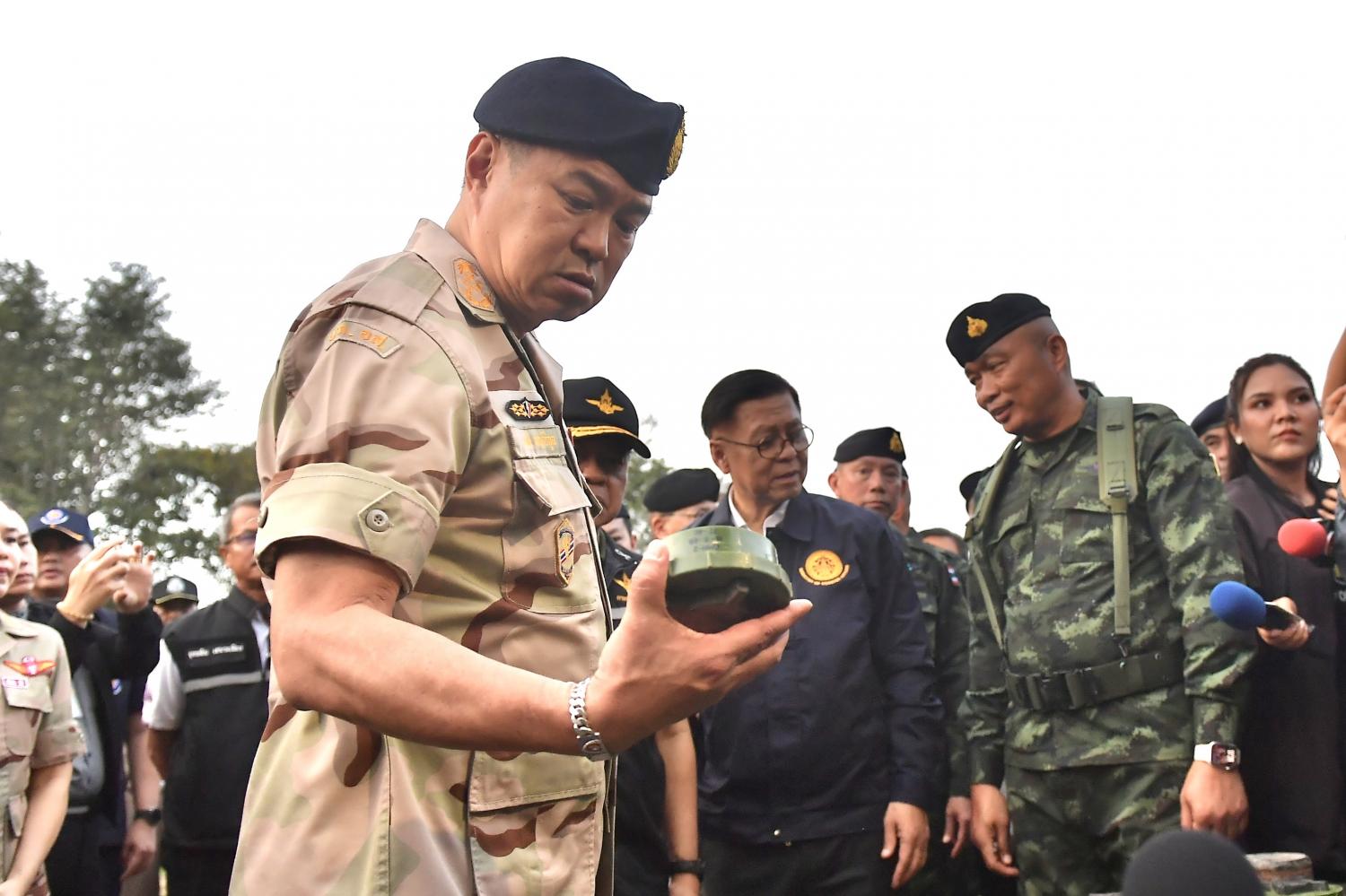
Mr Anutin inspects a recovered PMN-2 mine while receiving a briefing on border security at the 11th Infantry Battalion at Phu Makua, Kantharalak district, Si Sa Ket, earlier this month. Government House
Cars trudge through a flooded underpass on Liab Tang Rotfai Road, Bang Sue district, Bangkok following heavy rains in early November. Flooding in the capital following monsoon rains was compared with the linked nature of trade talks with the US and the border pact with Cambodia. Pattarapong Chatpattarasill
Prime Minister Anutin Charnvirakul, also leader of the Bhumjaithai Party, campaigns for BJT candidate Chintawan Taisaranakul, ahead of the Constituency 5 by-election, at Pho Krasang municipal hall in Si Sa Ket on Sept 21. Bhumjaithai Party
Prime Minister Anutin Charnvirakul, in his capacity as leader of the Bhumjaithai Party, on Sunday expressed confidence his party would gain the trust of the people in the general election expected early next year.
He is buoyed by a steady influx of political groups and influential families choosing to align with the party including Chartthaipattana Party leader Varawut Silpa-archa.
Mr Anutin said his team is accelerating preparations for the election. When asked whether his long-term ambition was to return as prime minister, Mr Anutin answered that his only goal was to earn greater public trust.
On becoming the largest party, he said Bhumjaithai would simply work hard, deliver on its promises, and let results speak for themselves.
He said every policy promised to the people will be implemented to the fullest extent, so citizens can see tangible results.
“If the public sees the party’s dedication, they will be confident and extend their trust,” Mr Anutin said.
Mr Anutin on Sunday welcomed a new wave of MPs defecting from parties in the former coalition government including the Pheu Thai Party, now in the opposition.
Bhumjaithai convened a special meeting at its Bangkok headquarters to establish a new MP candidate recruitment committee.
The event drew several veteran politicians who confirmed their move to the ruling party.
Among them were a group aligned with Chartthaipattana Party leader Varawut Silpa-archa and another headed by Sontaya Kunplome.
Speaking at Bhumjaithai headquarters, Mr Varawut told reporters that Chartthaipattana remains active and its status will become clearer once the election timetable is set.
For now, he said, the group continues to work for people in Nakhon Pathom and Suphan Buri, but cooperation with a larger party would strengthen its ability to deliver results.
When asked whether multiple factions could undermine the party unity, Mr Anutin said: “There are no factions. There is only one team — ‘Team Nu’. Everyone calls me brother. We talk every night.” Nu is Mr Anutin’s nickname in Thai.
He also confirmed the party has not yet discussed prime ministerial candidates for the next election, though Commerce Minister Suphajee Suthumpun has begun preliminary talks with the party.
“We must not be complacent. We must keep improving,” he said
Meanwhile, the People’s Party on Sunday unveiled three prime ministerial candidates of its own, signalling its readiness to compete at the national level.
Party leader Natthaphong Ruengpanyawut, a party-list MP, formally introduced the candidates during a press briefing.
The list consisted of Mr Natthaphong, Sirikanya Tansakul, party-list MP and deputy leader in charge of policy, and Weerayut Kanchuchat, deputy leader in charge of strategy.
Songkhla residents park their cars on a bridge as flood levels continue to recede in Hat Yai municipality. However, the area around Kim Yong Market remained waist-deep on Sunday. Songkhla Public Relations Office
Security forces and emergency crews have been instructed to mobilise all resources at hand to save Hat Yai, as severe flooding inundated large parts of the city.
Military units, along with disaster relief agencies and local authorities, are working around the clock to rescue residents who are trapped in their homes as floodwaters continue to rise across parts of the southern province of Songkhla.
Soldiers with the Fourth Army Region were instructed to help evacuate patients from hospitals in flood-hit areas on Sunday, in addition to delivering essential supplies to stranded residents.
Mobile medical units have also been set up at flood shelters to provide first aid and support vulnerable individuals.
Police, meanwhile, were ordered to patrol flood-hit communities throughout the day to prevent theft of properties, while traffic police put up warning signs to prevent motorists from getting stranded in flooded areas.
Rapid-response teams are also on standby to assist residents and support flood relief efforts, local authorities said.
Prime Minister Anutin Charnvirakul on Sunday visited Hat Yai to inspect the situation.
At the airport, he spoke to stranded passengers, including foreign tourists, before he received a briefing on relief operations.
He then boarded a truck to visit flood victims at a temporary shelter.
As of Sunday, 10 districts in Songkhla have been declared disaster-hit areas, with authorities in Hat Yai saying the situation in the economic hub of the southern region remains “critical”.
In the city, many streets in the main commercial area were submerged.
That said, water levels in some areas have begun to recede, allowing many stranded tourists from Malaysia to leave their hotels for the land border checkpoint, a hotel operator on Nipat Uthit 2 Road said.
Songkhla governor Rattasart Chidchoo said the floods, which began on Nov 19, have affected more than 465,000 people across 16 districts — most of whom, about 243,000, live in Hat Yai district. In Ranot district, strong winds have damaged more than 700 households. No casualties have been reported.
Local authorities have been instructed to maintain 24-hour communication lines and respond immediately to emergency calls.
Mr Anutin said post-flood rehabilitation will begin as soon as conditions allow.
Outside the city, floodwaters from Sadao district overflowed into communities along the U-Tapao canal, submerging Thung Lung intersection.
Sections of the Pak Thong–Khuan Chong Road were cut off by runoff from Na Mom district, forcing many motorists to abandon their vehicles.
The local meteorological office said more intense showers can be expected across the lower South, including Songkhla, until Wednesday due to a strong monsoon trough over the Gulf of Thailand.
Farmers harvest rice using a combine harvester in Nonthaburi. Pattarapong Chatpattarasill
China’s plan to buy 500,000 tonnes of Thai rice is expected to give a timely boost to exports at a time when the United States is applying tariff pressure across the region, says political economist Somjai Phagaphasvivat.
He said the rice deal with Beijing brings mutual benefits because countries in the region are under pressure from the US tariff measures and are seeking to diversify their markets.
Thailand’s growth is likely to reach only 1.2% in the third quarter, down from 3.2% in the first quarter and 2.8% in the second quarter, he said, adding that without new measures the final quarter is predicted to fall to 0.6%.
China’s rice purchase suits the needs of both countries, and together with Singapore preparing to buy another 100,000 tonnes of rice and food products, the government is confident Thailand can reach its rice export target of 7.5 million tonnes this year and possibly 8 million next year, he said.
“It’s a timely boost. Buying 500,000 tonnes is already a lift and if the payment is accelerated, the money can help this quarter and spill over into early next year,” he said.
The government says the rice purchase deal is likely to be signed next month when Chinese Premier Li Qiang visits Thailand for the Mekong‑Lancang summit in Bangkok.
Somjai: Deal blunts US tariff impact
Despite the rice deal, Mr Somjai said that Thailand has been cautious, maintaining a balance between the two superpowers.
Thailand holds joint military exercises with both the United States and China. But in trade and tourism, most countries in the region rely heavily on China because of US tariff pressure, he said.
Global trade rules have apparently weakened following US tariff policies, leaving smaller economies such as Thailand at a disadvantage, as the US exercises its “hard power”.
China, likewise, has responded to Japan with economic pressure after a recent political spat. It took offence at comments by Japan’s new PM regarding Japan’s stance on the need to protect Taiwan, which China covets as its own.
“We must engage both sides, maintain balance and diversify trade and investment especially among the Global South. A united Asean with a real single market would help enormously,” he said.
The rice deal and other economic measures, including the Khon La Khrueng Plus co-payment scheme, have improved public perceptions of the government, he said.
These measures show the government understands people’s problems, adding the co-payment programme also helps small shops upgrade their skills in marketing, cost control and digital technology.
Pramote: Demand for rice ‘strong’
Farmers upbeat
The rice deal has been welcomed by farmers groups who are hoping for a quick transaction so the revenue can flow into the rural economy.
Pramote Charoensilp, president of the Thai Agriculturist Association, said Thailand has yet to export around 280,000 tonnes to China overhanging from earlier agreements and it remains unclear whether the new order includes previous quota.
“But the fact that rice purchase was agreed during His Majesty the King’s visit is delightful and farmers are overwhelmed. I think the rice purchase will actually happen,” he said.
Mr Pramote said an order of 500,000 tonnes of rice from China is not huge relative to the country’s supply, but still meaningful. The Commerce Ministry has also secured interest from other countries, including an order of more than 100,000 tonnes from Singapore.
White rice is selling for just 4,000–5,000 baht per tonne while jasmine rice prices are strong at around 14 baht per kilogramme, he said, adding it is unclear what varieties China will buy.
“It is a good opportunity. China may buy more in the future. But the price of white rice will not rise much because most stocks are already with mills and traders, not farmers,” he said.
Mr Pramote said he is not concerned that the US may react negatively and reduce imports of Thai products.
“Thai jasmine rice is cheaper than Indian and Vietnamese rice, but better in quality. Demand remains strong,” he said.
Wittayakorn: Localprices have gone up
Prices improving
The ministry’s Department of Internal Trade (DIT) says domestic rice prices have increased sharply following measures approved by the National Rice Policy and Management Committee (NRPMC).
The measures include storage support schemes, delayed-sale programmes and expanded provincial paddy markets to absorb supply and stabilise the market.
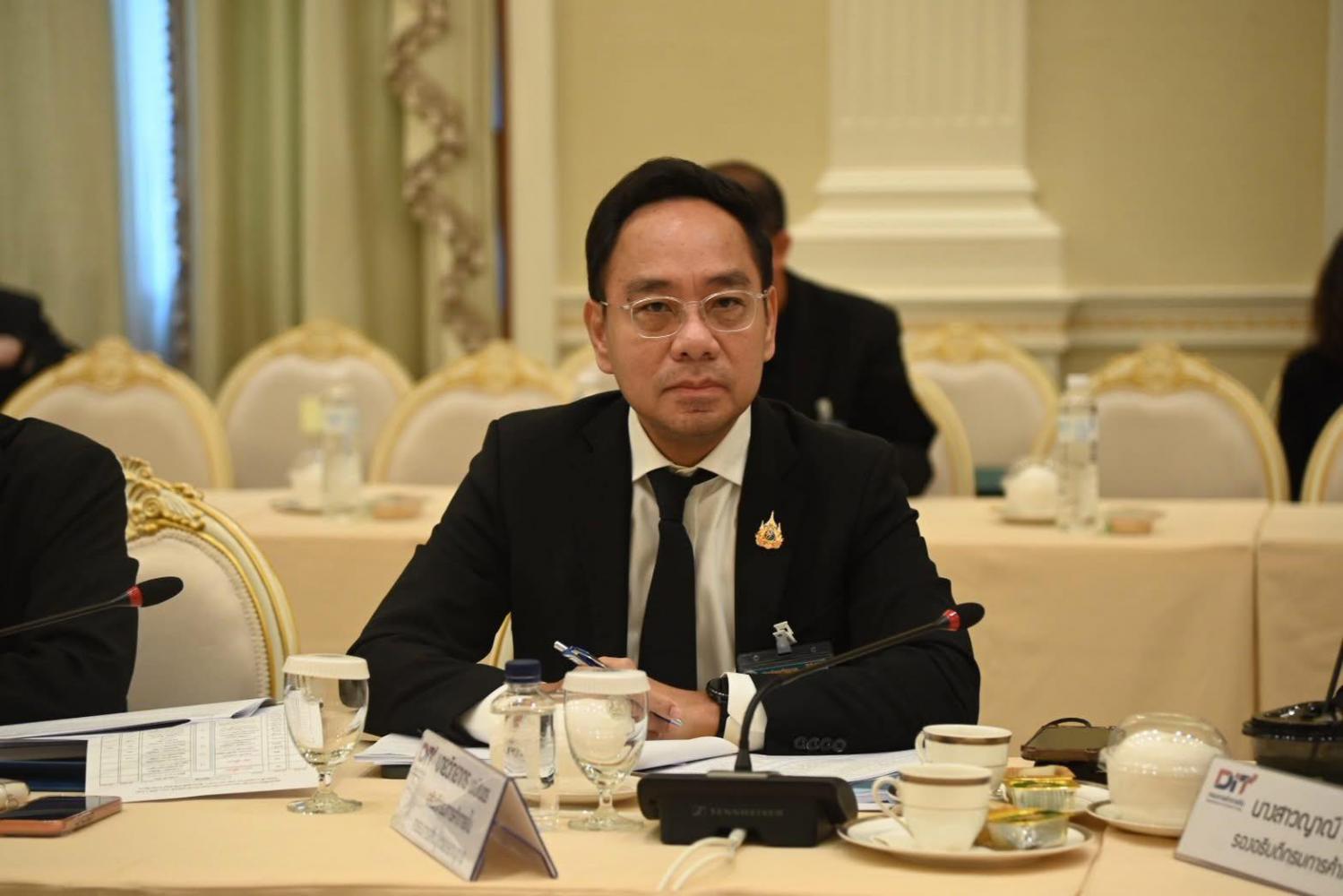
Wittayakorn Maneenetr, director-general of the DIT, said jasmine paddy prices have climbed to 14,700–16,100 baht per tonne, up by 1,000 baht, while white rice paddy is up by as much as 400 baht per tonne.
He said the ministry has organised provincial rice-market events since Nov 10 and the events will continue until April next year covering 32 provinces in the North, Northeast and Central Plains.
These rice market fairs have become a key mechanism to draw buyers from outside provinces directly into farming areas, he said. The events reduce transport burdens, create new sales channels and solve long-standing problems in districts where farmers previously had no buyers.
….says Tinubu should resign if he can’t provide security
The Peoples Democratic Party (PDP) has kicked against plans by the Federal Government to shut …
….says Tinubu should resign if he can’t provide security
The Peoples Democratic Party (PDP) has kicked against plans by the Federal Government to shut down schools over rising terrorist attacks and kidnappings.
Ini Ememobong, National Publicity Secretary of the party, on Sunday also called on President Bola Tinubu to resign if his administration cannot tackle insecurity.
The main opposition party reminded the All Progressives Congress (APC) administration that the protection of lives and property remains the primary responsibility of any government.
The reaction follows reports that the Federal Government has directed heads of the 41 unity colleges to shut down, in a bid to forestall further abductions of schoolchildren.
However, the PDP said: “At any time government is unwilling, unable, or incapable of executing this primary role, such a government must either ask for help (locally or internationally) or honourably resign, if it is sincere and responsible.”
The party noted that the country had witnessed a spate of kidnappings in different states — including the abduction of 25 students in Kebbi and 315 students and staff in Niger — which left families and communities in deep sorrow, fear, and anguish.
Related News
In response, different state governments in the affected regions adopted varying measures, including the closure of schools.
The PDP stated that contemplating the closure of the 41 federal government colleges amounts to surrendering to terrorists whose aim is to discourage children from pursuing formal education.
“We warn that this closure, if undertaken, like many of this administration’s quick-fix approaches to serious governance issues, will amount to a complete surrender to terrorists, whose sole aim is to shut down schools and prevent children from obtaining formal education, which they declare forbidden. If the schools are closed, the goal of the terrorists would have been inadvertently achieved,” the party said.
The PDP called on the Federal Government to develop a comprehensive security strategy instead of resorting to the simplistic approach of shutting down schools to prevent further kidnappings and score political points.
“This alarm is crucial because, a closure of schools will certainly exacerbate the already challenging educational situation in Northern Nigeria, where, according to UNICEF, the majority of the 18.3 million out-of-school children (10.2 million at the primary level and 8.1 million at the secondary level) in Nigeria reside.
“This data not only paints a grim picture but also mirrors the exact situation in Nigeria. The series of attacks and kidnappings in different states within a week, is indicative of the alarming insecurity that has become the contemporary lived experience and new reality of Nigerians under the APC-led Bola Tinubu government.
“We charge the federal government to immediately fund and implement the National Policy on Safety, Security and Violence-Free Schools anchored on community intelligence and quick security response, capable of anticipating and contending with attacks on schools. Insecurity in schools will be a big disincentivisation for education in the country, especially in Northern Nigeria,” he added.
The Department of Special Investigation (DSI) has launched a full-scale probe into the expanding scandal involving Chinese inmates who received VIP treatment inside Bangkok Remand Prison.
The case, initially referred by Justice Minister Pol Lt Gen Rutthapon Naowarat, centres on reports that Chinese prisoners were granted illicit privileges, including allegations that Chinese models were secretly brought into the prison for sexual encounters.
Under directives from DSI director-general Pol Maj Yutthana Praedam, the Security Crime Division has been assigned to investigate the network responsible for procuring women and determine what offences may apply.
The DSI chief on Sunday outlined the agency’s priorities: establishing the full facts, identifying officials who facilitated or enabled the misconduct, and tracing any influential figures operating behind the scenes.
Investigators will also examine whether the foreign inmates who paid for such services have links to transnational criminal groups, particularly in light of suspicious activity including large financial flows connected to the case.
A committee is reviewing the Corrections Act after prohibited items were found inside Bangkok Remand Prison under the supervision of former chief warden Manop Chomchuen, who has since been transferred to an inactive post pending further investigation into what officials admit is an unusual case.
The Immigration Bureau has been asked to examine Mr Manop’s travel records as part of the probe.
The Department of Corrections (DoC), led by deputy director-general Yutthana Nakrueangsri, has deployed reinforced teams to regulate the prison and remove banned items including knives, cigarettes, electronic devices, mobile phones, refrigerators, microwaves, and portable air conditioners.
On Nov 16, special operations teams conducted a series of surprise raids at the Bangkok Remand Prison, located in Lat Yao of Chatuchak district, without the participation of regular prison staff. Another raid followed on Nov 20.
According to a reporter close to the case, CCTV footage is now being reviewed for evidence.
Zones 2, 4, and 8, where many Chinese inmates are housed, are under close scrutiny, particularly Zone 8, which contains more than 900 prisoners and is adjacent to a disused carpentry workshop believed to have served as a potential meeting area.
The reporter also said the two Chinese inmates found with women in a concealed room have been transferred to the high-security Khao Bin Central Prison in Ratchaburi.
Pope Leo XVI has called for the immediate release of priests, students and other victims abducted in Nigeria and Cameroon amid a surge of kidnappings i…
Pope Leo XVI has called for the immediate release of priests, students and other victims abducted in Nigeria and Cameroon amid a surge of kidnappings in both countries.
In a message on X (formerly Twitter) on Sunday, the pontiff described the situation as “a source of great pain,” particularly for the young men and women taken and the families enduring the distress of their abduction.
“I was deeply saddened to learn of the kidnapping of priests, faithful, and students in Nigeria and Cameroon. I feel great pain, above all for the many young men and women who have been abducted and for their distressed families,” he said.
He urged authorities to take timely and effective action to secure the safe release of all hostages and to restore safety and hope in the affected communities.
“Let us #PrayTogether for these brothers and sisters of ours, and that churches and schools may always and everywhere remain places of safety and hope,” the pope added.
The appeal comes amid a series of attacks in Nigeria’s north-west and north-central regions, including the recent abduction of over 300 students from St. Mary’s Private Catholic School in Papiri, Niger State, as well as incidents in Cameroon targeting schools and clergy.