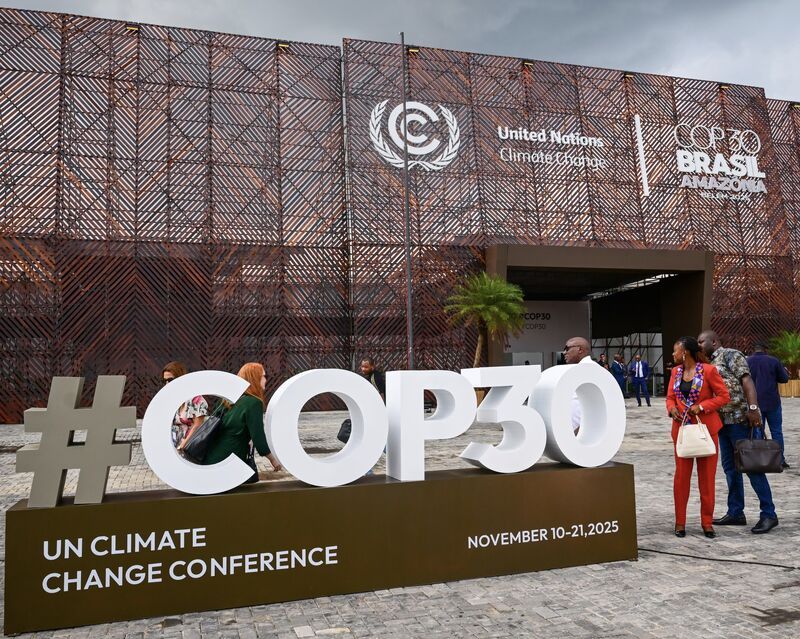
The UN climate conference COP30 wrapped up in Brazil on Saturday
without securing a firm commitment to phase out fossil fuels, a
failure that immediately sparked public protest from dozens of
countries, who warned that the summit’s final draft undermines
global efforts to keep warming to 1.5°C (2.7°F).
The draft outcome, put forward by Brazil as conference
president, avoided any explicit reference to phasing out oil, gas
or coal, following strong pushback from major fossil-fuel producers
and several emerging economies, according to Anadolu Agency.
Instead, it calls only for countries to step up climate action on a
“voluntary” basis.
The omission triggered a dispute on the floor during the final
plenary. COP30 President Andre Correa do Lago briefly halted the
session after delegates from the EU, Colombia, Panama and
Switzerland protested openly and raised their flags to signal their
objection to the text.
When proceedings resumed, he confirmed that the outcome
documents had been approved despite the protests and concerns that
delegations had not been given the chance to voice their positions
publicly.
“I’m sorry. I didn’t see the flags,” do Lago said.
More than 80 countries — including Colombia, France and Spain —
had spent the past two weeks pushing for a clear and explicit
roadmap to end fossil-fuel use.
Colombia was among the strongest critics. Environment Minister
Irene Vélez said the summit had failed its central purpose.
“Colombia will not endorse a text that denies science, blocks
the 1.5°C goal, and turns its back on people and life,” she
said.
President Gustavo Petro echoed that sentiment, writing on social
media that he rejected the final document.
“I cannot accept that the COP30 declaration does not clearly
state — as science does — that fossil fuels used by capital are the
cause of the climate crisis,” he said.
European Commissioner for Climate Action Wopke Hoekstra also
voiced disappointment, saying the EU had hoped for more ambition
but would nevertheless “support” the agreed text.
Despite the backlash, Brazilian President Luiz Inácio Lula da
Silva declared the conference a success, insisting “science
prevailed, multilateralism won.” Brazil said it would continue
working within the voluntary framework until COP31, when Türkiye
assumes the presidency.
The summit was also marked by the absence of the world’s largest
oil producer, the United States, which did not attend the gathering
in Belém.