BLANTYRE-(MaraviPost)-The Malawi Congress Party (MCP) has released a statement announcing that outgoing President Dr. Lazarus McCarthy Chakwera has peacefully transferred power to President-Elect Professor Arthur Peter Mutharika.
Signed by the party’s Publicity Secretary, Dr. Jessie Kabwila, the statement celebrates Dr. Chakwera’s statesmanship and his continued dedication to peace, democracy, and national unity.
Dr. Chakwera, according to the statement, has extended his warmest congratulations to Professor Mutharika following his victory in the just-concluded elections.
He has also wished the incoming President and his team success and divine guidance as they assume the responsibility of steering Malawi toward progress and prosperity.
The party highlighted that Dr. Chakwera had initially planned to attend the inauguration ceremony at Kamuzu Stadium to personally hand over power, in line with democratic tradition.
MCP Press Statement on power handover
However, a revised program released by the event organizers did not include him in the official proceedings.
The MCP emphasized that President Chakwera fully respects this decision, viewing it as part of the smooth transition process that Malawi must uphold to strengthen its democracy.
In the statement, the MCP reiterated that despite his absence from the ceremony, Dr. Chakwera remains committed to ensuring a peaceful handover of authority.
From his base, the outgoing leader symbolically transferred the instruments of power to President-Elect Mutharika, marking the official end of his administration.
Dr. Chakwera expressed hope that Professor Mutharika’s leadership will address the nation’s challenges and foster inclusive development.
He also urged Malawians to remain united, peaceful, and optimistic about the country’s future under new leadership.
The MCP’s message concluded by reaffirming the party’s belief in democratic governance and its support for national reconciliation and cooperation across political lines.
Dr. Chakwera’s graceful exit, the statement notes, reflects his enduring respect for the rule of law and his desire to see Malawi rise as a stronger and more united nation.
BLANTYRE-(MaraviPost)-President Professor Arthur Peter Mutharika has officially taken his oath of office as the seventh President of the Republic of Malawi.
The swearing-in ceremony took place at the Kamuzu Stadium in Blantyre before a packed audience of thousands of Malawians, foreign dignitaries, and invited guests.
Chief Justice Rizine Mzikamanda presided over the ceremony, administering the oaths of office to both Professor Mutharika and Vice President Justice Dr. Jane Ansah.
The event marked a historic moment in Malawi’s democratic journey, symbolizing a peaceful transition of power following the September 16 elections.
The atmosphere at the stadium was charged with excitement and pride as supporters of the Democratic Progressive Party (DPP) filled the stands, waving flags and singing patriotic songs.
Traditional dancers, musicians, and youth groups added colour and rhythm to the occasion, transforming the venue into a scene of national celebration.
In his inaugural address, President Mutharika expressed gratitude to the people of Malawi for entrusting him with another opportunity to lead the nation.
He reaffirmed his commitment to rebuilding the economy, restoring public confidence in government institutions, and promoting unity across political and regional divides.
President Mutharika also pledged to continue championing development projects aimed at improving infrastructure, agriculture, education, and healthcare.
He emphasized the importance of peace, hard work, and patriotism, urging Malawians to rise above division and focus on national progress.
Vice President Jane Ansah echoed the President’s sentiments, calling for renewed collaboration among all branches of government to deliver on campaign promises.
Among the notable dignitaries present were former Presidents Dr. Joyce Banda and Dr. Bakili Muluzi, as well as visiting leaders from Mozambique, Zimbabwe, and Tanzania.
Security at the event was tight, with the Malawi Defence Force conducting a ceremonial 21-gun salute and military parade in honour of the new Head of State.
As the ceremony concluded, crowds erupted in jubilation, chanting songs of victory and hope for a prosperous future under the new administration.
The inauguration not only signified a new political chapter but also reaffirmed Malawi’s reputation as a nation committed to democracy, peace, and orderly leadership transitions.
This inauguration represents more than a mere change of leadership—it symbolizes the resilience of Malawi’s democratic institutions and the enduring trust of its citizens in the power of the ballot.
It marks a renewed opportunity for the government to heal political divisions, restore confidence in governance, and focus on addressing the pressing economic challenges that confront the nation.
If President Mutharika’s administration stays true to its promises of reform, transparency, and inclusive development, this new term could set the tone for a more stable and prosperous Malawi.
We finally know how much time Diddy will spend behind bars after his transportation for prostitution convictions … and a sex worker and exotic dancer involved with the case are weighing in on the conclusion. As you know … Judge Arun Subramanian…
In the photo, which Us Weekly obtained on Friday, October 3, the former Bachelor star, 42, looked disheveled as she stood in front of a teal background.
Rycroft’s eyes are puffy in the mugshot, and her brown hair is pulled over to one side. Her face is also red.
The photo was made public after news broke that Rycroft was arrested on September 23 in Texas for a DWI. TMZ reported that Rycroft was released on bond eight hours after she posted a $1,000 bail and promised to appear in court.
Rycroft allegedly told officers at the time that a driver hit her car and fled the scene, but an eyewitness allegedly contradicted her report, according to a search warrant obtained by the outlet. The eyewitness alleged that Rycroft’s car was the only one involved in the incident.
Tarrant County police, meanwhile, claimed that Rycroft had “bloodshot eyes” and “slurred speech” while she stood next to an off-duty firefighter on the scene.
South Lake Police Department
“I want to remind the public of the fundamental principle of our justice system … every individual is presumed innocent until proven guilty,” Rycroft’s attorney, Bret Martin, told TMZ in a statement on Friday. “We, as a society, have gotten completely away from this fundamental concept. My client was arrested on the allegation of Driving While Intoxicated. An arrest is no indication of guilt.”
The statement continued, “It is imperative that we closely examine the circumstances of this case — including the conduct of law enforcement, the toxicology results, and the facts surrounding her arrest — before any conclusions are drawn. We respectfully request that the media and the public allow the legal process to unfold, and withhold any judgment whatsoever until all of the evidence has been properly analyzed and presented in a court of law.”
Rycroft has not publicly addressed her arrest. Us Weekly has reached out for comment.
Rycroft’s trouble with the law comes more than 15 years after she rose to fame on season 13 of The Bachelor, which aired in 2009. Rycroft won the season, winning Jason Mesnick’s final rose, but he later dumped her for runner-up Molly Mesnick. (Jason, 49, and Molly, 41, have been married since 2010.)
Following her split from Jason, Rycroft found love with former boyfriend Tye Strickland, whom she wed in December 2009. The pair went on to welcome three children, daughter Ava, 14, and sons Beckett, 11, and Cayson, 9.
“The problem is, we’re so far out of the newborn stage now,” she told Us when asked whether they wanted to expand their brood. “My youngest is four, and he’s the oldest baby that I’ve ever had in the house. I’m like, I don’t know if I could go back to the sleepless nights and the bassinet and the baby carrier.”
Rycroft added: “It’s kind of gotten to a point where they’re all kind of self-sufficient. They can play in the playroom, and I’m not worried about somebody dying. You know, life is good. … I put a decade of my life into that period. And now I’ve earned the reward.”
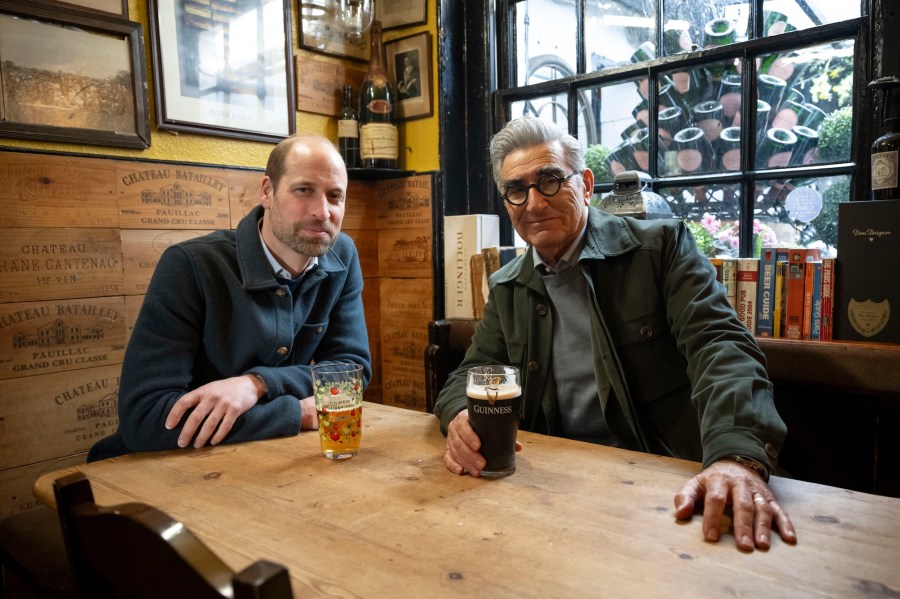
Levy, 78, revealed whether he was allowed to ask William, 43, about any topic while filming the Apple TV+ series, telling ITV News there weren’t any rules.
“Were you ever told you couldn’t ask questions, for example, about Harry and Meghan [Markle]? Did you find that was just something you didn’t want to go near?” the reporter asked Levy in an interview that aired on Thursday, October 2.
Levy shared, “I was not told I couldn’t ask anything, but it wasn’t really, you know, up to me, to get into that.”
The actor, who has been hosting the travel series for three seasons, confessed, “I had no interest in asking him about that, because it was, you know, [a] very delicate issue and certainly not up to me to get into it.”
Levy explained, “I think there were other things, you know, I could lead the conversation to that might be interesting for him and interesting for the world to hear, but that was something I wasn’t necessarily interested in getting into.”
Apple TV+
William and Harry, 41, have been estranged for years, which reached a fever pitch in 2020 when Harry and his wife, Meghan, 44, stepped back from their senior royal duties. Once the couple relocated from the U.K. to the U.S. that same year, the physical and emotional distance between the two siblings became even more clear.
In January 2023, Harry detailed some of his troubles with William in his tell-all memoir, Spare, including an alleged physical fight that transpired between the brothers over Meghan.
In the book, Harry claimed that William called Meghan “difficult” and “rude” while at his home in 2019, which led to an altercation. Despite their estrangement, Harry told ITV at the time that he would “like to have my brother back” amid their family feud.
While Harry has reunited with his father, King Charles III, over the past few years during visits to England — even though they too have been at odds for years — his relationship with William hasn’t seemed to warm up.
“I think that Harry’s relationship with his brother is a different beast than his relationship with his father,” royal expert Kristen Meinzerexclusively told Us Weekly in August. “But perhaps if Charles warms more to Harry, William will feel compelled to follow his lead.”
Apple TV+
A source, however, told Us at the time that “William doesn’t talk about Harry anymore” and he is reportedly “done” with his brother.
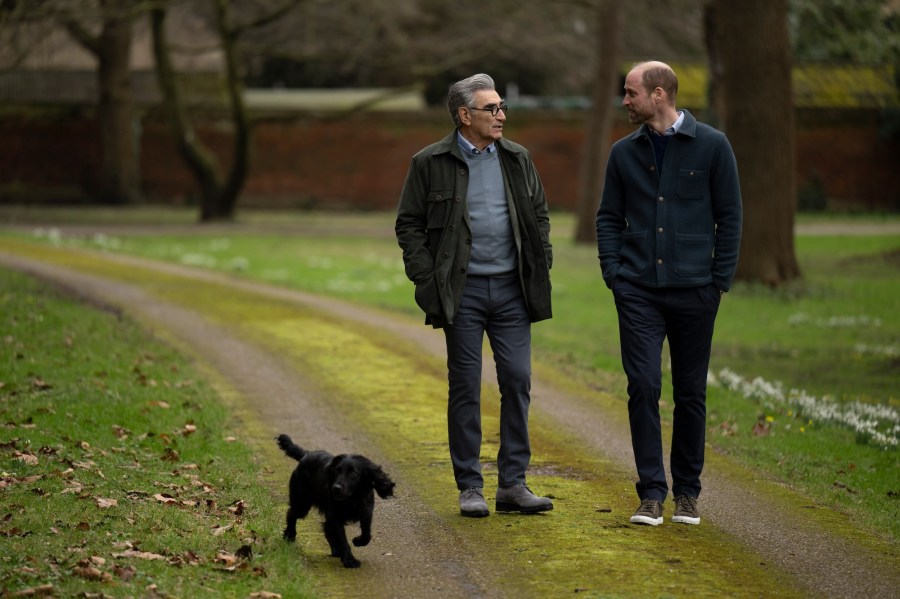
During William’s chat with Levy during The Reluctant Traveler, in which the two shared a pint and toured Windsor Castle, William did reference his younger brother. He also briefly talked about family in general.
“I hope we don’t go back to some of the practices in the past that Harry and I had to grow up in,” William told the Schitt’s Creek alum of his plan for running the kingdom after his father. “I will do everything that I can to make sure that we don’t regress in that situation. I think it’s safe to say that change is on my agenda. Change for good.”
Elsewhere in the episode, William confessed, “I think stuff to do with family overwhelms me quite a bit. Worry or stress around [the] family side of things does overwhelm me quite a bit. But, in terms of doing the job and things of that type, I don’t feel too overwhelmed by that. Not now, anyway.”
The Reluctant Traveler is now streaming on Apple TV+.
Sean “Diddy” Combs is speaking at length for the first time in his criminal case, addressing the court at his sentencing hearing … and he’s apologizing to his ex, Cassie Ventura. Diddy says … “I want to personally apologize again to Cassie…
In a drama unworthy of a statesman, Lazarus Chakwera has pulled a last-minute vanishing act from the swearing-in and inauguration ceremony of President-elect Professor Arthur Peter Mutharika at Kamuzu Stadium today.
What was initially billed as a dignified moment of political transition has been marred by the outgoing president’s eleventh-hour withdrawal—an act that speaks volumes about his character and the sorry state of his leadership.
The hard truth is that Malawians decisively voted Lazarus Chakwera out because he failed them miserably. His administration was a disaster wrapped in empty promises.
Lazarus Chakwera attends Eid al-Fitr Prayers at Mchoka Primary School Ground
Instead of delivering prosperity, the Chakwera government presided over an uncontrolled surge in the prices of basic goods and commodities, making daily life a bitter struggle for ordinary Malawians.
The inflationary tide rose unchecked, battering the pockets of a people already stretched thin. The electorate’s verdict was clear: enough was enough.
But the story does not end with electoral defeat. The hard truth is that since his loss, whispers have turned into a roar about massive looting and corruption within the State House, perpetrated by “Chakwera boys.” Reports have surfaced alleging that government vehicles have had their number plates swapped and sold across the border in Zambia, a brazen affront to national dignity and a clear indication of the rot that infested his government’s inner circles.
This scandalous theft has only deepened the public’s fury and sense of betrayal.
Barely two days before the inauguration, Chakwera’s administration failed spectacularly to rein in the skyrocketing fuel prices—a critical economic indicator that impacts every Malawian’s daily life.
This failure was no accident; it was symptomatic of a government that had lost control and the trust of its people. The fuel price hike was the last straw in a series of economic missteps.
Adding insult to injury, on Friday, Illovo Sugar announced price increases on sugar, while TNM Malawi followed suit with adjustments on their products.
These price hikes under the outgoing Chakwera government have made an already tough life even harder for the average Malawian.
It is not just bad governance; it is a slap in the face to a population that entrusted him with their hopes and futures.
The hard truth is that had Chakwera dared to show up at the inauguration, he would have faced a storm of boos, jeers, and outright humiliation. The man who once commanded the stage would not have been able to contain the public’s scorn.
His withdrawal is an act of cowardice—a desperate bid to avoid the judgment he so richly deserves.
It is the act of a leader who knows his time is up and who cannot face the music of his failures.
Contrary to some reports from reputable sources like The Nation claiming that the Democratic Progressive Party (DPP) barred Chakwera’s attendance, the hard truth is that these are outright lies, fabrications designed to shift blame and stoke division.
The DPP has categorically denied such allegations and confirmed that an invitation was extended to Chakwera, to which he initially responded positively. The narrative that DPP is exclusionary or intolerant is a myth.
In fact, the DPP today is a rebranded, renewed party that embodies tolerance and inclusivity—qualities glaringly absent in the outgoing administration.
The DPP’s leadership has proven itself capable of uniting diverse voices and steering the nation towards stability and hope.
Unlike Chakwera’s fractured and self-serving regime, the DPP has demonstrated a commitment to national reconciliation and progress.
The hard truth is that Malawi needs a leadership that does not run away from accountability but embraces it with open arms.
Chakwera’s entire tenure has been a study in missed opportunities and squandered trust.
The hard truth is that he only conceded defeat after intense intervention from former presidents His Excellencies Bakili Muluzi and Joyce Banda.
Without their pressure, Chakwera might have clung to power indefinitely, disregarding the democratic will of the people.
Such reluctance to accept electoral defeat reveals a dangerous arrogance and a disregard for democracy that should alarm every Malawian.
Let us not mince words: Lazarus Chakwera’s withdrawal from the inauguration is more than a political stunt—it is a metaphorical “flight from justice.” Like a captain abandoning a sinking ship, he is leaving the country to navigate the turbulent waters of economic hardship and social unrest without his guiding hand.
But the ship he leaves behind is riddled with holes—corruption scandals, economic mismanagement, and broken promises.
The hard truth is that Chakwera’s legacy will be remembered not for visionary leadership or transformative policies but for economic turmoil, rampant inflation, and the erosion of public trust.
Malawians deserve a leader who stands firm in victory or defeat, who faces the people’s judgment with dignity, and who puts the nation’s interests above personal pride.
In stark contrast, the DPP emerges as a beacon of renewal and hope.
The party’s commitment to inclusivity and tolerance is more than rhetoric; it is demonstrated through actions and policy directions that promise to restore stability and confidence in Malawi’s governance.
This is a party ready to listen, to engage, and to build a future that honors the sacrifices and aspirations of every Malawian.
Chakwera’s departure from the inauguration ceremony is a fitting symbol of his entire presidency: a series of disappointments culminating in a cowardly retreat. The hard truth is that Malawi cannot afford to dwell on the past mistakes of a failed leader.
Instead, it must rally behind a rebranded DPP that offers a chance to heal, rebuild, and move forward.
To the outgoing president, the message is clear: you were given a mandate to serve, yet you chose to squander it.
You were offered an opportunity to lead with integrity, but you opted for self-interest and denial.
Your withdrawal from this historic occasion is not just a personal failure—it is a national embarrassment.
Malawi is watching, and history will judge you harshly. The hard truth is that the people’s verdict is final.
Now, it is time to accept it, step aside gracefully, and allow the nation to heal under new leadership that respects democracy, embraces accountability, and puts Malawians first.
Lazarus Chakwera’s eleventh-hour withdrawal from the inauguration ceremony is a cowardly act that underscores a presidency marked by failure and dishonor.
Meanwhile, the DPP stands ready as a rebranded force of tolerance, inclusiveness, and renewed hope for Malawi’s future. The choice is clear, and the people have spoken.
It is time to turn the page and write a new chapter—one of dignity, progress, and unity.
The news that President Lazarus Chakwera and outgoing Secretary to the President and Cabinet (SPC) Colleen Zamba have been barred from attending the Swearing-In and Inauguration Ceremony for President-elect Peter Mutharika is not just a political footnote—it is a deeply troubling development that undermines the very statesmanship the nation seeks to foster.
Reports indicate that elements within the inauguration organising committee, specifically those representing the Democratic Progressive Party (DPP), argue that the event “is none of their business, this is about the new government.” This stance is fundamentally flawed and dangerously shortsighted.
The transition of power is not a zero-sum game; it is a meticulously choreographed relay race where the outgoing runner, by handing over the baton, validates the process and legitimizes the incoming victor.
President Chakwera has already demonstrated exemplary democratic decorum. He conceded defeat last week and publicly committed to ensuring a smooth, peaceful, and professional transfer of power.
His planned attendance was set to be the ultimate symbolic act—the visual proof of a robust democracy where leaders respect the popular will and peacefully pass the highest office.
To reject this symbolic gesture is not an act of strength or a clean break; it is an act of political pettiness that replaces national unity with partisan squabbles.
An inauguration is not a private party for the winning party; it is a national celebration of democracy and constitutional continuity.
Every citizen, including the outgoing Head of State, has a place in witnessing and participating in this solemn transfer of authority.
Furthermore, the exclusion of SPC Colleen Zamba is counterproductive to the immediate needs of the new administration.
The SPC is the linchpin of the civil service and the administrative facilitator of the entire handover.
Barring her suggests that certain organizing committee members misunderstand the critical, apolitical role the Office of the President and Cabinet plays in ensuring the machinery of government remains operational during the shift.
Her presence would underscore the continuity of the State, regardless of who occupies the Presidency.
While the incoming administration has every right to organize the event, the focus must remain on magnanimity and healing the divisions of a hard-fought election.
The reported efforts to exclude the outgoing leadership send a chilling message that the new government prioritizes settling political scores over fostering reconciliation and a unified national identity.
President-elect Mutharika and the DPP must recognize that true victory is demonstrated not just at the ballot box, but in the generosity and inclusiveness of their leadership.
They should immediately overrule this reported decision, invite President Chakwera and SPC Zamba back, and allow the inauguration to be what it should be: a moment of national unity and respect for the democratic journey.
Anything less cheapens the achievement and casts an unnecessary shadow over the new government’s commitment to democratic norms.
Flames Head Coach Kalisto Pasuwa has handed FCB Nyasa Big Bullets striker Babatunde Adepoju his maiden national team call-up for the upcoming 2026 FIFA World Cup Qualifiers against Equatorial Guinea and São Tomé.
This follows the forward’s successful nationality switch which now makes him eligible to represent Malawi at international level.
Babatunde, who is the current leading scorer in the TNM Super League, is expected to inject firepower into the Flames’ attack as Malawi begins its qualification journey.
Nyasa Big Bullets striker Babatunde Adepoju in Flames Jersey
In other news the Netball Association of Malawi (NAM) has confirmed that it will conduct a bench officials training session from 7 to 9 October 2025 at the Griffin Saenda Sports Complex in Blantyre ahead of the Africa Netball Cup.
NAM General Secretary Yamikani Khungwa Kauma said the training will bring together 31 officials drawn from all regions of the country in order to strengthen bench management and align with international standards.
Malawi is set to host the Africa Netball Cup in December with nine countries competing in both men’s and women’s categories, making this edition one of the most competitive in the tournament’s history.
In the ThumbsUp SRFA Premier Division League, a total of 375 goals have been scored from 128 matches played so far. Samson Zakeyu of Ekhaya FC leads the scoring charts with 10 goals while Hermes James of The Boyz sits second on eight.
Chikondi Chulu of Ekhaya Reserve, Eric Sadia of Nyambadwe United and Ellard M’sosa of Ntopwa United follow closely with seven goals each. Several other players including Emmanuel Lifa and Stain Matengere of Mighty Wanderers Reserve, Thomson Selemani and Madalitso Hadji of Chilobwe United, as well as Gift Sato of Immigration, Corazo Zonda of Zingwangwa United, Yusuf Nantunga of Ekhaya Reserve, Diverson Daudi of FOMO Reserve and Movic Banda of FCB Nyasa Big Bullets Reserve, have all found the back of the net six times each.
Attention will also be on England this weekend as the Premier League serves up a mouthwatering line-up of fixtures on 4 and 5 October 2025. Leeds United will host Tottenham Hotspur, Arsenal clash with West Ham United and Manchester United take on Sunderland.
Jude Bellingham, England player of the year
Chelsea and Liverpool face off in one of the weekend’s biggest games, while AFC Bournemouth play Fulham, Wolves meet Brighton, Newcastle United battle Nottingham Forest and Aston Villa lock horns with Burnley. Brentford are scheduled to host champions Manchester City, while Everton and Crystal Palace complete the round of fixtures.
Meanwhile, Real Madrid and England midfielder Jude Bellingham has capped off a remarkable season by being named the England Men’s Player of the Year for 2024/25, ahead of fellow nominees Declan Rice and Harry Kane.
BLANTYRE-(MaraviPost)-In what should have been a day of celebration and unity, the Democratic Progressive Party’s (DPP) recent directive banning youth cadets from painting themselves blue at the swearing-in ceremony of President-elect Professor Arthur Peter Mutharika has sparked a contentious debate.
The decision, rooted in the DPP’s desire to present itself as a rebranded entity, claims to prevent any association with the past indiscretions linked to such displays.
However, this ban has broader implications, concerning not just the DPP’s internal dynamics, but the very essence of self-expression and the cultural parallels found in other facets of life.
Painting oneself in a party’s or team’s colors is not only harmless but is a global symbol of allegiance and enthusiasm.
To start, it is essential to contextualize the act of painting oneself in political colors within a broader, societal framework.
The painting of bodies or faces to showcase allegiance is not unique to political outfits; rather, it is a tradition prevalent in various cultural and social settings worldwide.
Take, for instance, the renowned sports clubs such as Manchester United, Liverpool, or Manchester City in the world of English football. Fans proudly adorn themselves in their team colors, often painting their faces or bodies to exhibit their passionate support.
This practice is celebrated as a legitimate expression of fandom and nowhere is it deemed criminal. It brings vibrancy, excitement, and an added layer of emotional investment to their sport.
This begs the question — why then should the political equivalent be any different?
The argument posited by the DPP suggests a need to distance the party from an unruly or unseemly past.
The focus appears to be on rebranding, moving away from stereotypes associated with supporters who painted themselves with party colors. Yet, the decision to ban this practice seems to undermine an aspect of enthusiasm and culture that political events thrive on.
At political rallies, flags wave, songs are sung, and people come together to demonstrate solidarity, often showcasing colors in various forms — body paint being a common one.
It fosters a sense of community, unites supporters, and underlines devotion, traits that should be amplified in any democratic society, rather than quashed.
Let us turn our attention to what constitutes actual criminal behavior. A critical distinction must be drawn between benign expressions of support, such as body painting, and actions that are legitimately unlawful.
True misdemeanors in any organized society would include activities like the use of unregistered vehicle number plates. As noted, within certain groups, there might be a proclivity for placing unregistered number plates with illicit or unofficial insignias — now that is a legitimate concern.
Such acts transcend simple exhibitionism or artistic expression and delve into areas that compromise legal standards and public safety.
In the context of the DPP and its youthful cadets, the act of painting oneself blue is emblematic — it illustrates pride, hope, and participation. It is crucial to foster these impulses rather than suppress them, particularly when they do not infringe upon the rights or safety of others.
Suppression of such harmless expressions can also alienate younger demographics, potentially deterring future engagement in political processes — outcomes no party should desire.
Moreover, from a security standpoint, the unwarranted criminalization of painting bodies with party colors is counterproductive.
Law enforcement and party officials are better suited to focus on substantive issues, such as ensuring that the ceremony remains peaceful and that actual criminal activities — like vandalism or unauthorized vehicle modifications — are effectively monitored and controlled.
When the emphasis is misplaced onto trivial matters like body paint, it risks diluting the attention from more critical security concerns.
Furthermore, this ban on body painting can be perceived as an infringement on personal expression. Democratic societies thrive on freedom of speech and expression, principles vital for a vibrant political environment.
Any curtailment of these liberties, unless genuinely warranted by concerns of public order, risks diminishing the democratic fabric that supports freedom of expression and lively political discourse. By allowing such expressions, parties can embrace a culture of inclusivity and acceptance of diverse expressions of loyalty and belief.
It’s also important to acknowledge that political identity and its manifestations can be deeply personal.
For supporters, especially the youth who may already feel disenchanted with systemic barriers, such acts of visible support can be empowering.
Painting oneself in party colors is a physical manifestation of personal and communal identity, akin to donning a jersey to support a beloved sports team.
To ban such harmless expressions is to potentially alienate a significant group of supporters, stripping away an accessible means of participation and celebration.
While the DPP’s motivation to rebrand and distance itself from unseemly associations is understandable, banning an act as benign as painting oneself blue during political events undermines genuine expressions of support and allegiance. Such acts are not only non-criminal but are ingrained in cultural and social practices around the world.
Real criminal conduct involves actions that genuinely harm legal standards and public safety, like the use of falsified vehicle number plates.
Thus, it is imperative that the party comprehends these distinctions. Instead of creating unnecessary barriers to self-expression, efforts should be directed towards accommodating and encouraging diverse forms of enthusiasm and participation.
After all, a democracy is most robust when it embraces the full spectrum of its citizens’ voices.