Authorities trying to adjust discharge rates to reduce impact on downstream provinces

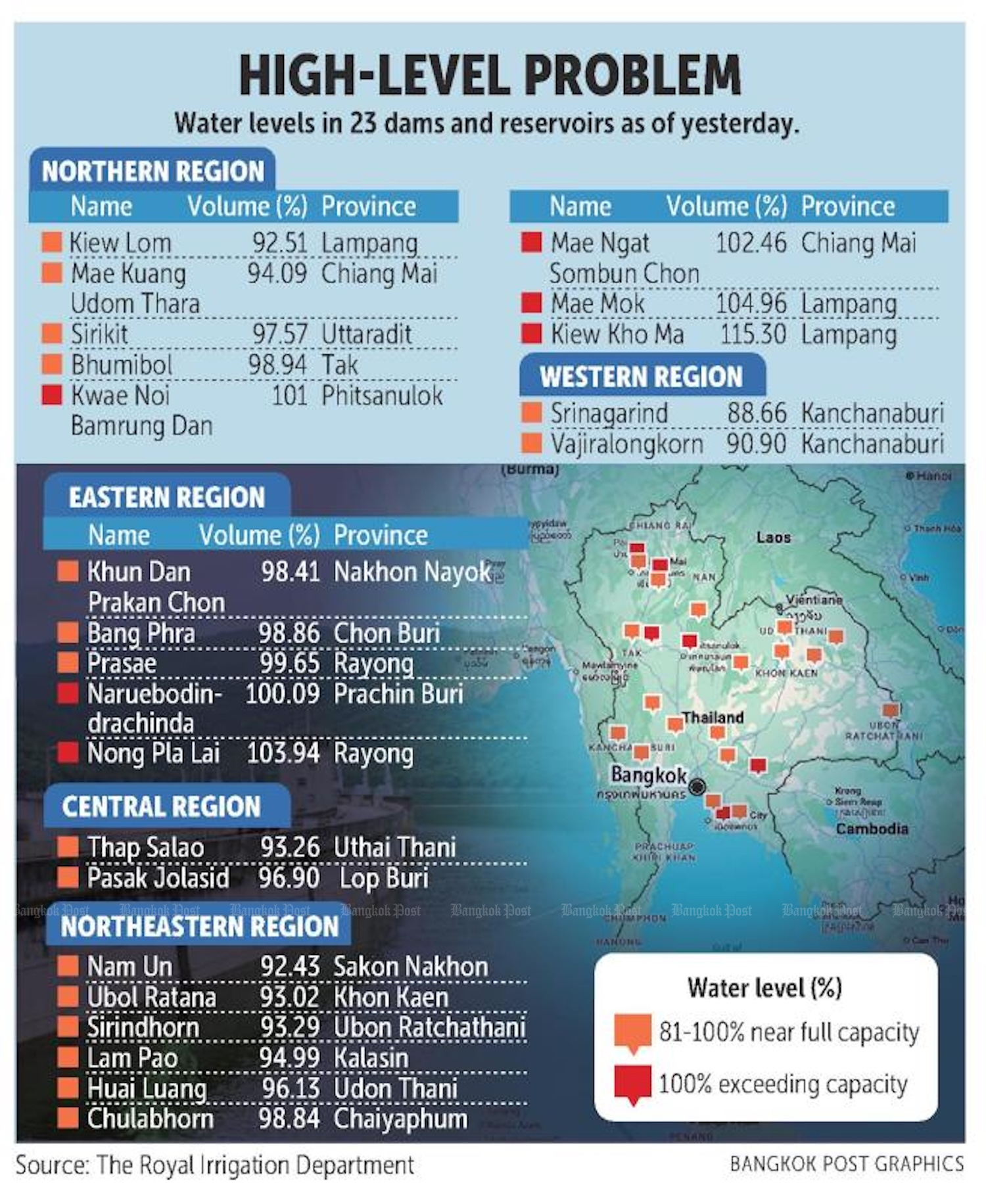
The reservoir behind the Bhumibol Dam in Tak province could reach full capacity within two days, according to PM’s Office Minister Paradorn Prissanananthakul, as concerns of flooding in various areas of Thailand grow.
The Royal Irrigation Department (RID) has been ordered to reduce the rate of discharge from the Sirikit Dam in Uttaradit, while diverting more water from the Chao Phraya River into floodplain areas on both of its banks to manage rising water levels.
Mr Paradorn said the government is closely monitoring the situation and preparing additional relief measures, including consideration of a long-term plan to elevate flood-prone homes in provinces such as Ayutthaya and Ang Thong that are repeatedly inundated.
He said the current rate of discharge from Bhumibol Dam on the Ping River, a tributary of the Chao Phraya in northern Tak province, stands at 45 to 48 million cubic metres per day, far below the estimated inflow of 90 million cubic metres.
This means the reservoir is accumulating around 40 million cu/m of water daily. With its total capacity slightly above 100 million cu/m, the dam could be full in just two days if the inflow continues at this rate.
“If we let this continue, the Bhumibol Dam will be completely full within 48 hours,” Mr Paradorn warned, adding that the department will need to lift discharge to 50–55 million cu/m per day to prevent overflow.
This increase will automatically raise the Ping and Chao Phraya river levels, he said. The department is currently releasing about 2,800 million cu/m per day, but more adjustments will be required.
To balance the system, the ministry will reduce water discharge from the Sirikit Dam in Uttaradit — where inflows are lower — by about 5 million cu/m per day or more, to limit water reaching the Chao Phraya.
The department has also agreed to raise discharge rates through western and eastern floodways from 500 cu/m per second to between 600 and 650 cu/m per second, helping stabilise river levels.
While this may cause some flooding in floodplain zones, these areas are designated as temporary water-retention zones, and water will be drained once levels subside. Mr Paradorn said public demonstrations calling for faster water release prompted the prime minister to personally oversee discussions and monitoring.
The cabinet has already approved initial compensation for affected communities, while the Disaster Prevention and Mitigation Department will propose additional relief budgets in stages for efficiency, he said.
Households that suffered during the rainy season have already received some compensation, he noted, while long-term assistance will be provided for those that have been flooded for over two months, in line with the prime minister’s directives.
When asked whether Bangkok is at risk, Mr Paradorn acknowledged that the discharges are delayed, but floodwaters could reach the capital. The government therefore plans to maximise storage in floodplains on both riverbanks to protect urban zones.
Regarding structural adaptation, Mr Paradorn confirmed that “house raising” projects are being considered for chronically flooded districts in Ayutthaya and Ang Thong.