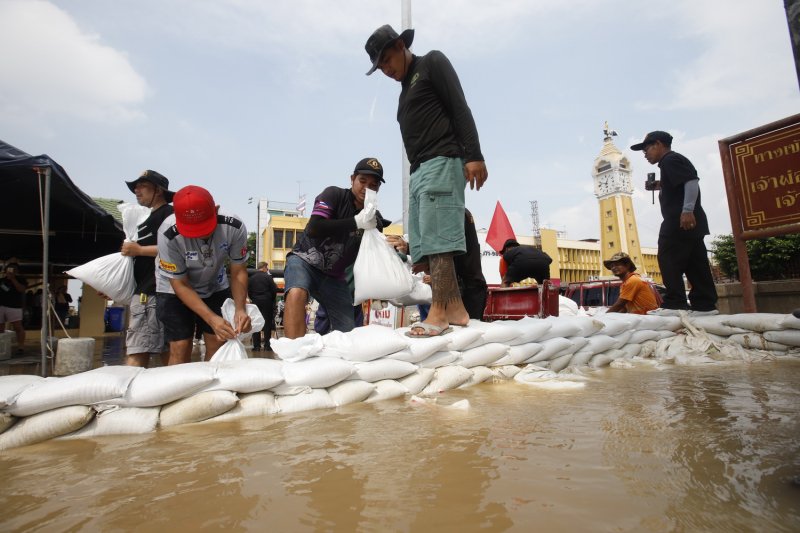
Fears of an epic flood similar to the catastrophic inundation of 2011 have returned to haunt the public once again.
The reaction is understandable. People are shocked to learn that 23 major dams and reservoirs across the country — except the South — are filled to the brim with water and, as such, might not be able to take in much more.
The revelation has also eroded public trust in the government. Back in August, the Office of the National Water Resources (ONWR) said 15 of these dams would be about 80% full by the end of the rainy season, so it advised relevant government agencies to release water to ensure the dams had enough space to store the excess.
On Sunday, the ONWR said the nation’s dams and reservoirs still had sufficient capacity to accommodate the influx of water from recent storms.
But the situation on the ground paints a totally different picture. The Bhumibol Dam, for instance, is 98.84% full, while the Sirikit Dam is about 97.57% full. The Nong Pla Lai Dam, meanwhile, is no longer able to accommodate much more water, with water levels reaching 103.94% of its total capacity.
In response, the government has ordered officials to increase the discharge rates at the Chao Phraya and Bhumibol dams to free up space for more water. As a result, many areas which lie downstream of these major dams, like Chai Nat and Uthai Thani, are now dealing with widespread flooding.
It is important to remember that many residents living in flood-catchment areas in Ayutthaya and Angthong have had to deal with constant flooding for almost four months now. The release of water from upstream reservoirs will certainly make life worse for them.
While the likelihood of this year’s floods matching the severity of the inundation in 2011 remains small — the volume of flood water is only about 35% of the volume reported in 2011 — the fact of the matter remains that even after a decade and a half, Thailand’s flood management has not improved much.
Various governments have tried to resolve the problem over the years with different approaches, for instance, by forming new agencies such as the ONWR, increasing investments in infrastructure, and implementing a new, early warning system.
But climate change is making rainfall patterns harder to predict. When coupled with land changes which have seen many flood catchment areas turned into commercial developments, the task of managing floods will only get harder as time progresses.
Furthermore, while the ONWR was formed five years ago to improve coordination, the reality is that government agencies are still working independently from one another, making flood management difficult.
Government and state bodies need to change their water management plans. Instead of focusing on rescue, relief and compensation, the ONWR must work closely with relevant agencies such as the Royal Irrigation Department to prevent and mitigate flooding.
Flood warnings must be issued earlier, so those living in high-risk areas have plenty of time to prepare and evacuate. Furthermore, the government must explain to the public why it can’t drain the water from reservoirs. Ultimately, flood management must be fair to all. The government can’t continue using some communities as flood buffer zones.
Without better coordination, flood management will never improve.