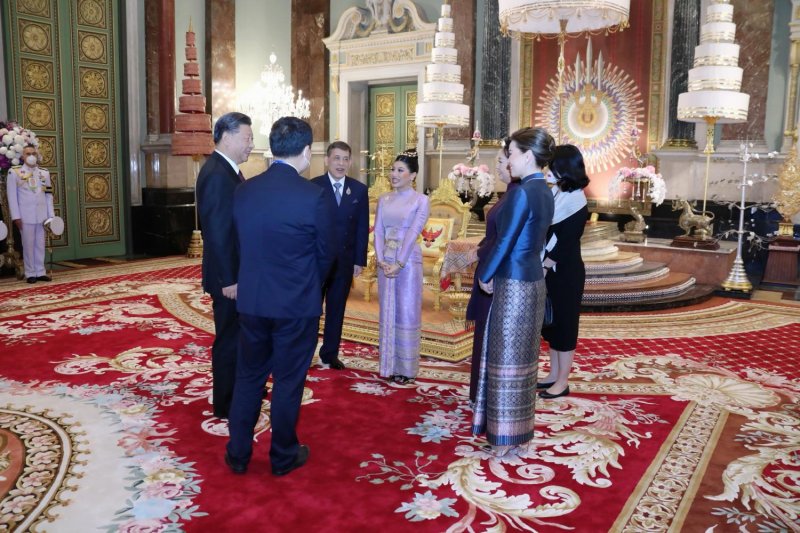
The long-awaited trip to China by His Majesty King Maha Vajiralongkorn Phra Vajiraklaochaoyuhua and Her Majesty Queen Suthida Bajrasudhabimalalakshana is now official, with the state visit scheduled from Thursday to Monday. The historic visit will be the first by a reigning Thai monarch. Both countries, which established diplomatic ties in 1975, are also commemorating the golden jubilee of their friendship.
The trip has been in the making since Chinese President Xi Jinping invited the King. The two met when Xi participated in the Apec leaders’ meeting hosted by Bangkok in November 2022.
The five-day visit comes amid the fast-shifting geopolitical landscape in the region and beyond. It is also an opportunity to redefine what the next 50 years of Thai-Chinese relations would look like. After all, China has become one of the world’s most powerful countries, meaning that Thailand must navigate a more complex world.
For the past decades, the phrase zhong–tai yi jia qin, which means China and Thailand are one family, has been the motto of the relationship. It reflects a special warmth rooted in history, culture and kinship, nurtured by economic and political pragmatism. Given the current global environment, good old sentiment alone is no longer enough. China is a growing global power. Beijing now also has economic and technological influences affecting the nature of its engagement with Thailand and the rest of Southeast Asia.
To sustain a healthy friendship into the next five decades, the relationship must become transformative and anchored in strategy, mutual respect and interest, and a deeper understanding of China’s power dynamics.
China’s rise is unstoppable. Recently, at the 80th United Nations General Assembly, Beijing declared that it would no longer take up trade benefits as a developing country under the World Trade Organization (WTO). In effect, this means that China considers itself a developed country. This is a structural change and the new reality of China, which Thailand has to embrace.
Beijing is no longer a developing power seeking friends. Rather, it is a global actor shaping the rules of trade, technology, and security. Its regional influence is extensive, ranging from the Belt and Road Initiative to cross-border digital infrastructure and green technology. From Thailand’s vantage point, this presents both unprecedented opportunities and important challenges.
Historically, Thai diplomacy has been all about balancing relationships with major powers. During the Cold War, Bangkok was a key US ally while managing pragmatic ties with China. This balancing act preserved national autonomy and benefited the country’s security and economy. But the present US-China rivalry has become more volatile and has intertwined regional politics in all dimensions. It is unavoidable that Thailand must now craft a strategy without swaying towards either camp.
The royal visit to China will thus carry hefty strategic weight. Doubtless, it will reaffirm their historical friendship and adaptive ability to new realities. The next 50 years of Thai–Chinese cooperation must be built around concrete, forward-looking agendas that respond to shared futures and challenges where national security and economic transformation intersect.
At the top of the agenda today are transnational crime and cybersecurity cooperation. The proliferation of online scams, digital fraud networks, and cross-border criminal syndicates operating along the Thai–Myanmar, Thai–Cambodian and Thai–Lao borders have become a major security concern. Many of these criminal groups adeptly use technology and cross-border platforms and existing loopholes, often targeting Thai, Chinese and other global citizens.
It is imperative that the two governments strengthen and institutionalise cooperation between their law enforcement agencies, intelligence networks, and cybersecurity regulators. Both countries have been cooperating on these operations over the past years. Given the present mammoth scale of transnational cybercrime, deeper cooperation and mutual trust are pivotal to setting up mechanisms for data-sharing and frameworks for digital surveillance. These are new areas of security cooperation that will increasingly define Thai-Chinese relations in the new era.
Furthermore, the digital economy and green transition offer fertile ground for collaboration. As both nations invest in next-generation industries, Thailand can leverage China’s technological edge in artificial intelligence, e-commerce, and digital finance.
At the same time, such cooperation must enhance national capacity rather than dependency. Likewise, the electric vehicle (EV) industry, which has already expanded rapidly in Thailand with Chinese investment, should be guided by long-term sustainability goals, local content development, and environmental safeguards.
Both sides could also jointly explore green financing, battery recycling technology, and carbon-reduction mechanisms that align with Asean’s broader sustainability agenda.
Finally, the evolving strategic environment demands that Thailand engage China with open eyes and pragmatic restraint. China’s growing core interests in the South China Sea, Mekong Basin, and global governance institutions indicate that its regional influence continues to expand.
Under the Anutin government, Thai foreign policy is in high gear, especially in its engagement with Beijing. Thailand has also increased its engagement with friends and allies, especially China and the US. To keep ties with Beijing and Washington in balance and beneficial to Thailand, Bangkok needs diplomatic finesse to adapt to meet the future digital and geopolitical challenges.
Furthermore, Thai policymakers must invest in China-related literacy. They must better grasp how Beijing shapes its interests, exerts influence, and negotiates results. Most importantly, they must understand how China has been fighting to preserve its national interest and global narratives.
Future Thai leaders must speak the language of friendship as well as think in terms of strategic interdependence. Comprehending China’s decision-making process is a must. It will help the country to appreciate the Middle Kingdom’s economic statecraft and long-term policies to preserve equilibrium and avoid missteps.
As China rapidly becomes the world’s most powerful country, Thailand’s approach must have strategic clarity.
While nostalgia remains pivotal, the next phase of Thai–Chinese relations should be defined by cooperation in areas that safeguard national interests and address global challenges, especially those related to cyber threats and transnational crime, clean energy and digital innovation.
The current 50th anniversary of diplomatic ties is therefore the beginning of the second golden jubilee — an opportunity to renew their friendship with vision and pragmatism. Together, they can elevate their strategic partnership toward a shared future and shared prosperity, grounded in a clear understanding of the evolving global power dynamics.