[unable to retrieve full-text content]

read more Court Orders Police to Withdraw Officers After Setting Aside Enforcement Order
Asianet Pakistan Private Limited
SOURCED FROM CURRENT NEWSPAPERS AND JOURNALS
[unable to retrieve full-text content]read more Court Orders Police to Withdraw Officers After Setting Aside Enforcement Order
[unable to retrieve full-text content]
read more Court Orders Police to Withdraw Officers After Setting Aside Enforcement Order
[unable to retrieve full-text content]read more Court Orders Police to Withdraw Officers After Setting Aside Enforcement Order
[unable to retrieve full-text content]
read more Court Orders Police to Withdraw Officers After Setting Aside Enforcement Order
In the first 10 months of 2025, Georgia imported electr…

In the first 10 months of 2025, Georgia imported electricity from Azerbaijan worth…
Find the plan that suits you best.
Full digital access to all news for 1 month
Full digital access to all news for 3 months
2.00₼
Select
-33%
Full digital access to all news for 6 months
3.84₼
Select
-36%
Full digital access to all news for 1 year
7.10₼
Select
-41%
Here we are to serve you with news right now. It does not cost much, but worth your attention.
Choose to support open, independent, quality journalism and subscribe on a monthly basis.
By subscribing to our online newspaper, you can have full digital access to all news, analysis, and much more.
Subscribe
You can also follow AzerNEWS on Twitter @AzerNewsAz or Facebook @AzerNewsNewspaper
Thank you!
Introduction: The true measure of leadership
The highest form of leadership is not authority; it is service. Leadership is not defined by the number of…
Introduction: The true measure of leadership
The highest form of leadership is not authority; it is service. Leadership is not defined by the number of people who follow you, but by the number of lives that are better because you lived. Authentic leadership transcends titles and positions; it is a sacred calling to make a meaningful difference in the lives of others.
Genuine leaders rise by lifting others in a world increasingly driven by self-interest. They see service not as a burden but as a privilege. They understand that leadership is not about being in charge but caring for those in their charge. Great leaders, therefore, are servants at heart: men and women whose purpose is to serve humanity with humility, empathy, and integrity.
1. Service: The soul of leadership
Service is the heartbeat of leadership. It transforms power into purpose and authority into influence. The best leaders recognise that the essence of their role is not to command but to contribute, not to dominate but to make a difference.
History consistently rewards those who lead through service. Mahatma Gandhi led through sacrifice, Nelson Mandela led through forgiveness, and Mother Teresa led through compassion. Their legacies endure not because they sought fame but because they chose to serve.
Accurate service is not transactional; it is transformational. It changes both the giver and the receiver. It uplifts communities, restores dignity, and strengthens the moral fabric of society. Leadership grounded in service creates movements that outlast generations.
2. Vision: The compass of purpose
No leader can truly serve without vision. Vision is what gives direction to passion and meaning to mission. It is the ability to see beyond current realities into a preferred future and to inspire others to pursue it with conviction.
A leader without vision is like a traveller without a compass. Vision clarifies why we lead, where we are going, and what values will guide us. As Proverbs 29:18 reminds us, “Where there is no vision, the people perish.”
Visionary leaders do not merely describe the future—they create it. They paint pictures of possibility in the minds of their followers. They see opportunities where others see obstacles and cultivate hope even in seasons of uncertainty. Such leaders ignite belief, and belief ignites transformation.
3. Mission: Turning vision into impact
If vision is the compass which provides the direction, mission is the movement and means to the destination. Mission translates dreams into deeds and ideals into impact. It defines how a leader’s vision becomes reality.
Every effective leader is guided by a clear and actionable mission—to serve, build, inspire, or transform. The most impactful missions are those rooted in empathy, sustained by excellence, and expressed through enduring systems that outlive the leader.
Leadership that succeeds in mission-building focuses not merely on temporary acts of goodwill but on sustainable transformation—creating structures, nurturing successors, and developing communities that thrive beyond one’s tenure.
4. The pillars of leadership success
Leadership success is not an accident but a product of disciplined choices and consistent values. Across history and across contexts, great leaders share certain enduring traits that sustain their success:
• Purpose and vision: They lead from a deep sense of calling.
• Character and integrity: Their word is their bond; their lives are their message.
• Emotional intelligence: They listen deeply and connect genuinely.
• Continuous learning: They remain students, not just instructors.
• Strategic discipline: They turn vision into actionable results.
• Servant leadership: They prioritise people over prestige.
• Resilience: They stand firm in adversity and rise stronger from it.
• Legacy mindset: They build institutions, not empires.
These qualities are not optional—they are essential. Leadership without integrity is manipulation. Leadership without learning becomes stagnation. Leadership without service is a mere occupation.
5. Servant leadership: Power under control
Servant leadership remains the highest form of leadership. It finds strength in humility and power in purpose. Servant leaders measure success not by how high they climb but by how many they lift on their way up.
Jesus Christ demonstrated this timeless truth when He said, “Whoever wants to become great among you must be your servant.” (Matthew 20:26). True greatness is rooted in the willingness to serve others selflessly.
Servant leaders build people, not empires. They mentor others, create opportunities, and multiply capacity. They leave behind not monuments of self-promotion, but movements of transformation.
6. Resilience and courage: Standing firm in the storm
Leadership is not for the faint-hearted. Every great leader faces storms—resistance, criticism, and uncertainty. What differentiates the ordinary from the extraordinary is resilience—the ability to persevere through pain and continue with purpose.
Resilient leaders understand that adversity is not the end but the forge of greatness. Courage allows them to act rightly even when it is unpopular, to speak truth when silence seems safer, and to persist when others have given up.
After 27 years of imprisonment, Nelson Mandela emerged not with bitterness but with a renewed determination to unify his nation. His resilience redefined leadership as endurance with grace.
7. Legacy: Building for generations
The actual test of leadership is not what happens during one’s tenure, but what endures after it. Success is personal; significance is generational.
Great leaders think beyond their lifetime. They invest in people, principles, and institutions that will continue flourishing long after they are gone. They lead with a legacy mindset—seeing leadership not as possession, but as a trust to be stewarded.
As John C. Maxwell aptly said, “Success is about you, but significance is about others.” Legacy leaders build systems, nurture values, and cultivate successors.
8. The integration of heart, head, and hands
Leadership excellence emerges when the heart, head, and hands harmonise.
• The heart gives compassion—the motivation to serve selflessly.
• The head provides vision and strategy—the direction to lead effectively.
• The hands translate both into action—the discipline to make things happen.
When leaders integrate these three dimensions, they achieve both success and significance. They inspire trust, shape culture, and leave footprints worthy of emulation.
Conclusion: A call to visionary service
In every generation, there arises a need for leaders who understand that service is not a stepping stone to greatness; it is greatness. The future belongs to those who serve it into existence.
As we reflect on the essence of authentic leadership, let us remember:
• Lead with vision — see beyond what is.
• Live with values—stand firm on what is right.
• Serve with heart — give without expecting reward.
When leaders serve with sincerity, think with clarity, and act with integrity, they ignite a ripple effect of transformation that touches generations.
Leadership, in its purest form, is love expressed through responsibility. It is the art of turning purpose into progress and compassion into change. Let every act of service become a seed of hope for the world we wish to see.
Prof. Lere Baale, DBA, MBA, BPharm: President & Chairman, Governing Council – Nigeria Academy of Pharmacy; CEO – Business School Netherlands International (Nigeria).

Deloitte Thailand identifies operating models, technology adoption and investor confidence
…
Deloitte Thailand identifies operating models, technology adoption and investor confidence

The public and private sectors must work on three key areas collaboratively to improve Thailand’s economic prospects, according to Metinee Jongsaliswang, country managing partner of Deloitte Thailand.
The first area for businesses to focus on is optimising their operating models, she said during a panel discussion at the Bangkok Post Economic Forum 2025 on Friday.
While cost cutting can help entrepreneurs in turbulent times, Ms Metinee emphasised redesigning operating models to capture value with fewer friction points.
Second, she said businesses should take optimum advantage of technologies as growth multipliers, as tech is now mandatory.
According to Deloitte’s CEO survey of companies in Asia-Pacific Economic Cooperation nations, 60% have applied artificial intelligence (AI) in two or more of their business functions.
However, to ensure the effective application of AI in business, Ms Metinee said firms should set clear goals and develop use cases, because 95% of companies around the globe have failed to effectively apply such technology due to unclear goals.
“We must be in the 5% group. We must ensure we know what we are doing and what we achieved,” she said.
Finally, investor confidence must be reinforced as investors across the globe are looking for more stability and transparency, said Ms Metinee.
This can be achieved through enhancing transparency and good governance to foster trust in financial systems, while ensuring accountability throughout Thailand’s value chain, she said.
To accomplish these goals, Ms Metinee suggested strong collaboration between the government and private sectors.
She said Thailand should embrace technological transformation and position itself as a digital hub, while equipping the younger generation with technological and future-ready skills.
As data becomes a strategic asset, the nation needs to leverage data centres. Deloitte expects the global sovereign cloud market to grow by 26%, reaching $170 billion in 2028.
“This target is only three years away, right around the corner. We must leverage this to obtain reliable demand, high performance and energy-efficient data infrastructure in Thailand,” said Ms Metinee.
“This is not only the government’s responsibility, but all of us here. Public-private partnership is timely and necessary.”
Strong foundation paves the way for industry-specific innovation, says Huawei Thailand chief
…
Strong foundation paves the way for industry-specific innovation, says Huawei Thailand chief

Strong data-related technological infrastructure is key to ensuring Thailand’s economic stability, says Chawapol Jariyawiroj, president of Huawei Technologies (Thailand).
While technology and innovation contribute to economic stability, the country needs to ensure the strength of data-related foundational infrastructure and industry-specific technology to secure an impactful outcome, Mr Chawapol said during a panel discussion at the Bangkok Post Economic Forum 2025 on Friday.
He said digitisation and technology make vital contributions to Thai economic development and stability by breaking limits and making the country competitive.
“Some people may see these contributions as bits and pieces, but for Huawei these technologies require data to deliver tangible outcomes,” said Mr Chawapol.
“Technologies and platforms are necessary to capture and deliver this data between equipment quickly and within countries securely.”
Furthermore, he said these data-related technologies must be environmentally friendly.
“All of these technologies deliver digital intelligence, enabling the public and private sectors in Thailand to redefine themselves and reinvent,” said Mr Chawapol.
To ensure effective infrastructure in telecoms and connectivity for Thailand’s economic development and stability, he suggested strengthening the foundational infrastructure in areas such as cloud computing, seeking high speed and low disruption with strong security to handle sensitive data.
“When we talk about enabling the Thai economy, it is not only tourism or healthcare. These are the types of critical work and data applications via technology that cannot decrease,” said Mr Chawapol.
With a strong foundational infrastructure, Thailand could move on to work on industry-specific infrastructure and technology, which requires industry expertise and specific technology compatible with each industry.
As an example, Thailand aspires to be a wellness and healthcare hub and has strong potential to become one, attracting quality visitors, he said.
Technology could enhance the potential of this hub and it requires specific data such as health data, behavioural data and financial data to work, said Mr Chawapol, adding each data requires a specific form of technology to function effectively.
“Insightful data can help developers craft impactful applications that allow industry operators to create service excellence that is both valuable and sustainable,” he said.
“In terms of digitisation, I urge us to think about how we build this sustainability with our own local system.”—Government urged to work with businesses to lift economic growth
Skipper of chartered fishing vessel found unconscious but alive
…
Skipper of chartered fishing vessel found unconscious but alive

All 14 passengers were rescued after a chartered fishing boat capsized off the coast of Pattaya on Friday, with the skipper found unconscious but alive and brought ashore for emergency treatment.
The incident occurred when the vessel carrying 14 Thai tourists sank near Koh Man Wichai, about 20 kilometres off the coast of Pattaya city in Chon Buri, after being hit by strong waves and high winds.
Natthawut Sihamat, 28, said he and 13 family members had travelled from Bangkok and hired the fishing boat from skipper Suphat Juyaem, known as “Tai Lek”, to take them to Koh Man Wichai, a small island located 11km southwest of Koh Lan. They boarded the boat at Laem Bali Hai pier around 7am.
At about 9am, while the boat was heading out to sea, the skipper went below deck to fix the engine, saying the bilge pump was not working. As he was repairing it, strong waves and winds struck, causing the vessel to turn sideways against the waves. A powerful wave then hit the boat on the port side, causing it to list heavily and sink rapidly.
Mr Natthawut said he rushed to help everyone grab onto anything they could for survival as the vessel went down. They floated in the sea for more than seven hours.
Yongyut Decharasamee, another passenger, said that not all of the passengers had properly fitted life jackets, and some could not swim.
Four people, including a young girl, volunteered to swim to Koh Man Wichai to seek help, while the others including the skipper and two young boys continued holding on in open water until a rescue team arrived.
Mr Yongyut said he drifted in the sea for hours before managing to reach Koh Man Wichai, where he met up with the four who had gone there earlier. (Story continues below)
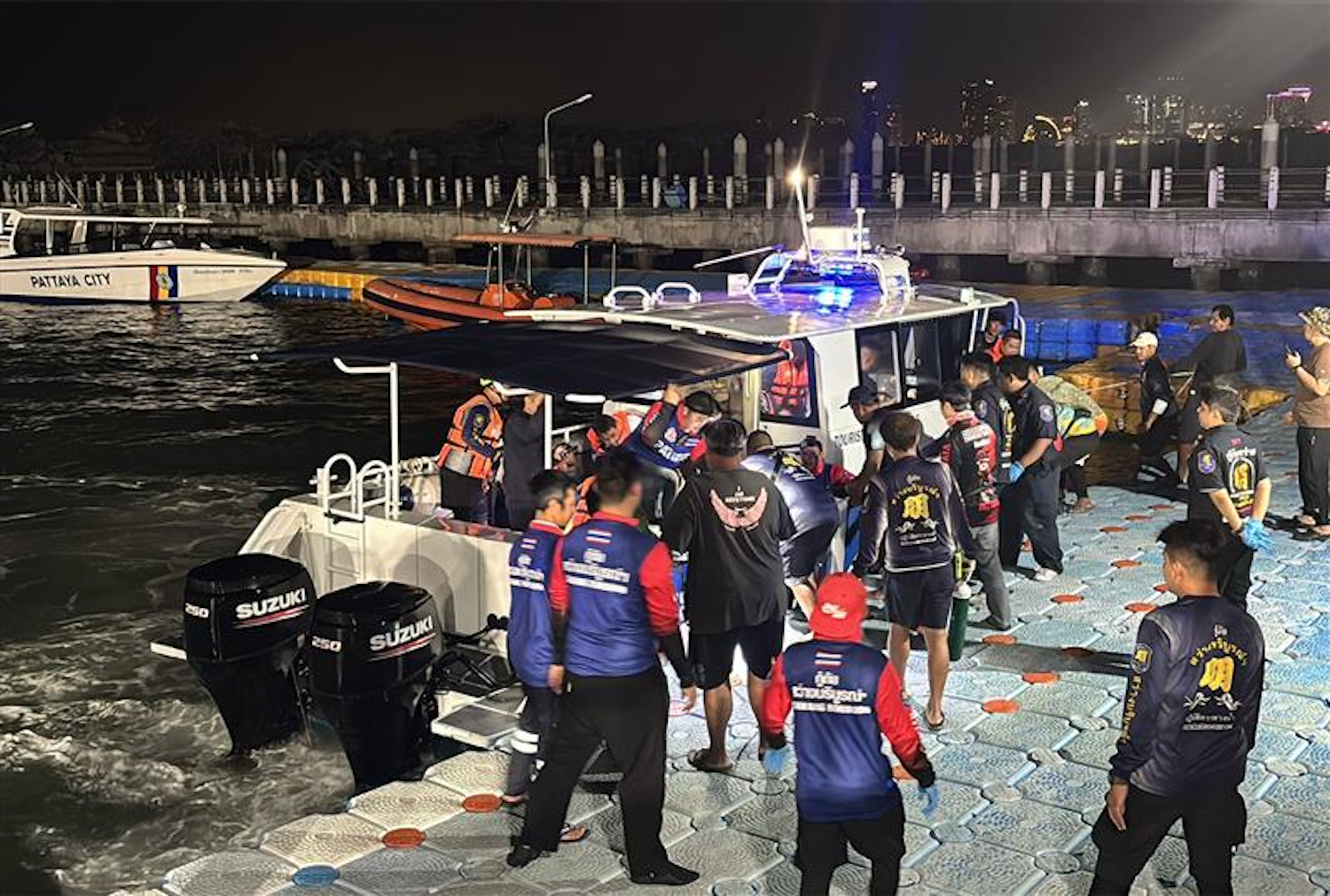
All missing passengers and the boat skipper are taken to shore after their boat capsized off Pattaya on Friday. (Photo: Amporn Sangkaew)
According to the Chon Buri Maritime Enforcement Command Centre (Thai-MECC), the alarm was first raised at 1.33pm through a marine rescue Line group and the emergency hotline 1465.
The Thai-MECC deployed patrol vessel 4008 to search the area, coordinating efforts with nearby boats in rough sea conditions.
Authorities urged all vessels in surrounding waters to immediately report sightings of survivors or floating objects to the 1465 hotline.
At 5.30pm, rescue units reported that all of the missing people, including the skipper, had been located and retrieved from the water. One person was found unresponsive but with vital signs. All were being transferred from inflatable rescue boats to shore.
Authorities also corrected earlier reports that the boat was carrying 13 people, saying there were 15 in all — the skipper and 14 passengers. All of the survivors are safe. However, Mr Suphat was suffering the effects of severe water inhalation and lost consciousness before being rushed to hospital for treatment.
Officials said a full investigation was under way into the cause of the capsize and the boat’s safety equipment.
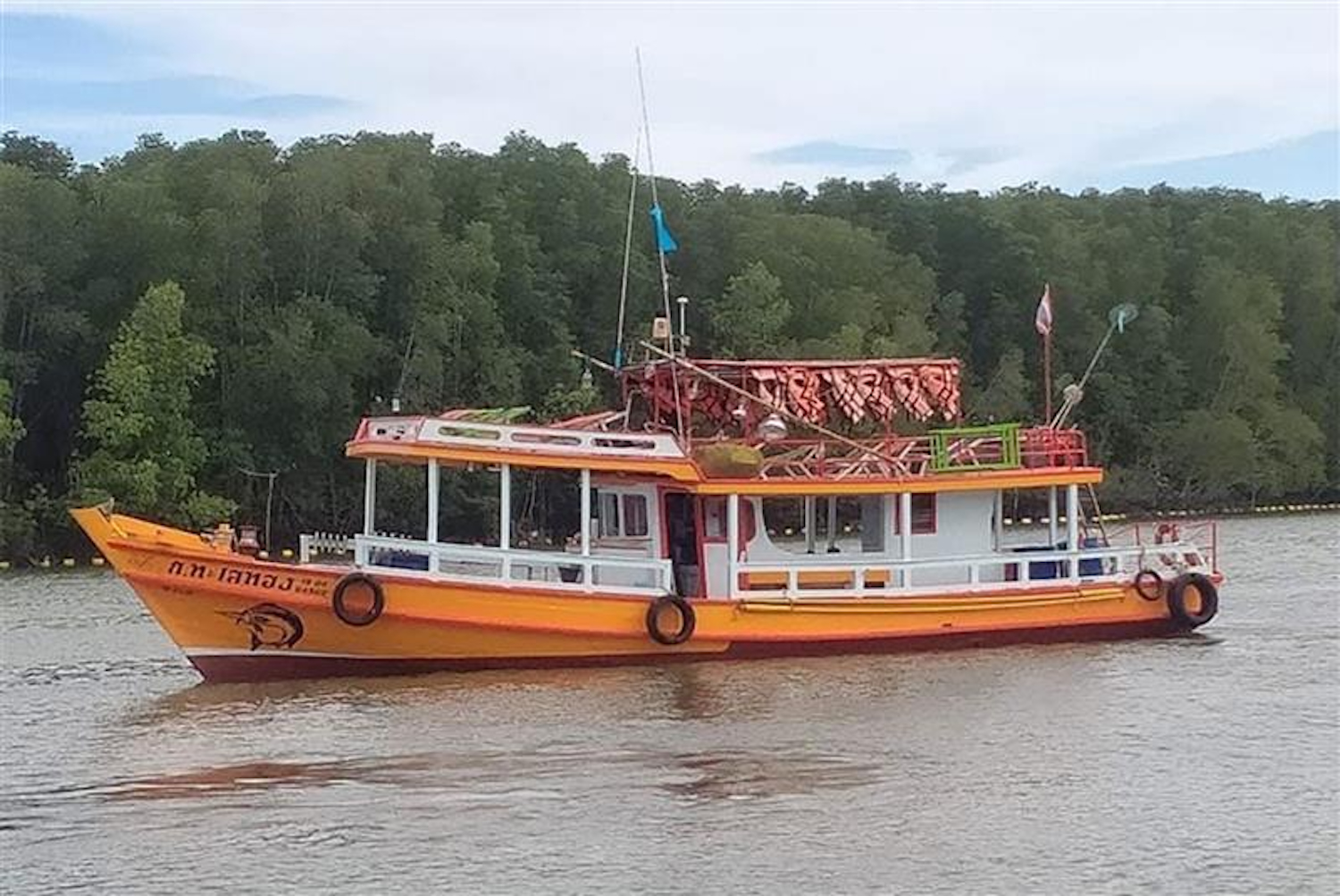
The fishing boat that carried 14 Thai tourists before it sank near Koh Man Wichai off the coast of Pattaya city. (Photo: Amporn Sangkaew)
The musical comedy “If Not That One, Then This One” by the
outstanding Azerbaijani composer Uzeyir Hajibayli, has been
presented at Baku Music Academy’s Opera Studio,…

The musical comedy “If Not That One, Then This One” by the
outstanding Azerbaijani composer Uzeyir Hajibayli, has been
presented at Baku Music Academy’s Opera Studio,
Azernews reports.
First premiered in 1911 at the Azerbaijan State Academic Opera
and Ballet Theater, this timeless work has endured for over a
century, continuing to captivate audiences with its vibrant
portrayal of Baku life at the beginning of the 20th century.
Directed by the Honored Artist Hafiz Guliyev, this new
production masterfully balances the spirit of the original with
dynamic modern staging. Guliyev’s direction emphasized the lively
dialogues and the fast-paced, engaging nature of the narrative
while preserving the essence of the classic.
Honored Artist Sevil Hajiyeva took charge of the musical portion
of the performance, leading the ensemble through Uzeyir Hajibayli’s
unforgettable melodies.
The story follows Meshadi Ibad, a wealthy yet miserly man who
hopes to marry the beautiful Gulnaz. However, Gulnaz’s heart
belongs to Sarvar, a poor but educated and honorable man, creating
a dramatic conflict. Amidst this love triangle, the audience is
treated to a series of comedic schemes, misunderstandings, and
witty exchanges. Each character brings a distinct personality to
the stage, and every scene feels like a vivid snapshot of life.
Despite the play’s century-old origins, its themes remain
strikingly relevant today. The timeless conflict between love and
materialism, tradition and progress resonates with modern
audiences, who laughed and applauded throughout the
performance.
The musical comedy affirms that true feelings transcend
calculations, and that progressive ideals are stronger than rigid
traditions.
The performance featured prominent soloists and emerging talents
from the Azerbaijan State Academic Opera and Ballet Theater,
including People’s Artists Azar Zeynalov (Meshadi Ibad) and Akram
Poladov (Rustam Bay).
The cast also included Honored Artists such as Gulustan Aliyeva
(Senem), Jahangir Gurbanov (Gochu Asgar), and Alakbar Aliyev
(Hasanguli Bay), as well as talented soloists like Atesh Garayev
(Sarvar) and Gunel Hajiyeva (Gulnaz).
Azerbaijan increased its gold production to 2,593 kilog…

Azerbaijan increased its gold production to 2,593 kilograms in the first 10 months of 2025, marking a…
Find the plan that suits you best.
Full digital access to all news for 1 month
Full digital access to all news for 3 months
2.00₼
Select
-33%
Full digital access to all news for 6 months
3.84₼
Select
-36%
Full digital access to all news for 1 year
7.10₼
Select
-41%
Here we are to serve you with news right now. It does not cost much, but worth your attention.
Choose to support open, independent, quality journalism and subscribe on a monthly basis.
By subscribing to our online newspaper, you can have full digital access to all news, analysis, and much more.
Subscribe
You can also follow AzerNEWS on Twitter @AzerNewsAz or Facebook @AzerNewsNewspaper
Thank you!
Microsoft Thailand chief stresses need for massive training programme to equip everyone with AI skills
…
Microsoft Thailand chief stresses need for massive training programme to equip everyone with AI skills

Thailand can strategically position itself to become an artificial intelligence hub in Asia, fuelled by investment in data centres, a commitment to green energy availability and accelerated training, says the managing director of Microsoft Thailand.
“Thailand is in a great position for investment in digital services,” Dhanawat Suthumpun said during a panel discussion at the Bangkok Post Economic Forum 2025 on Friday.
“AI offers an amazing opportunity, and I hope Thailand can unlock the challenges we face today and create a lot of opportunities.”
For example, AI can be used to provide real-time data on supply and demand, enabling the Ministry of Commerce (MOC) to offer “MOC GPT” as a platform where exporters can access services.
AI can also be used to empower and transform all sectors, provide inclusive education, offer co-coaching with teachers and address workforce gaps, he said.
Mr Dhanawat urged organisations to embrace AI at scale.
Thailand has strong potential to attract foreign investment thanks to its strategic geographical location, power availability and digital talent, he said.
Microsoft invested $80 billion globally in 2024, and is committed to spending $100 billion this year on AI, data centres and cloud infrastructure.
“This global investment includes data centres in Thailand through our partnerships,” said Mr Dhanawat.
In addition, Microsoft Thailand has invested several million dollars in programmes to train 1.6 million users.
He said Thailand should harness AI to shift its focus from a labour-intensive, volume-based model to a high-value, innovation-driven economy. This requires a massive national training programme and strong public-private investment partnerships, said Mr Dhanawat.
With AI tools rapidly becoming more widely available to businesses, the competitive edge lies in a workforce’s ability to use them effectively, he said.
The immediate priority is a massive training programme to equip all Thais and companies with the necessary AI skills to generate business impact.
“Being a ‘second-fastest follower’ is a losing strategy in a modern, differentiated economy,” said Mr Dhanawat.
“Thailand must position itself at the forefront of innovation.”
He said a major obstacle to transformation, particularly for small and medium-sized enterprises (SMEs), is financial constraints on investment in new technology.
While SMEs recognise AI’s benefits, many are focused on survival and lack the capital for digital transformation, said Mr Dhanawat.
The country needs a public-private partnership model similar to Singapore, where the government offers significant subsidies to SMEs for AI investment, he said.
Without co-investment or subsidies, SMEs risk being trapped — aware of the need to transform but unable to afford the initial investment, said Mr Dhanawat.