Ashes to ashes: The five phases  of Johnny Enrile

LONGEVITY Juan Ponce Enrile’s government career spanned six decades, bookended by two Marcos presidencies, with congressional stints and not a few controversies in between. He was defense minister under Marcos Sr. and chief presidential legal couns…

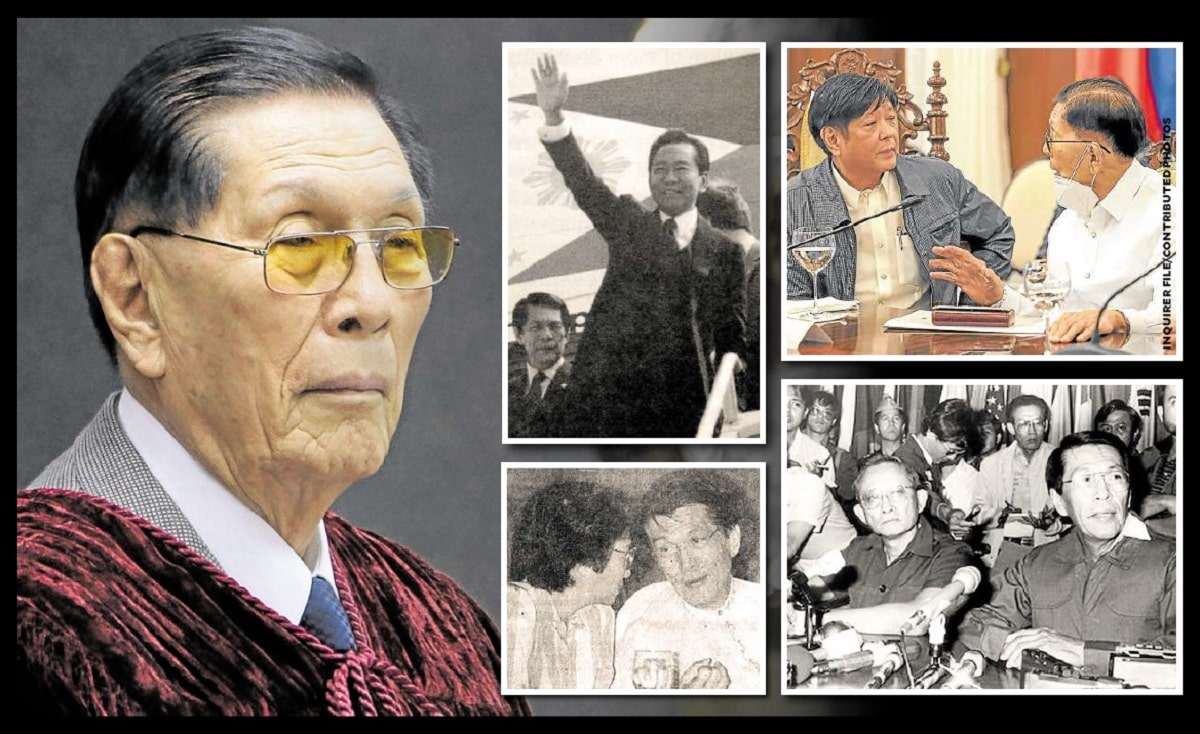
LONGEVITY Juan Ponce Enrile’s government career spanned six decades, bookended by two Marcos presidencies, with congressional stints and not a few controversies in between. He was defense minister under Marcos Sr. and chief presidential legal counsel under Marcos Jr.; an “Edsa hero” along with Fidel Ramos; and defense chief briefly in the Cory Aquino years (insets). As Senate President (main photo), he presided over the impeachment trial of Chief Justice Renato Corona.

(First of three parts)

MANILA, Philippines — Juan Ponce Enrile, once Ferdinand Marcos Sr.’s principal lieutenant in planning the dictatorship only to oust him, ended up half a century later as consiglieri to the son.

In 2010, writing for Rogue Magazine, I made Enrile the face of the Emperor card in the Tarot deck and wrote: “Nothing grows under the shade of the Banyan Tree, or so goes the fortune cookie saying familiar in our part of the world. The Patriarch is a political colossus, a living monument, and a wizened, formidable operator to whom all scurry for favor and preferment. For those purely interested in power, or for whom ability fortunately marries with fortune, resulting in both prestige and political clout, to be considered a patriarch is the summit of a career, and the foundation for an enduring line of leaders. Too much success can, of course, as the saying implies, stunt the growth of a successor generation, or even of one’s successors. But this is something best left to journalists, historians, and posterity to puzzle over. It would be impolitic to mention this dire possibility in polite company—or the patriarch’s.”

As it turned out, this was far from Enrile’s political sunset. He would be disgraced again and rehabilitated again, remaining a durable player in politics for another decade and a half.

With his passing comes the opportunity to take stock of his life, one that spanned five distinct phases in which he was never far from center stage, from the mid-20th century to the first quarter of the 21st century.

Enrile I: The Prodigal Son

Like Ferdinand Marcos (Sr.), Juan Ponce Enrile was both an outsider and an insider who came of age at the moment when the certainties of Philippine society were smashed by World War II. Marcos, despite his accomplishments, had been given short shrift by his more pedigreed peers, though he considered himself provincial gentry: His father had achieved modest political standing, but Ferdinand himself would rise to prominence in part due to the manner in which he defended himself on a charge of political murder, and through shrewd networking forged during the murky years of the Japanese occupation.

Juan Ponce Enrile for his part, belonged to that subset of the upper class for whom being born illegitimate would prove a temporary but still psychologically searing obstacle. His authorized version of his own story has him growing up as an impoverished son of a laundrywoman; he benefited from the patronage of minor civil servants and officials whose patronage may have been fostered by the knowledge that his father was a former legislator turned partner in one of the most prestigious Filipino-American law firms of the prewar and immediate postwar period.

Article continues after this advertisement

After the obligatory (because biodata-burnishing) stint as a young guerrilla, he says he embarked on being reunited with his father, who not only welcomed him but took the life-changing decision to legitimize him. With his academic performance, he was, in time, an up-and-coming lawyer on his own terms, the icing on the cake being that his father made him a junior partner in his firm. There, he gained experience as a corporate, and not criminal, lawyer.

Marcos himself, already a coming man before the war, assiduously dedicated himself to arriving in postwar society. He said all the right things but believed none of it.

Enrile II: The Useful Man

By the time the paths of Juan Ponce Enrile and Ferdinand Marcos (Sr.) crossed in 1964, both were men who’d outgrown the period of deference and dependence on the old upper class. In Marcos’ case, aside from cool calculation, luck served him well: two of his fiercest opponents, Eulogio Rodriguez, a durable prewar and postwar machine politician, and Arsenio Lacson, postwar originator of the iconoclastic urban tough guy in urban politics, had died by then.

After 15 years in the Liberal Party during which he’d wrested the Senate presidency, Marcos found his path to the presidency blocked by his erstwhile party chief, and then incumbent President, Diosdado Macapagal, who decided to renege on a previous promise to serve only one term.

Worse, Macapagal had bungled one of the biggest postwar corruption scandals surrounding influence peddling by an American tycoon, Harry Stonehill, deporting him in a panic, which left implicated officials like Marcos looking quite guilty, indeed.

The opposition Nacionalista Party obligingly welcomed Marcos into its ranks, and in the last hurrah of old-time party politics, Marcos engineered a victory in the party convention. He then won the presidency on the basis of being a guerrilla hero confronting an incumbent who’d collaborated with the Japanese.

Political momentum

In 1967, Filipino voters for the first time rejected a proposed amendment to the Constitution. This created the political momentum for the holding of a Constitutional Convention and the possibility of removing, either by amendment or through an entirely new constitution, term limits on the presidency. This, in turn, opened up one of the tracks Marcos would pursue to perpetuate himself in power.

The moves would require, first of all, his reelection: a feat at which all his predecessors, bar one, had failed.

Up to 1967, Enrile had served in the fiscal side of things, in sensitive posts, first as head of the Bureau of Customs, then as head of the Insurance Commission, and then undersecretary and finally secretary of finance. The series of appointments leading up to 1967 is revealing of Enrile’s usefulness, since that year (1967) also happened to be a crucial midterm election year. (In the Philippines, presidential midterms, in which control of the Senate is decided for the rest of the President’s term, has always served as a referendum on the incumbent president, determining if they will enter the preparatory period for seeking reelection as fatally damaged lame ducks or viable candidates).

From his first job in the politically sensitive, extremely lucrative Bureau of Customs to heading the entire Finance Department, Enrile was obviously the man with the smarts and finesse to build up the Marcos war chest.

But in 1968, Enrile was given a new job: secretary of justice, one he held throughout the period in which Marcos sought, and achieved, the only successful presidential reelection bid since Manuel Quezon’s in 1941. Enrile managed to retain—and increase—Marcos’ confidence in him despite having been widely considered an ally of Rafael Salas, who’d been Marcos’ dynamic executive secretary but who was purged in July 1969. Enrile was proving adept at the byzantine intrigue of court life.

Sub rosa assignment

Marcos himself, in his diary, wrote that he assigned the task of looking into how different regimes declared and ruled, under a state of emergency, in that watershed year, 1969. Again, in a period of increasing radical protest and intensifying political polarization, the selection of Enrile as secretary of justice points to how useful he was—including his sub rosa assignment of researching how to establish a dictatorship.

By February 1970, shortly after Marcos had been assaulted after his State of the Nation Address before Congress and an urban insurrection by students led to a direct attack on the presidential palace in January of that year, Enrile was given the Defense portfolio.

The Marcos-approved story (in a Marcos propaganda channel) goes that it was an ad hoc assignment due to the incumbent Secretary of National Defense showing up drunk in the midst of the student assault on the Palace. Another ad hoc move may have been the ill-fated decision to field Enrile as a senatorial candidate in the unprecedented second midterm election of Marcos, in which his candidates fared badly in marked contrast to his first successful midterm election.

Having fallen on his sword for his chief, electorally speaking, Enrile returned to the Defense Department for the main event: martial law.

(To be continued)

Thai conglomerate readies $1B investment in PH 

MANILA, Philippines – Charoen Pokphand Foods Philippines Corp. (CPF) is investing $1 billion over five years to scale up its hog production and help restore local swine production to pre-African swine fever (ASF) levels by 2028.
In a statement on …

Thai conglomerate readies B investment in PH

MANILA, Philippines – Charoen Pokphand Foods Philippines Corp. (CPF) is investing $1 billion over five years to scale up its hog production and help restore local swine production to pre-African swine fever (ASF) levels by 2028.

In a statement on Thursday, the Department of Agriculture (DA) said the local business of Thai conglomerate Charoen Pokphand Foods PLC unveiled its plan to raise its hog production capacity to 7 million head by 2030 from the current 1.3 million.

Article continues after this advertisement

READ: Thai firm to supply PH with 100 live hogs daily

FEATURED STORIES

Of the total, 4.8 million will be in Luzon, 1 million in the Visayas and 1.2 million in Mindanao.

Vaccination

The DA said CPF’s expansion plan would help the agency achieve its target of restoring the domestic hog population to pre-ASF levels within the next three years, which involves vaccination and the distribution of breeders.

Citing government data, the DA said the population has declined to about 8 million head from 13 million in 2019, when the first case of ASF was reported.

CPF is also considering nine locations nationwide for agro-industrial complexes, with each spanning roughly 20 hectares.

Article continues after this advertisement

READ: Still grappling with ASF, Philippine meat imports up 26% in Q1

Each site will feature feed production and hog processing facilities.

Article continues after this advertisement

The DA said feed plants were expected to produce around 10,000 tons per month, which would require corn output from 5,000 hectares.

Agriculture Secretary Francisco Tiu Laurel Jr. encouraged the company to consider constructing some facilities near major tourist hubs to alleviate food costs.

“This CPF expansion aligns perfectly with President Marcos Jr.’s vision of a zero-kilometer food system—producing food where it’s needed—and advancing agricultural investment to create jobs and ensure food security,” Tiu Laurel said.

Meat imports

CPF announced its significant investment as the country’s meat imports rose by 13.5 percent to 1.18 billion kilograms (kg) in the January to September period from 1.04 billion kg a year prior, data from the Bureau of Animal Industry showed.

As in the past reporting periods, pork cornered 53.4 percent of the total with 632.99 million kg. It reflects a 22.2-percent increase.

Chicken came next with 368.08 million kg, 6.4 percent higher. It captured a market share of 31.1 percent.

Beef, meanwhile, went up by 4.3 percent to 150.15 million kg, equivalent to 12.7 percent.

Brazil is still the country’s leading meat supplier with 39.1 percent, followed by the United States (16.4 percent) and Spain (11.1 percent).

ASF-free zones

The DA recently issued Administrative Circular No. 12, recognizing ASF-free zones within accredited exporting countries, seeking to ensure the safe importation of swine and pork products while protecting the country from ASF.


Your subscription could not be saved. Please try again.


Your subscription has been successful.

This means an accredited exporting country may apply for an ASF regionalization, allowing imports from areas free of ASF within their jurisdiction. The accord is valid for two years, subject to regular evaluation.

The applicant country needs to submit an official request addressed to the chief veterinary officer of the Philippines, along with documents and reports, including detailed reports on ASF surveillance, control measures and boundaries of ASF-free regions.

Authorities nab P107-M in smuggled cigarettes in Zamboanga City 

Police operatives in Zamboanga City trapped two motorized vessels loaded with 1,532 master cases of smuggled cigarettes  in the vicinity of Sta. Cruz Island in Zamboanga City on Wednesday afternoon. —PHOTO BY POLICE REGIONAL OFFICE -9

Police operatives in Zamboanga City trapped two motorized vessels loaded with 1,532 master cases of smuggled cigarettes  in the vicinity of Sta. Cruz Island in Zamboanga City on Wednesday afternoon. —PHOTO BY POLICE REGIONAL OFFICE -9

PAGADIAN CITY, ZAMBOANGA DEL SUR, Philippines — Authorities in Zamboanga City intercepted two motorized vessels loaded with smuggled cigarettes in the waters off Sta. Cruz Island in Zamboanga City on Wednesday afternoon.

Brigadier General Eleazar Matta, Zamboanga Peninsula Police Regional Office director, disclosed that during a seaborne patrol, the operating teams detected two suspicious motorized boats, which they later trapped and were found loaded with 1,532 master cases of assorted cigarettes with an estimated market value amounting to P107.2 million.

The authorities arrested seven crew members who were residents of Sulu, Tawi-Tawi, and Zamboanga City after they failed to present documents for the cargo.

The smuggled cigarettes were placed under the custody of the police’s 2nd Zamboanga City Mobile Force Company, while the motorized boat and the arrested individuals were turned over to the Zamboanga City Police Station 11 for inquest proceedings. /cb

PVL: Creamline sweeps Choco Mucho to reach quarterfinals

Kyle Negrito and the Creamline Cool Smashers during a game against Choco Mucho Flying Titans in the PVL Reinforced Conference. –MARLO CUETO/INQUIRER.net
MANILA, Philippines–Creamline booked a spot in the PVL Reinforced Conference quarterfinals with…

Kyle Negrito and the Creamline Cool Smashers during a game against Choco Mucho Flying Titans in the PVL Reinforced Conference

Kyle Negrito and the Creamline Cool Smashers during a game against Choco Mucho Flying Titans in the PVL Reinforced Conference. –MARLO CUETO/INQUIRER.net

MANILA, Philippines–Creamline booked a spot in the PVL Reinforced Conference quarterfinals with a 25-17, 25-17, 25-23 win over Choco Mucho on Thursday at Smart Araneta Coliseum.

The defending champions looked in control early, taking the first two sets, but Choco Mucho rallied in the third, briefly leading 23-22 behind Royse Tubino’s backrow attack.  Creamline held its composure, with Coco Schwan and Michele Gumabao delivering timely hits to close out the match in one hour, 18 minutes.

Article continues after this advertisement

READ: PVL: Creamline reaches for experience to shut door on Nxled

FEATURED STORIES

“The team really performed and responded well today, especially our ousted hitters. They worked hard and so did our bench players. Teamwork helped us win today,” said Creamline coach Sherwin Meneses.

Schwan led Creamline with 15 points, Gumabao added nine, and Tots Carlos, Pangs Panaga, Sheen Toring, Alyssa Valdez, and Lorie Bernardo combined for 24 more, highlighting the team’s depth. Playmaker Kyle Negrito, named Best Player of the Game, delivered 18 excellent sets and six points.

Creamline Cool Smashers’ Coco Schwan during a game against Choco Mucho Flying TItans in the PVL Reinforced Conference. –MARLO CUETO/INQUIRER.net

“We know we can’t be complacent in the coming games. We need to work for every point, every possession. Our main goal is to execute our system properly, and we’re happy to have done that today, especially in straight sets,” said Negrito.

Article continues after this advertisement

With the Flying Titans breathing down their necks, the Cool Smashers turned to their experience to fend off any attempts to extend the game.

“We know that if we let our guard down, Choco Mucho will take advantage. We worked hard for that,” Negrito added.

For Choco Mucho, Isa Molde led with 11 points, while import Marlee Smith and Royse Tubino added five and six points, respectively. But the Flying Titans’ late rally fell short.

Article continues after this advertisement

Creamline improved to 5-2 ahead of the knockout quarterfinals, which begin November 24 at the Araneta Coliseum. Choco Mucho ends its campaign at 2-5.


Your subscription could not be saved. Please try again.


Your subscription has been successful.

Marcos to agencies: Ensure typhoon victims can recover, rebuild lives

President Ferdinand Marcos Jr. Screenshot from an RTVM video

MANILA, Philippines — President Ferdinand Marcos Jr. has directed concerned government agencies to continue providing assistance to those affected by Typhoon Uwan in Catanduanes, the P…

President Ferdinand Marcos Jr. Screenshot from an RTVM video

MANILA, Philippines — President Ferdinand Marcos Jr. has directed concerned government agencies to continue providing assistance to those affected by Typhoon Uwan in Catanduanes, the Presidential Communications Office (PCO) said.

The directive aims to ensure that typhoon victims can recover and rebuild their lives as soon as possible.

“The assistance includes the Integrated Disaster Shelter Assistance Program (IDSAP) of the Department of Human Settlements and Urban Development (DHSUD) to provide cash assistance to residents whose homes were destroyed or damaged by Super Typhoon Uwan,” the PCO said in a press release.

Earlier, Marcos visited Tubli Elementary School in Barangay Tubli, Caramoran town, to assess the damage caused by Uwan as well as by Super Typhoon Pepito a year earlier.

Of the school’s 23 classrooms, one was completely destroyed, 14 sustained major damage, and the rest suffered minor damage due to Uwan. The incident affected 739 learners and 30 staff members.

To support students and displaced residents, the government donated two Starlink internet satellite units—one to Tubli Elementary School and another to the Caramoran local government unit.

Marcos also inspected damaged houses and the seawall in the same barangay.

Article continues after this advertisement

 “Caramoran has reported 558 totally damaged houses and 2,127 partially damaged houses,” the PCO said.

 “In Barangay Tubli, where the seawall helped protect the coastal community, there were 158 totally damaged and 370 partially damaged houses while nearly all motor bancas were destroyed during the super typhoon,” it added.

Typhoon Uwan left at least 27 dead and around 2.4 million residents displaced, based on the latest data from the Office of Civil Defense.

In a social media post on Monday, Marcos lauded emergency response teams for Typhoon Uwan and added that the preemptive evacuations they carried out “made all the difference.”

“I want to thank our local governments, first responders, and volunteers for acting quickly and working together to keep our people safe. The preemptive evacuations you carried out made all the difference. Your prompt action is very significant,” Marcos said in the post. /mr

New BIR chief named by President Marcos

New Bureau of Internal Revenue Commissioner Charlito Martin Mendoza (Photo from DOF Facebook)

MANILA, Philippines – President Ferdinand R. Marcos Jr. has appointed Finance Undersecretary Charlito Martin Mendo…

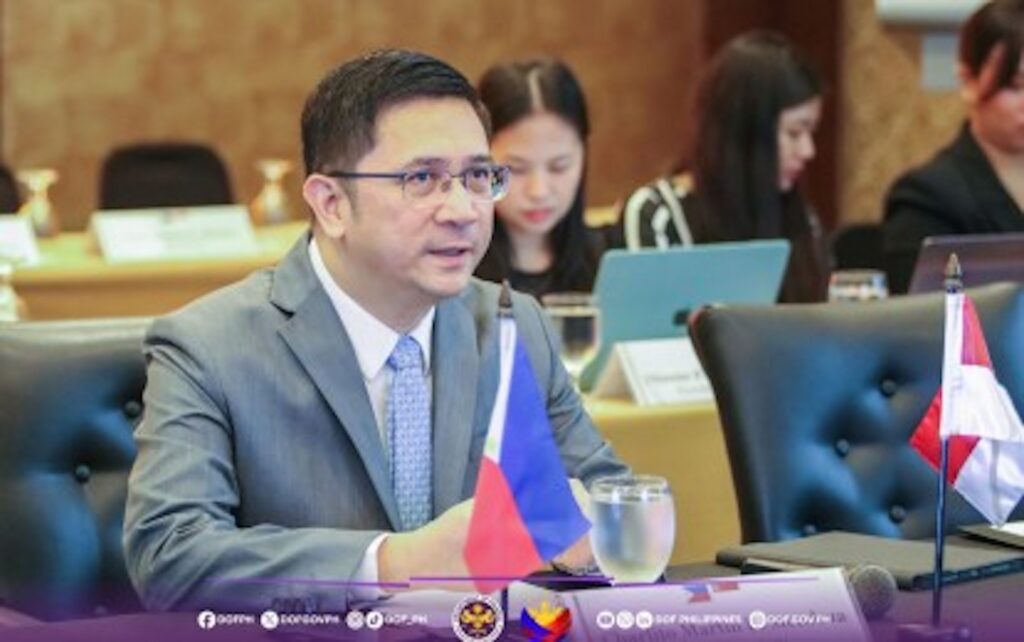
New BIR chief named by President Marcos. Photo shows New Bureau of Internal Revenue Commissioner Charlito Martin Mendoza.(Photo from DOF Facebook)
New Bureau of Internal Revenue Commissioner Charlito Martin Mendoza (Photo from DOF Facebook)

MANILA, Philippines – President Ferdinand R. Marcos Jr. has appointed Finance Undersecretary Charlito Martin Mendoza as the new commissioner of the Bureau of Internal Revenue (BIR).

Presidential Communications Office Acting Secretary Dave Gomez on Wednesday confirmed Mendoza’s latest appointment.

READ: Winston Pepito is acting Cebu City vice mayor from Oct. 9 to Nov. 22

Mendoza replaced BIR chief Romeo Lumagui Jr., who served the agency for three years.

Gomez did not disclose the reason for Lumagui’s exit.

Before his new role, Mendoza served as undersecretary for the Revenue Operations Group (ROG) of the Department of Finance, where he oversaw the operations of BIR and the Bureau of Customs (BOC) to help the government meet its annual revenue collection targets.

From July 2019 to Oct. 2022, Mendoza also worked as district collector for the BOC Port of Cebu, where he led the port to achieve record-breaking revenue collection and significant border protection milestones.

Under his leadership, the Port of Cebu became the first customs collection district to have its main port and all subports ISO 9001:2015 certified.

READ: Peso slides to new record low of 59.17 to $1

Before joining the government, Mendoza had a thriving legal career, working as a founding partner of the Palafox Patriarca Romero and Mendoza Law Firm and an associate lawyer at the Angara Abello Concepcion Regala and Cruz Law Offices (ACCRALAW) and the Suarez and Narvasa Law Firm.

He also served as a law professor and a Pre-Bar and Mandatory Continuing Legal Education lecturer.

Mendoza placed third in the 2004 Philippine Bar Exam after earning his Bachelor of Laws degree from San Beda University.

He is also a licensed Geodetic Engineer, having earned a degree in Geodetic Engineering from the University of the Philippines. (PNA)

READ: Gov’t budget deficit widens by 56% in August on revenue slump


Your subscription could not be saved. Please try again.


Your subscription has been successful.

Read Next

Disclaimer: The comments uploaded on this site do not necessarily represent or reflect the views of management and owner of Cebudailynews. We reserve the right to exclude comments that we deem to be inconsistent with our editorial standards.

Climate crisis is a health crisis, WHO chief says at COP30

This aerial view shows a truck carrying wood through a deforested area of the Amazon rainforest in the surroundings of Belem, Para State, Brazil, on Nov. 12, 2025, during the COP30 UN Climate Change Conference. —Photo by Mauro Pimentel | Agence Fra…

This aerial view shows a truck carrying wood through a deforested area of the Amazon rainforest in the surroundings of Belem, Para State, Brazil, on Nov. 12, 2025, during the COP30 UN Climate Change Conference. —Photo by Mauro Pimentel | Agence France-Presse

GENEVA, Switzerland — The WHO said Wednesday that it was time for formal negotiations on health at the COP climate summits, saying the climate crisis was also a health crisis.

Tedros Adhanom Ghebreyesus, head of the World Health Organization, was at the United Nations’ ongoing COP30 summit in Belem, Brazil, last week, where he advocated for health to be more prominent in climate change discussions.

“Health is the most compelling region for climate action, but for too long health has been a footnote in climate negotiations,” Tedros said at a press conference in Geneva.

Article continues after this advertisement

READ: China hopes US will ‘some day’ return to climate fold

FEATURED STORIES

GLOBALNATION

GLOBALNATION

GLOBALNATION

“It’s much easier to convince people of the urgency of protecting their own health or that of their children than to protect glaciers or ecosystems. Both are important; one is a lot closer to home.”

He said Thursday would be the dedicated health day at COP30, when its host, Brazil, will announce a climate change adaptation plan focused on health, with actions to help countries prepare their health systems and respond to health impacts.

“The climate crisis is a health crisis,” Tedros said.

The WHO’s environment and climate change chief, Rudiger Krech, added that “While we have seen a lot of health discussions at the COP, we have not yet seen a formal place for negotiations on health”.

“It is high time that health becomes an issue for formal negotiations, and we hope to see this at COP31” next year, he said.


Your subscription could not be saved. Please try again.


Your subscription has been successful.

US Mint presses final pennies as production ends after over 230 years

U.S. Treasurer Brandon Beach holds one of the last pennies pressed at the U.S. Mint in Philadelphia, Wednesday, Nov. 12, 2025. (AP Photo)

 PHILADELPHIA — The U.S. ended production of the penny Wednesday, abandoning the 1-cent coins that we…

U.S. Treasurer Brandon Beach holds one of the last pennies pressed at the U.S. Mint in Philadelphia, Wednesday, Nov. 12, 2025. (AP Photo)

 PHILADELPHIA — The U.S. ended production of the penny Wednesday, abandoning the 1-cent coins that were embedded in American culture for more than 230 years as symbols of frugality and the price of a person’s thoughts but had become nearly worthless.

When it was introduced in 1793, a penny could buy a biscuit, a candle or a piece of candy. But now most of them are cast aside to sit in jars or junk drawers, and each one costs nearly 4 cents to make.

“God bless America, and we’re going to save the taxpayers $56 million,” Treasurer Brandon Beach said at the U.S. Mint in Philadelphia before hitting a button to strike the final penny. The coins were then carefully placed on a tray for journalists to see. The last few pennies were to be auctioned off.

Article continues after this advertisement

Billions of pennies are still in circulation and will remain legal tender, but new ones will no longer be made.

FEATURED STORIES

GLOBALNATION

GLOBALNATION

GLOBALNATION

The last U.S. coin to be discontinued was the half-cent in 1857, Beach said.

Most penny production ended over the summer, officials said. During the final pressing, workers at the mint stood quietly on the factory floor as if bidding farewell to an old friend. When the last coins emerged, the men and women broke into applause and cheered one another.

“It’s an emotional day,” said Clayton Crotty, who has worked at the mint for 15 years. “But it’s not unexpected.”

President Donald Trump ordered the penny’s demise as costs climbed and the 1-cent valuation became virtually obsolete.

Article continues after this advertisement

“For far too long the United States has minted pennies which literally cost us more than 2 cents,” Trump wrote in an online post in February. “This is so wasteful!”

Still, many Americans have a nostalgia for them, seeing pennies as lucky or fun to collect. And some retailers voiced concerns in recent weeks as supplies ran low and the end of production drew near. They said the phaseout was abrupt and came with no government guidance on how to handle transactions.

Article continues after this advertisement

Some businesses rounded prices down to avoid shortchanging shoppers. Others pleaded with customers to bring exact change. The more creative among them gave out prizes, such as a free drink, in exchange for a pile of pennies.

“We have been advocating abolition of the penny for 30 years. But this is not the way we wanted it to go,” Jeff Lenard of the National Association of Convenience Stores said last month.

Proponents of eliminating the coin cited cost savings, speedier checkouts at cash registers and the fact that some countries have already eliminated their 1-cent coins. Canada, for instance, stopped minting its penny in 2012.

Some banks began rationing supplies, a somewhat paradoxical result of the effort to address what many see as a glut of the coins. Over the last century, about half of the coins made at mints in Philadelphia and Denver have been pennies.

But they cost far less to produce than the nickel, which costs nearly 14 cents to make. The diminutive dime, by comparison, costs less than 6 cents to produce, and the quarter nearly 15 cents.

No matter their face value, collectors and historians consider them an important historical record. Frank Holt, an emeritus professor at the University of Houston who has studied the history of coins, laments the loss.


Your subscription could not be saved. Please try again.


Your subscription has been successful.

“We put mottoes on them and self-identifiers, and we decide — in the case of the United States — which dead persons are most important to us and should be commemorated,” he said. “They reflect our politics, our religion, our art, our sense of ourselves, our ideals, our aspirations.”

UST begins salvaging what remains of its strong start

UST center Collins Akowe tries to score against UE big man Precious Momowei during a UAAP Season 88 men’s basketball game on Wednesday, November 12, 2025, at Mall of Asia Arena.–UAAP PHOTO
University of Santo Tomas started UAAP Season 88 like a contend…

UST center Collins Akowe tries to score against UE big man Precious Momowei during a UAAP Season 88 men’s basketball game on Wednesday, November 12, 2025, at Mall of Asia Arena.–UAAP PHOTO

University of Santo Tomas started UAAP Season 88 like a contender in a hurry.

The Tigers jumped to a 4-1 record in the men’s basketball tournament in a manner that left its opponents gasping—in the case of Ateneo during a triple-overtime duel, almost literally.

Article continues after this advertisement

But as quickly as their status as title contenders rose, the Tigers halted.

FEATURED STORIES

Full stop. Screeching. UST’s strong start didn’t just lose steam; it turned into a free fall—from Big Bang to Big Crunch in a snap of a cosmic finger.

In a lot of those losses, it was easy to pinpoint what went wrong.

In their fourth loss through five games since their blazing start, the Tigers missed 24 free throws in a one-point loss to defending champion University of the Philippines.

Article continues after this advertisement

For a team that went from tempering expectations to talking about the need to hang together in the middle of a crisis, that defeat gave the Tigers a starting point.

If they were to salvage a season, they would need to do it together—even when it came to relearning free throws.

“We’ve been working as a team in terms of free throw,” Collins Akowe, the team’s hardworking foreign student-athlete, said. “After and before practice, we stay there to shoot free throws as a team. We don’t do it individually.”

Article continues after this advertisement

There was still much to be desired on Wednesday, when the Tigers swamped winless University of the East, 109-97, to improve to 6-5.

After shooting just 54 percent from the stripe against the Maroons, UST made 24 out of 39 attempts against the Warriors (62 percent), good enough against a team with little to fight for.

Akowe personified that improvement, going 6-of-10 after missing half his free throws against UP.

But the Tigers know they need to get better—together.

Saved by offense

At one point during the season, they shared the tournament lead and were largely in the hunt for a Final Four bonus. Now, UST needs wins to gain a more solid footing in the next round.

“Heading into the coming games, we will keep working and hopefully, we get better … [and] come out in future games and get some wins,” Akowe said.

The win against UE will give UST some momentum, especially since it was built on the same road the Tigers took to that 4-0 star: Dizzying start, offense-heavy.

There were traces of the stall that led to that string of avoidable defeats—the Warriors managed to bite off a 20-point third-quarter lead, coming to within nine in the fourth.

But UST turned to its offense again, knocking two triples late in the game to take a 100-83 spread.

The Tigers earned a reprieve. But there’s still work to be done.


Your subscription could not be saved. Please try again.


Your subscription has been successful.

“We want that unity. We need to stay together during these tough times,” Akowe said. “I’m kind of happy because at least we still showed progress.” —with a report from Rommel Fuertes Jr.