Diane Keaton’s Final Instagram Post Features Dog Reggie for National Pet Day

Diane Keaton’s final Instagram post was all about wishing her followers a happy National Pet Day.

The post, from April 11, was made in collaboration with Hudson Grace, the home decor company which sold Keaton’s collection.

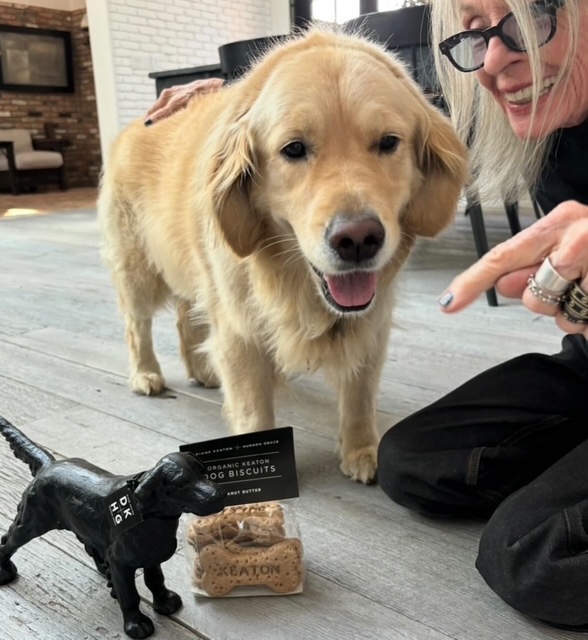
“Proof our pets have great taste too!” the company wrote in the caption, alongside a photo of Keaton with her golden retriever, Reggie, and some of the products from her line. “Happy National Pet Day from HG & Diane Keaton.”

The post also included photos of Reggie modeling one of the dog beds that are part of Keaton’s Hudson Grace collection.

Diane Keaton, Star of ‘Annie Hall’ and More, Dead at 79

A spokesperson confirmed to People on Saturday, October 11, that the famed actress died in California. She was 79. No further information regarding her death was provided and the family has asked for privacy during this difficult time.

Fans have already begun posting comments of sympathy on the post since her death was announced.

“RIP,” said one user with an angel emoji and a heart emoji. “Just watched you in Book Club a few nights ago.”

“I just heard the news and am so shocked & sad,” said another user. “Sending my condolences and love to the Keaton family and friends. RIP Diane. Gone too soon.”

Hudson Grace announced its collaboration with Keaton back in August 2024, with Reggie front and center of the announcement.

Diane Keaton and her dog Reggie
Diane Keaton/Instagram

“Happy National Dog Day!” the caption read, with a photo of Keaton hugging Reggie. “Our new pet collection is all inspired by Diane Keaton’s beloved dog, Reggie! From dog beds to Reggie’s favorite ‘KEATON’ treats, find everything to treat your furry friends in-stores and at the link in bio.”

The Oscar-winning actress was known for her roles in The Godfather, Annie Hall, The Father of the Bride and the Book Club movies.

Keaton later became a hallmark of romance and comedy films, telling Us Weekly in 2022 about her newfound preference for physical roles.

“I got to do some physical things, which I loved, and it made me want to do more physical things in movies instead of just not using your body,” she exclusively told Us about signing onto Mack & Rita. “I mean, really. I haven’t had a chance to do that for a long time. I want to do more of that in something. Hopefully something like that would come along.”

Diane Keaton’s Most Memorable Roles: ‘The Godfather’ and More

She added, “I’ve never done anything so stupid [like this character]. It fits my personality. You can be a dingbat. That’s what I feel the best. That’s why I want to have another movie where I get to do more of that. That’s probably not gonna happen.”

Keaton also told Us at the time what it would take to make another Father of the Bride movie with her former costars Steve Martin, Martin Short, Kimberly Williams Paisley and Kieran Culkin.

“No one’s come forward with it. But if it were to happen, sure. Of course I would,” Keaton told Us in 2022. “Steven, Marty, I mean, they’ve got their television show [Only Murders in the Building] now. I mean, they’re giants and they’re just incredibly great actors and funny and smart and all that. We all know that, and it works. How they’re doing it on TV is pretty remarkable.”

Keaton is survived by her two children, Dexter and Duke, whom she adopted in her 50s.

The post Diane Keaton’s Final Instagram Post Features Dog Reggie for National Pet Day appeared first on The Maravi Post.

Tennessee Explosion Leaves No Survivors, Sheriff Gets Emotional On Video

The explosion at an ammunition plant in Tennessee left no survivors … and Sheriff Chris Davis teared up when delivering the heartbreaking news. In a press conference Saturday, authorities said they did not find any of the 18 people who went…

The post Tennessee Explosion Leaves No Survivors, Sheriff Gets Emotional On Video appeared first on The Maravi Post.

Ashley Darby Appears to Throws Shade at ‘RHOP’ Costar Wendy Osefo

Ashley Darby is seemingly poking fun at the news of Wendy Osefo’s recent felony arrest … as she didn’t hold back in a recent video. The ‘Real Housewives of Potomac’ star appeared to throw major shade at her castmate during a performance at Mr.…

The post Ashley Darby Appears to Throws Shade at ‘RHOP’ Costar Wendy Osefo appeared first on The Maravi Post.

Grey’s Anatomy’s Anthony Hill Teases ‘Curve Balls’ After Season 22 Explosion

It turns out the Grey’s Anatomy premiere explosion is just the start of season 22’s many twists and turns, according to show star Anthony Hill.

“There’s a lot of challenges for the people who survived the blast for lots of different reasons,” Hill, 37, who portrays Dr. Winston Ndugu, exclusively told Us Weekly on Friday, October 10. “Everybody has their own traumas from that experience in that blast, and then, picking up the pieces and trying to literally put the hospital back together and figure out how to move forward is going to be a tough dynamic to navigate for everybody and health physically, mentally and emotionally.”

According to Hill, the fallout will include “big curve balls” for the surviving Grey Sloan Memorial doctors.

“A lot of us are looking at each other in these scenes just like, ‘This is crazy,’ but I think that’s a testament to the writers,” Hill teased to Us. “They figured out how to do this show in a way that’s so effective for people, and that’s why people keep coming back and watching it. They just really enjoy what ride they’re gonna go on [each] week. And so, I think we’re doing a pretty good job. I think people will like it.”

Which ‘Grey’s Anatomy’ Stars Are — And Aren’t — Returning for Season 22?

During the Thursday, October 9, premiere, the Grey Sloan team grappled with the fallout from the shocking explosion at the end of last season. While many of the physicians’ lives hung in the balance throughout the episode, it was ultimately Dr. Monica Beltran (Natalie Morales) who succumbed to her injuries.

Winston, Jules Millen (Adelaide Kane), Amelia Shepherd (Caterina Scorsone) and the rest of the Grey Sloan crew were left reeling when they learned the news.

“I mean, if you think about Jules’ experience through that, her mentor died in her arms,” Hill told Us. “That’s horribly traumatic, and that’s just one example.”

Greys-Anatomy-Anthony-Hill-and-Caterina-Scorsone-inline-178593_0422
Caterina Scorsone and and Anthony Hill in the ‘Grey’s Anatomy’ season 22 premiere. Disney/Anne Marie Fox

After Jules watched pediatric surgeon Monica die in the operating room, she sought comfort in Winston’s arms while breaking down in tears. (As fans will remember, Winston and his subordinate dealt with a will-they-won’t-they story line in season 21.)

“That was a very emotional scene for Addie to play, so it’s a layered scene for her,” Hill told Us of working alongside Kane, 35, in the premiere. “I just found myself trying to be present with my acting coworker and [tried] to help [her] give the best performance [she] could. … It’s heated, like, it’s charged. I don’t know if we were aware of that fully, but seeing it play out [in the episode] was really beautiful.”

He continued, “We’re just trying to be honest in the moment, but then seeing how effective that was [was] kind of jarring. I was like, ‘Oh, man, where is this going?’ And it’s a nice slow burn that they’ve written, so we’ll see where it ends. There might be some curve balls.”

While it might have looked like Winston and Jules shared a near-kiss, Hill told Us that his character wasn’t actually thinking about romance in the heat of the moment.

Grey’s Anatomy’s Biggest Exits Over the Years

“Winston was trying to be there for Jules. He sees she’s having a breakdown. He cares about her,” Hill explained. “He knows [there are] levels of trauma that are indescribable. … First of all, what happens through that, sometimes you can’t control, and I think there was an energy between them that was undeniable in that moment. So were either of them going in for a kiss? Not purposefully, but I think what ended up evolving in that scene was something kind of magnetic and kind of special that wasn’t planned.”

The drama won’t stop there, however, with Hill teasing that fans could perhaps see another shocking death before the season’s finale.

“This is Grey’s Anatomy, so we know that nobody’s all good ever. Shonda [Rhimes] set that tone early,” Hill quipped, referring to the creator of the hit medical drama. “I think there’s plenty of room for complications to happen with any of these characters that could end in a demise. It’s just how the show is, and it’s built-in. … We’re shooting some things that may play into that. We’re about halfway through right now, so it’s getting a little spicy.”

Grey’s Anatomy airs on ABC Thursdays at 10 p.m. ET.

The post Grey’s Anatomy’s Anthony Hill Teases ‘Curve Balls’ After Season 22 Explosion appeared first on The Maravi Post.

ESPN Hosts Ryan Clark, Scott Van Pelt Apologize for Kyren Lacy Comments

In the latest development of the Kyren Lacy case, ESPN hosts Ryan Clark and Scott Van Pelt have walked back their previous comments regarding the former LSU wide receiver and his alleged role in a fatal car crash in December.

During the Thursday, October 9, episode of ESPN’s First Take, Clark apologized for comments he made during the Monday Night Football broadcast, in which he proclaimed Lacy’s innocence.

“In full transparency y’all, I knew Kyren Lacy personally. But nothing matters to me more than the truth,” Clark said on Thursday. “I always strive to do my best to mix authenticity with the most complete and up-to-date information available. I failed to do that on Monday night based on the subsequent evidence that has been released by the Louisiana State Police Department.”

He continued, “I set the highest standards of fairness, and most importantly, righteousness in my work. I didn’t meet that standard.”

Police Maintain LSU Player Kyren Lacy Was Responsible for Fatal Car Crash

On Friday, October 3 – three days before Clark made his original comments on Monday Night Football – Lacy’s lawyer presented security camera footage from a nearby gas station that seemed to contradict the alleged circumstances of the December crash.

At the time of the accident, Louisiana State Police believed Lacy caused the crash that killed 78-year-old Herman Hall, but the new evidence called the alleged circumstances into question.

“Kyren Lacy was supposed to be in the NFL,” Clark said on the Monday Night Football broadcast. “Kyren Lacy was accused of something and investigated for something he didn’t do, and he died having to live with the guilt and the consequences of a guilty man, knowing he was innocent.

kyren-lacy-espn.jpg
John Nacion/FilmMagic/Ella Hall/LSU/University Images via Getty Images

The host continued, “Recently it was discovered that he was 72 yards away from the crash. That police and state policemen tried to coerce and doctor and use ways to manipulate statements that put this young man behind bars. … Kyren Lacy was innocent. Kyren Lacy should be here with us. Nothing will every repair or replace the pain that his parents have to feel and his loved ones have to feel.”

Since the new evidence from Lacy’s lawyer came to light, police maintained that Lacy was responsible for the accident, releasing a new video on Tuesday, October 7, that allegedly showed Lacy driving erratically and ultimately causing the accident. This new evidence prompted Clark’s apology on Thursday.

New Shocking Details Emerge in Death of Former LSU Wide Receiver Kyren Lacy

Also on Thursday, Van Pelt walked back statements he made on the same Monday Night Football broadcast with Clark.

“The one certainty here is that this was a senseless tragedy in December and it’s magnified by a second life lost in April,” Van Pelt said on Thursday’s episode of SportsCenter. “I apologize for the incomplete reaction that aired on this show on Monday night.”

Back in April, months after the original accident, Lacy, 24, was involved in a police chase in Houston that lasted “several miles” and resulted in a crash. The Harris County Sheriff’s Office claimed that Lacy refused to stop for an officer and was subsequently chased. When authorities reached his vehicle after the crash, it was revealed that Lacy had died by suicide.

His death came one day before he was scheduled to appear in front of a grand jury in Houston on charges of negligent homicide, felony hit-and-run with death and reckless operation of a vehicle in connection to the incident in December.

The post ESPN Hosts Ryan Clark, Scott Van Pelt Apologize for Kyren Lacy Comments appeared first on The Maravi Post.

Science or skills? Why Nigeria must choose both

When the Federal Government, through the National Board for Technical Education (NBTE), announced earlier this year that Federal Science and Technical Colleges (FSTCs) would be converted into purely technical colleges, the move stirred both applause and unease. According to the NBTE, new admissions into these schools will no longer accommodate science-based subjects; instead, the colleges will focus entirely on vocational and technical training.

The logic is clear and easy to understand. Nigeria is facing a widening technical skills gap. Industries constantly lament the shortage of trained welders, machinists, electricians, and ICT technicians. Meanwhile, graduate unemployment remains high, partly because many young people emerge from universities with degrees but without market-ready skills. By emphasizing technical education, the government hopes to produce a workforce equipped for immediate industrial needs, reduce dependence on foreign artisans, and give young Nigerians practical pathways to employment. Yet, as commendable as this looks, the question remains: is it wise to ask science to take a back seat?

Science has always been more than classroom theory or an abstract discipline. Science is the discipline that tries to explain life, and how different phenomena occur in life and then use this knowledge to make life easier, create innovations and products that help humans live a more productive and healthier life. The fact that many people in Nigeria do not see it as such, and do not even understand or even really value science is a testament of our collective refusal or failure to invest in equipment and infrastructure. Many of the schools teaching science at primary, secondary and even tertiary levels in Nigeria do so without having well equipped laboratories. This has reduced the quality of the science being taught in these schools and has turned it into an abstract study which students and even the general public find difficult to relate with. Sometimes in academic circles it is jokingly said that what we practice in our country is science in the ‘tropics’ and not real science as the rest of the world is doing. Subjects like biology, chemistry, physics, and mathematics are the backbone of innovation, research, and industry. They prepare students not only for professional courses such as medicine, Information and computer technology, engineering, and pharmacy but also for emerging fields like biotechnology, artificial intelligence, and renewable energy. To sideline science in favor of technical training is to weaken the intellectual foundations of Nigeria’s future knowledge economy.

There is danger if we insist on adopting this one-sided approach. Germany, admired for its technical education system, runs a dual model where vocational training is integrated with academic foundations. South Korea invested heavily in both science high schools and technical institutions during its industrial rise, which is why it now leads in semiconductors, ICT, and biotechnology. Singapore balances strong polytechnics with science-rich junior colleges. None of these countries abandoned science for skills; instead, they combined the two to create robust education systems. Let us not create a workforce of people who can only ‘do’ but cannot think as a result of not understanding the basic science principles that guide the work they do and the output they produce.

In my capacity as a SIWES coordinator, I have visited industries across Nigeria and witnessed first-hand how industrialization is reshaping the workplace. Increasingly, machines and automation is pushing traditional artisans out of factories, replacing manual tasks with technology-driven processes. About a little while ago, breweries, bottling plants, Car battery producing entities and companies producing detergents used to have thousands of casual and technical workers manning many of their units and carrying out one technical or manual function or the other. Machines and automation is rapidly changing this narrative and this shows that technical knowledge and expertise cannot and should not be acquired at the expense of understanding the underlying science principles. The future is going in the direction of robotics and we cannot have technical people who have zero knowledge of science principles.

The reality of the workplace today shows why science must not be thrown out of the window in our pursuit of technical education. If technical people are trained without a scientific foundation, they risk being confined to routine, low-level tasks, repetitive and low paying jobs without prospects for future. Yet, with science integrated into their training, technical workers can evolve into problem-solvers capable of adapting, innovating, and driving the very technologies that are manning and thus transforming industries in Nigeria.

The world itself is evolving and doing so very quickly, and so are technical skills. Modern technicians are no longer expected to only ‘use their hands’; they must understand the science and technology behind their work. Today’s automotive technician, for an example, must grasp not only mechanical repairs but also electronics, computer diagnostics, Artificial intelligence, autonomous vehicles and chemistry in battery technology among other things. Without the knowledge of science, technical training risks becoming stagnant but with science foundation technical training will remain dynamic, equipping graduates to innovate and remain relevant in a fast-changing economy.

This is why the door should not be shut on science in technical colleges. What is needed is not an outright divergence between science and skills but a deliberate convergence and blend of technical expertise and science. Technical training should be firmly supported by scientific understanding of the underlying principles. When science and skills converge, students not only learn how to ‘do’ but also why and how they are doing it and they can then think of how to improve it. This approach prepares Nigeria’s youth not just for today’s labor market but also for tomorrow’s knowledge-driven economy.

As the NBTE and the Federal Ministry of Education push this policy forward, it is crucial that they also listen to educators, scientists, parents, and industry leaders. Nigeria cannot afford a reform that solves today’s unemployment crisis at the expense of tomorrow’s innovation. A balanced education system where science sharpens the mind and skills train the hand is the true recipe for national development. The choice before us is not science or skills. The real future lies in science and skills together building a generation that can both work today and innovate for tomorrow.

Taye (PhD) writes in from the Department of Biological Sciences, Lead City University, Ibadan.

Herbert Macaulay’s pardon, Oseni and Umahi

WORDS are sacred, sovereign objects. This sacredness makes them very essential to democratic freedom. In his poem, The Word Is An Egg, great Nigerian poet and dramatist, Niyi Osundare demonstrated the primacy of the word, whether written or spoken. To show the uniqueness of the word, Osundare’s Yoruba people say, like the broken egg, when you break the shell of the word by uttering it, it dissolves into nothingness. Both the one who utters it and the word itself are then never the same. Believing that the word is sacred, Yoruba transfer that sacredness to the African giant pouched rat (Okete). Whatever this giant rat tells the earth when it is digging its hole, it must comply, they believe. The Yoruba chant this belief in incantations that decree abidance to their command. Thus, drawing largely from the cosmology of his people, Osundare said the word predated man and even the world. ‘In the beginning was not the word/In the word was the beginning’ he wrote. In the world of this poet, the word is omnipotent and omnipresent. The word is creation and the creator.

By granting presidential pardon to Herbert Macaulay, Mamman Vatsa, Ken Saro-Wiwa and others last week, the Nigerian president seems to affirm the primacy of the word. Essentially, what unites these three great Nigerians is their use of the word, spoken and written. Macaulay, for instance, apart from being a Nigerian nationalist, politician, surveyor, engineer and architect, he was also a journalist and newspaper founder. It must be said that virtually all nationalists in the colony were journalists. Realizing the power of the word, especially the written word, against colonialists, nationalists crusading for independence not only founded newspapers for this purpose, the word became their weapon of war. Ernest Sese Ikoli, Nnamdi Azikiwe, Obafemi Awolowo, S. L. Akintola etc. were all journalists whose arsenal against the colonizers was the written word.

From 1898 when he disengaged from public service, Macaulay joined the anti-colonial government forces. In the service of this quest, he co-founded the Nigerian Daily News newspaper where he bore his fangs against the colonial government. Some of his pieces included one he entitled ‘Justitia Fiat: The moral obligation of the British Government to the House of Docemo’ and ‘Henry Carr Must Go’. The newspaper also became the platform he deployed to attack his political opponents and ex-associates like Henry Carr and Adamo Akeju, the Obanikoro of Lagos.

Macaulay’s adversarial journalism eventually led to his travails in the hands of the colonialists. He was notorious for the network of informants he kept who, for handsome fees, passed stolen sensitive information from the colonial government to him. These included minutes from colonial government meetings. He then got them published as exclusive stories damaging to white rule in newspapers that he was acquainted with. For this, Macaulay was nicknamed Wizard of Kirsten Hall.

By the twilight of the 1800s, Macaulay had begun to veer from his profession into activism. He became a lone voice against colonial policies on land, water, and what he felt was non-judicial use of public funds. He was also a member of the Anti-Slavery Aborigines’ Protection Society.

In order to bring him to book due to his trenchant opposition to government, Macaulay’s private survey and architect practice was used to allege fraud and criminal misappropriation of funds from an estate where he was engaged as an executor. The Mary Franklin Estate belonging to a deceased client of Macaulay’s, which he was managing, became an object of litigation. In 1913, he was tried by a Robert Irving, who was the prosecuting counsel in the case, for stealing 350 pounds and imprisoned for two years. Some historians claim Macaulay might have been a victim of vendetta. For all his fights for the people of Lagos, a song was composed in Macaulay’s honour which goes thus, ‘E ki Macaulay o, Oyinbo alawo dudu’ (Macaulay deserves reverence; this white man in black skin). Another Yoruba Sakara genre musician of the Lagos colony of the 1920s and 1930s, Abibu Oluwa, regarded as the first breakout start of that traditional musical genre, recorded a track in his tribute where he sang, ‘Macaulay Macaulay, Ejòn’gboro’. Ejòn’gboro – Snake on the Street – was Macaulay’s alias.

Both Saro-Wiwa and Vatsa also personified the sacredness of the word. Apart from his environmental activism, Saro-Wiwa was a great writer whose works included television, drama and prose. Same goes for Major General Mamman Jiya Vatsa who was also an accomplished poet and writer.

I went on the above historical journey to situate the Tinubu administration’s perhaps unintended recognition of the sacredness of the word in the president’s last week pardon granted Macaulay, Saro-Wiwa and Vatsa. However, for the administration and a herd of its servile supporters, it is the proverbial favour of Esu Elegbara, the devil. As Esu approbates, it reprobates. Like Esu, the benefit Tinubu gave with one hand, he and his social media lieutenants repossessed with the other a thousand times. Take for instance the television confrontation between Rufai Oseni of Arise TV and Minister of Works, Dave Umahi last week. In the obsession to demonize Rufai, those I label regime boot-lickers took away what looked like harvested gains by the Tinubu administration. By granting those patrons of the word pardon, even though some have said for political reasons, he invariably acknowledged the potency of their word-crusading.

Let us get some fundamentals right. First, Rufai Oseni is one of Nigeria’s most brilliant journalists. I confess to being addicted to watching him. In my 30 years active romance with the word, seldom have I encountered someone in possession of such robustness of mind and an obsessive quest for the good of society. Anchoring his belief on Niyi Osundare’s credo that the word is powerful, omnipotent and omnipresent, the creation and the creator, Oseni uses words to be a guiding principle for those who want a good society.

Last Friday when the Norwegian Nobel committee, in far away Oslo, was announcing Maria Corina Machado as its 2025 Prize winner, my mind went to Oseni, his crusade for a just society and his travails in the hands of Nigerians who have grown luscious inside the sewers of bad governance.

Permit me to state that, substitute Venezuela for Nigeria and the committee could as well have been referring to Rufai Oseni. In his small corner of television advocacy and activism, Oseni, like Machado, challenges monarchical rule dressed in the garb of democracy. He has tirelessly advocated for free elections and representative government. If you read the work of two scholars, Olakunle A. Lawal and Oluwasegun M. Jimo, in their journal article entitled ‘Missiles from ‘Kirsten Hall’: Herbert Macaulay versus Hugh Clifford, 1922 – 1931′ as I did, you would see in Rufai Oseni the Herbert Macaulay spirit.

A motley crowd palace courtiers denigrate Rufai Oseni today for rousing us all against a brand of civilian colonialists, the type Macaulay fought to a standstill. Like Macaulay, Oseni faces intense persecution. Macaulay’s is mostly from Lagos people and the colonial government whose perception of him was that he was an unnecessary pest. Many think same of Oseni, too. If Macaulay had been an anchor on TV as Oseni is, the Tinubu government Rottweilers would have bayed for his blood, too. During Macaulay’s court trial, a local musician called Gbadamosi Bishi composed a song for him which approximates the high level of opposition against colonial rule of the time.

What many do not know is that what Rufai Oseni and his very few fellow travelers on this rarely-traveled road go through in fighting bad governance and entrenched forces of democratic retrogression is significant. You may deplore his method of fighting the self-serving and the ‘violent machinery of the state’, but you cannot undermine the fact that Oseni is, just like Machado, a ‘symbol of (our) collective aspiration against an alien government that (doesn’t care for our) welfare.’

The Nobel committee had strong words for those who perceive criticism of the government as adversarial. The committee stated that ‘what lies at the heart of democracy’ is ‘our shared willingness to defend the principles of popular rule, even though we disagree.’ Its description of Machado’s seemingly hopeless Venezuela seems to find mutual validity in Nigeria.

In a country where hero-worship and the belly, rather than principle, dictate the compass of individuals’ stands in the blight of normalcy currently reigning in Nigeria, the word, as represented by the media, plays crucial role as representatives of free speech. The Rufai kind who hold governments accountable is fast becoming extinct. When a Minister of Works appears vague and opaque on the cost of roads under his superintendence on national television, it is the responsibility of a journalist to make the minister lose his appetite. That was what Rufai did. You may not like how he did it but that is business for further discourse. That he courageously did it, without kow-tow-ing to his dollars and grits, Oseni deserves our own Nobel. Erstwhile clan members with whom the likes of Rufai ingressed and egressed through the same aganrandi (a traditional Yoruba door) have recently almost all exited, citing their love for country and how ‘hate and anger should not blind Nigerians to progress.’ The Rufais should be commended for not following the ignominious paths of our brothers, Judas.

Come to think of it, what Rufai demanded was just accountability. If a government awards a Lagos-Calabar Coastal Highway, a 700 km project, for $11-13 billion (?15.6 trillion) to the self-confessed friend of the president, where his son is a director, methinks this incongruity should raise red flag in the minds of any righteousness-seeking nation. If however you have chosen to live a fawning life of grovelling before your Ali Baba and the Forty Thieves over this matter, why demonize those who are asking questions? Even the governor of Oyo State, Engr Seyi Makinde, an engineer like Dave Umahi, has imputed that his ministerial grandiloquence has no place in accountability. So, why was Umahi waffling on cost of the road per kilometer? The reality is, an average Southwesterner may never ply that coastal road in ten years, whereas he cannot but ply the Ibadan-Ilesa road, for example, which kills the people on a daily basis. But for ulterior motive of self-enrichment, why would a government expend scarce national resources on a white elephant road while abandoning the people to die on consequential roads that have become deathtraps?

We are not all Lagosians who don’t ask questions. Lagos has never asked a single question about the running of their state since 1999. But that is Lagosians’ own problem. What Rufai Oseni and some of us are saying is that, in reality, we are not advocating that the Agatu should not chant the Yoruba traditional oral praise poetry called Rara. Rara is chanted at ceremonies and used as salute in praise of an individual. What we however deplore is the Agatu chanting the praise song of our mother – ‘Aa ni ki Agatu ma sun rara; k’o sa ma fi ki iya wa’. This fear is raised because Agatu, a Benue State tribe, many of whom lived in the Southwest, were renowned for their predilection of mis-pronunciation while mimicking Yoruba words. In other words, those obsequious fawners of power should not extend their canopy of silence to our side.

The truth is, words are what despots and pretentious lovers of democracy first seek to hold captive. Yet, the word is the most valuable hand-tool of democracy. The choice is however ours: We can continue to demonize the Rufai Osenis and idolize individuals who fawn before regimes, the palace appeasers, courtiers and regime sympathizers like Reno Omokri, Daniel Bwala and their clan. As I told one of them on a Whatsapp platform last week, we will all someday reap the fruits of where we stand.
NANS hails FG over release of 4,000 inmates

The National Association of Nigerian Students (NANS) has commended the Minister of Interior, Olubunmi Tunji-Ojo, for his groundbreaking humanitarian initiative that secured the release of 4,068 inmates across correctional facilities nationwide, describing it as a major step towards reforming Nigeria’s criminal justice system and advancing President Bola Tinubu’s Renewed Hope Agenda.

In a statement issued by its Assistant Secretary-General, Adejuwon Olatunji Emmanuel, NANS lauded the Minister for what it termed ‘a display of empathy, efficiency, and reform-driven governance.’

According to the association, the initiative, funded through ?585 million raised from private contributions, was achieved at zero cost to the Federal Government and has already restored freedom, training, and reintegration opportunities to thousands of inmates who were held due to their inability to pay fines or bail conditions.

‘Through this noble action, Tunji-Ojo has restored hope to thousands of Nigerians and reaffirmed the administration’s commitment to humane and reform-oriented governance,’ the statement read in part.

NANS described the project as a clear demonstration of the Renewed Hope Agenda in action, commending President Tinubu for appointing leaders with vision, compassion, and administrative excellence.

‘His tireless commitment to reforming the correctional system reflects the new direction of the Tinubu administration – one that values rehabilitation and human dignity over condemnation,’ the students’ body said.

The association further noted that the Interior Minister’s leadership continues to inspire trust in governance and public institutions, emphasising that his approach to reform aligns with modern global practices in restorative justice.

‘We sincerely appreciate President Bola Ahmed Tinubu for giving Nigeria such a visionary, proactive, and people-centred Minister. The impact of Hon. BTO’s leadership continues to resonate across all sectors, inspiring a new wave of trust in public service,’ the statement added.

NANS reaffirmed its confidence in the Tinubu administration’s ongoing reform agenda and expressed optimism that similar initiatives would continue to address systemic issues across Nigeria’s justice and correctional systems.

‘Indeed, Nigeria is in motion under the Renewed Hope Agenda,’ the statement concluded.