PM Anutin vows to end floods by next month

Farmers to be compensated for use of fields for water retention

Farmers to be compensated for use of fields for water retention

Prime Minister Anutin Charnvirakul hands out relief supplies to flood-affected residents at Wat Bandai Chang in Sena district of Ayutthaya province on Wednesday. (Photo: Government House)

Prime Minister Anutin Charnvirakul has vowed to end flooding by next month and provide monthly compensation to affected farmers whose farmland has been used as water retention areas until the floods subside.

Mr Anutin, who also serves as interior minister, visited flood-hit communities in Ang Thong province on Wednesday, after surveying flooded areas of Ayutthaya, Ang Thong, Sing Buri and Chai Nat by air.

At Pamokwitthayaphum School Stadium in Pamok district of Ang Thong, Mr Anutin distributed relief supplies and met flood victims. He was joined by cabinet ministers including PM’s Office Minister Paradorn Prissanananthakul, who is also a Bhumjaithai Party MP for the central province.

Mr Anutin expressed concern for residents affected by the floods, acknowledging that while nature plays a role, “the government must take responsibility for managing the crisis effectively”.

He directed Mr Paradorn to remain in the province throughout the flood period, except for essential cabinet meetings, and to prioritise on-site flood-relief efforts.

“Many families have lost property, had to move their belongings and are enduring life surrounded by water,” Mr Anutin said. “Farmers in Ang Thong have sacrificed their rice fields and farmland to retain floodwater, protecting urban and economic zones from greater damage. I thank everyone for that sacrifice.”

The prime minister said he had instructed ministers to prepare monthly compensation payments for farmers and landowners who have turned their land into temporary retention areas.

“I will use the budget under my supervision to provide monthly support until the floodwaters completely recede,” he said. “Usually, the water lasts two to three months, but this time it’s been four to five months already. The government must step in to ease your burden.”

He ordered all ministries, particularly the Interior Ministry, to assist local authorities in alleviating hardship. He said he had coordinated with the Office of National Water Resources (ONWR), the Royal Irrigation Department and the Agriculture Ministry to jointly manage water flow and drainage to minimise future impacts.

“I know the pain and frustration of those affected, and I welcome criticism. You can direct your anger at me — I understand your suffering,” he said. “My goal is to make December a month of happiness so families can return home and celebrate the New Year together.”

The government has already approved 9,000 baht in aid per household for general flood victims. “No amount of money can replace what has been lost,” Mr Anutin said, “but what people truly need is to resume their normal lives.”

ONWR secretary-general Danucha Pichayanan said water levels in the reservoirs at the country’s four main dams — Bhumibol, Sirikit, Kwae Noi Bamrung Dan and Pasak Jolasid — in the Chao Phraya River basin are nearing or have exceeded full capacity.

ASCO reports nearly 5 mln tons of cargo transported in past ten months

Azerbaijan Caspian Shipping Company (ASCO) transported …

ASCO reports nearly 5 mln tons of cargo transported in past ten months

Nazrin Abdul

Azerbaijan Caspian Shipping Company (ASCO) transported a total of 4,838,499 tons of cargo using its tankers and general dry cargo vessels from January to October 2025. During the same period last year, these figures stood at…

Find the plan that suits you best.

1 month subscription

Full digital access to all news for 1 month

3 months subscription

Full digital access to all news for 3 months

2.00

Select

-33%

6 months subscription

Full digital access to all news for 6 months

3.84

Select

-36%

1 year subscription

Full digital access to all news for 1 year

7.10

Select

-41%

Here we are to serve you with news right now. It does not cost much, but worth your attention.

Choose to support open, independent, quality journalism and subscribe on a monthly basis.

By subscribing to our online newspaper, you can have full digital access to all news, analysis, and much more.

Subscribe

You can also follow AzerNEWS on Twitter @AzerNewsAz or Facebook @AzerNewsNewspaper

Thank you!

Romeo Lumagui out as BIR chief

Jean Mangaluz – Philstar.comNovember 12, 2025 | 9:51pm

MANILA, Philippines — The Palace on Wednesday, November 12, confirmed that Romeo Lumagu…

Jean Mangaluz – Philstar.com

November 12, 2025 | 9:51pm

MANILA, Philippines — The Palace on Wednesday, November 12, confirmed that Romeo Lumagui has been sacked as the commissioner of the Bureau of Internal Revenue (BIR). 

Initial reports of Lumagui being replaced were confirmed by Presidential Communications Office (PCO) Secretary Dave Gomez. 

Lumagui is replaced by Department of Finance (DOF) Undersecretary Charlito Mendoza. 

“Pursuant to the provisions of existing laws, you are hereby appointed Commissioner, Bureau of Internal Revenue, Department of Finance, Romeo D. Lumagui Jr.,” President Ferdinand Marcos Jr. wrote in a letter to the incoming BIR chief. 

Before Lumagui was removed, the BIR had filed a P7.1 billion case against the Discaya couple, two key figures in the flood control anomaly mess. 

Prior to his appointment, Mendoza was the undersecretary for the Revenue Operations Group in the DOF. 

The group was tasked with overseeing the operations of both the BIR and the Bureau of Customs (BOC). 

Mendoza has also been a district collector for the BOC Port of Cebu from 2019 to 2022. 


Mobile phone air pollution alerts in pipeline

Cell broadcast system to provide real-time updates as Thailand’s PM2.5 season nears

PUBLISHED : 12 Nov 2025 at 20:25

Cell broadcast system to provide real-time updates as Thailand’s PM2.5 season nears

Smog blankets Bangkok on Monday. (Photo: Pattarapong Chatpattarasill)

A nationwide alert system for PM2.5 fine dust pollution, including real-time updates through the cell broadcast system, is in the works as air quality in Bangkok is worsening to the “orange” level with the onset of the cool season.

The Pollution Control Department (PCD) and related agencies are working to expedite development of the system, in collaboration with the telecom operator Advanced Info Service (AIS).

The goal is to ensure the public receives accurate, timely information about air quality directly on their mobile phones, according to the Ministry of Natural Resources and Environment.

The PCD will act as the lead agency responsible for monitoring and reporting PM2.5 levels nationwide. The data will be transmitted to the Department of Disaster Prevention and Mitigation, which will distribute alerts via the cell broadcast system to residents in affected areas without requiring users to install additional applications.

The alerts will include three key components: the current situation and severity of PM2.5 concentrations, forecasts and trends in the affected areas, and health and safety recommendations for the public to reduce exposure and mitigate health risks.

Air quality in Bangkok began to worsen this week, with PM2.5 levels reaching the orange level in three districts, indicating negative health impacts.

Fine dust pollution in Bangkok has many causes, notably vehicle emissions and open burning, which includes agricultural burning, waste burning and forest fires.

ANOH boss advocates culture-driven efficiency in Nigeria’s energy industry

Effiong Okon, Managing Director of ANOH Gas Processing Company Limited (AGPC), has called for a stronger focus on work culture as the most critical ena…

Effiong Okon, Managing Director of ANOH Gas Processing Company Limited (AGPC), has called for a stronger focus on work culture as the most critical enabler of operational efficiency and business transformation in Nigeria’s oil and gas industry.

He made this known at the National Association of Petroleum Engineers Annual Conference themed “Driving Operational Efficiency and Human Capital Development in the Oil and Gas Sector Towards Economic Advancement,” in Lagos.

According to him, while technology remains a vital tool in modern operations, true efficiency is driven by people and organisational culture.

Read also: Clean energy investment in Nigeria, other developing Nations, hits $21.6bn — UNFCCC

“It’s still people behind technology that create value,” he said. “Culture takes time to build, it’s not just about slogans or policies but about embedding efficiency into our processes, systems, and daily ways of working.”

Drawing from his experience, he cited Seplat’s Business Improvement Programme in 2018, which established a dedicated workstream on cultural transformation, as well as AGPC’s ongoing Culture Journey being implemented with the support of Culture Factor Group. Both initiatives, he said, were designed to define and entrench the values and behaviors that drive optimal performance.

He said: “When people come from different organisational traditions, you must deliberately define the culture you want. That’s where real performance transformation begins.

Read also: Nigeria secures €21m German funding to accelerate clean energy transition

Related News

“Benchmarking allows us to see where we stand compared to top-quartile or best-in-class performance and where improvement is needed. Making small, consistent changes every day leads to major transformation over time.

“Leaders shouldn’t stay behind their desks. They need to be visible at the frontlines, visit production and project sites, engage with staff and contractors, and understand the real challenges teams face. Many performance issues stem from systemic gaps, not lack of effort.”

Beyond systems and metrics, the AGPC boss noted that teamwork and shared accountability remain essential to achieving lasting efficiency.

Read also: Nigeria, Germany deepen ties on energy, security, trade

“Talent alone doesn’t create value. What matters is how well your people and systems work together toward collective outcomes,” he said.

He concluded by reiterating that true operational efficiency must evolve into a culture, one that cuts across every level of the organisation.

“When your systems, processes, and leadership behaviors align, efficiency becomes a way of life, not just a talking point,” he said.

Okon also encouraged companies to adopt a culture of continuous improvement, referencing the “Go See, Ask Why” approach of the Toyota Production System and the Kaizen philosophy, which emphasise small, consistent changes that collectively drive major transformation over time.

Lebanese say Israel preventing post-war reconstruction

Israel says it is striking Hezbollah …

Israel says it is striking Hezbollah targets in southern Lebanon to prevent the group from rebuilding its strength in breach of a ceasefire, but local people complain it is destroying civilian reconstruction efforts. (Photo: AFP)

Israel says it is striking Hezbollah targets in southern Lebanon to prevent the group from rebuilding its strength in breach of a ceasefire, but local people complain it is destroying civilian reconstruction efforts. (Photo: AFP)

MSAILEH, Lebanon – When engineer Tarek Mazraani started campaigning for the reconstruction of war-battered southern Lebanon, Israeli drones hovered ominously overhead — their loudspeakers sometimes calling him out by name.

Despite a ceasefire struck last November aiming to put an end to more than a year of fighting with Hezbollah, Israel has kept up near-daily strikes on Lebanon.

In addition to hitting alleged militants, it has recently also targeted bulldozers, excavators and prefabricated houses, often saying they were part of efforts to restore Hezbollah infrastructure.

The bombing has prevented tens of thousands of people from returning to their homes, and has made rebuilding heavily-damaged border villages — like Mazraani’s Hula — almost impossible.

“For us, the war has not ended,” Mazraani, 61, told AFP.

“We can’t return to our villages, rebuild or even check on our homes.”

In cash-strapped Lebanon, authorities have yet to begin reconstruction efforts, and have been hoping for international support, particularly from Gulf countries.

They have also blamed Israeli strikes for preventing efforts to rebuild, which the World Bank estimates could cost $11 billion.

Eager to go back home, Mazraani established the “Association of the Residents of Border Villages” to call for the return of displaced people and the start of reconstruction.

He even started making plans to rebuild homes he had previously designed.

But in October, Israeli drones flew over southern villages, broadcasting a message through loudspeakers.

They called out Mazraani by name and urged residents to expel him, implicitly accusing him of having ties with Hezbollah, which he denies.

Asked by AFP, the Israeli army would not say on what basis they accuse Mazraani of working with Hezbollah.

“They are bombing prefabricated houses, and not allowing anyone to get close to the border,” said Mazraani, who has moved to Beirut for fear of Israel’s threats.

“They are saying: no reconstruction before handing over the weapons,” he added, referring to Israel’s demand that Hezbollah disarm.

‘Nothing military here’

Amnesty International has estimated that “more than 10,000 structures were heavily damaged or destroyed” between October of last year — when Israel launched a ground offensive into southern Lebanon — and late January.

It noted that much of the destruction followed the November 2024 truce that took effect after two months of open war.

Just last month, Israeli strikes destroyed more than 300 bulldozers and excavators in yards in the Msaileh area, one of which belonged to Ahmed Tabaja, 65.

Surrounded by burned-out machinery, his hands stained black, Tabaja said he hoped to repair just five of his 120 vehicles destroyed in the strikes — a devastating loss amounting to five million dollars.

“Everyone knows there is nothing military here,” he insisted.

The yards, located near the highway, are open and visible. “There is nothing to hide,” he said.

In a nearby town, Hussein Kiniar, 32, said he couldn’t believe his eyes as he surveyed the heavy machinery garage his father built 30 years ago.

He said Israel struck the family’s yard twice: first during the war, and again in September after it was repaired.

The first strike cost five million dollars, and the second added another seven million in losses, he estimated.

“I watched everything burn right before my eyes,” Kiniar said.

The Israeli army said that day it had targeted “a Hezbollah site in the Ansariyah area of southern Lebanon, which stored engineering vehicles intended to rebuild the terrorist organisation’s capabilities and support its terrorist activity.”

Kiniar denied that he or the site were linked to Hezbollah.

“We are a civilian business,” he said.

Disarmament disagreements

In October, Israel killed two engineers working for a company sanctioned by the United States over alleged Hezbollah ties.

Under US pressure and fearing an escalation in strikes, the Lebanese government has moved to begin disarming Hezbollah, a plan the movement and its allies oppose.

But Israel accuses Beirut of acting too slowly and, despite the stipulation in the ceasefire that it withdraw, it maintains troops in five areas in southern Lebanon.

Hezbollah, meanwhile, insists Israel pull back, stop its attacks and allow reconstruction to begin before it can discuss the fate of its weapons.

In the aftermath of the 2006 war with Israel, Hezbollah spearheaded rebuilding in the south, with much of the effort financed by Iran.

But this time, the group’s financial dealings have been under heightened scrutiny.

It has insisted the state should fund post-war reconstruction, and it has only paid compensation for its own associates’ rent and repairs.

For three long seasons, olive grower Mohammed Rizk, 69, hasn’t been able to cultivate his land.

He now lives with his son just outside the city of Nabatiyeh, having been forced out of his border village where his once-vibrant grove lies neglected.

“The war hasn’t ended,” he said. “It will only be over when we return home.”

Bulldogs repel Tamaraws, boost bid for semis bonus

John Bryan Ulanday – Philstar.comNovember 12, 2025 | 7:57pm

MANILA, Philippines — Already qualified in the Final Four, National University secured …

John Bryan Ulanday – Philstar.com

November 12, 2025 | 7:57pm

MANILA, Philippines — Already qualified in the Final Four, National University secured at least a playoff for one of the two twice-to-beat incentives with a tough 70-64 win over Far Eastern University in the UAAP Season 88 men’s basketball Wednesday at the Mall of Asia Arena.

MVP contender Jake Figueroa starred in the clutch once again with a dagger triple in the final minute as the Bulldogs claimed their fourth straight win to leap to 10-2 with two games to spare against first-game winner University of Santo Tomas (6-5), which moved to solo fourth, and the winless University of the East (0-11).

With only titleholder UP (8-3) and La Salle (6-4) left as the teams who could rise to 10 wins, NU is already assured of a knockout battle for the No. 2 seed given a possible tie.

NU wants no complications though with an inside track to seal the No. 1 seed for a bigger chance at a final return after a decade.

“Wala pa kaming napapatunayan. We know FEU na hindi basta-basta bibigay and the players worked hard for this win pero hindi pa rin kami satisfied kasi alam namin namin na hindi magiging madali itong papasok na last stretch,” said coach Jeff Napa. “Lagi naming in-explain sa team ‘yung next level na kailangan naming ma-meet.”

NU built an early 11-point lead but found FEU a tougher nut to track in the second half compared to an 84-68 win in the first round, paving way for another Figueroa takeover en route to finishing with 17 points, six rebounds, five assists, a steal and a block.

PJ Palacielo and Paul Francisco added 10 and nine points, respectively, while Jolo Manansala and Reinhard Jumamoy chipped in eight points each to complement Figueroa, whose trey after the Tamaraws came as close to 63-67 on Jed Daa’s own triple brought the Bulldogs home. 

Janrey Pasaol (15) and Kirby Mongcopa (10) paced the Tamaraws in a costly loss to fall to 4-7, needing to win all of its last games and hope for the losses of the squads ahead of them like University Santo Tomas (6-5), Ateneo (5-5) and Adamson (5-6) to stay in contention.

Earlier, UST slightly broke free from that pack with a wire-to-wire 109-97 win over the also-ran UE behind the 19 points of Nic Cabañero in only 23 minutes of play.

Collins Akowe hauled down a 16-16 double-double while Gelo Crisostomo, Forthsky Padrigao and Amiel Acido had 14, 11 and 10 points, respectively, as the Growling Tigers snapped a four-game skid to get back on Final Four contention.

“It was a tough stretch for us with four straight losses. Hindi namin maintindihan kung anong naging problema pero credit lang din sa players na through adversity, we stuck together. Kahit mahirap, naniwala sila sa isa’t,” said assistant coach Japs Cuan as the Growling Tigers brace for a crucial outing against the Blue Eagles right behind them this Saturday.

Wello Lingolingo posted 18 points while Dylan Despi and Precious Momowei tallied 17 points apiece to lead the also-ran Red Warriors (0-11), who absorbed their 18th straight defeat dating back to the second round last season after an impressive 5-2 start.

In women’s basketball, Kent Pastrana rifled in a career-high of 35 points as Final Four-bound UST (11-0) moved closer to a season sweep after a 125-50 trashing of UE (0-11), which slid to its 22nd straight loss since ending a 40-game skid last season. 

The scores:

First Game

UST 109 – Cabañero 19, Akowe 16, Crisostomo 14, Padrigao 11, Acido 10, Paranada 7, Llemit 6, Estacio 5, Buenaflor 5, Danting 5, Calum 4, Manding 3, Bangco 2, Laure 2, Bucsit 0.

UE 97 – Lingolingo 18, Despi 17, Momowei 17, Jimenez 15, Lagat 13, Cruz-Dumont 9, Datumalim 7, Distrito 1, Tañedo 0, Mulingtapang 0, Malaga 0, Robles 0.

Quarterscores: 33-16, 57-41, 87-67, 109-97

Second Game

NU 70 – Figueroa 17, Palacielo 10, Francisco 9, Manansala 8, Jumamoy 8, Parks 5, Enriquez 4, Padrones 4, Garcia 2, John 2, Tulabut 1, Dela Cruz 0, Solomon 0.

FEU 64 – Pasaol 15, Mongcopa 10, Daa 7, Owens 7, Bautista 5, Konateh 5, Felipe 5, Montemayor 4, Jones 4, Ona 2.

Quarterscores: 18-13, 38-34, 53-48, 70-64


Cambodia and Thailand trade blame after border gunfire

Brief incident in Sa Kaeo raises temperature as all work stops on peace agreement

Brief incident in Sa Kaeo raises temperature as all work stops on peace agreement

Old landmines recovered from disputed areas following the Thai-Cambodian border conflict in late July are displayed during a press tour organised by the Royal Thai Army in the Surin province on Aug 20, 2025. (Photo: AFP)

Old landmines recovered from disputed areas following the Thai-Cambodian border conflict in late July are displayed during a press tour organised by the Royal Thai Army in the Surin province on Aug 20, 2025. (Photo: AFP)

PHNOM PENH – Cambodia and Thailand traded accusations of fresh clashes along their border on Wednesday, after Bangkok said it was pausing the implementation of a US-backed peace deal.

Officials on both sides have reported gunfire across the boundary between Sa Kaeo province in Thailand and Banteay Meanchey in Cambodia, but their accounts differed.

“Thai soldiers opened fire on civilians,” Cambodian information minister Neth Pheaktra told AFP, citing local authorities who reported five people wounded.

The Cambodian Ministry of Defence, as well as Prime Minister Hun Manet, subsequently said one person had been killed. The reports could not be independently verified.

“I condemn the use of violence by the Thai side on Cambodian civilians in Prey Chan village in the late afternoon of November 12, 2025 which resulted in three Cambodian civilians wounded and one dead,” Hun Manet wrote on Facebook.

‘Warning shots’

Royal Thai Army spokesman Maj Gen Winthai Suvaree said Cambodian soldiers “fired shots into Thai territory” around 4pm and that Thai troops “took cover and fired warning shots in response”.

“The incident lasted about 10 minutes before calm was restored,” he said in a statement. “No Thai casualties were reported.”

The disputed frontier settlement, which Thailand says is part of Ban Nong Ya Kaew village in Sa Kaeo, but which Cambodia says is part of Prey Chan village in Banteay Meanchey, has been the site of previous confrontations.

Cambodia’s information ministry shared images and video which it alleged showed wounded civilians, including one man being treated in an ambulance with a bloodied leg.

AFP was not able to verify the provenance of the images.

Cambodian villager Hul Malis told AFP by phone that gunfire from across the border had wounded at least three people in her area.

“They just shot at us. We did nothing,” she said. “I am so frightened, I am running away now.”

Her husband, Thong Kimleang, told AFP the Thai military “fired a lot of shots” for around 15 minutes.

Five days of hostilities at a handful of border flashpoints in late July killed 43 people and displaced around 300,000 before a ceasefire took effect.

However, Thailand paused implementation of a follow-on deal to wind down hostilities, after a blast from what it said was a newly laid landmine wounded four of its soldiers on Monday.

“We are of the view the agreement for peace is over,” Prime Minister Anutin Charnvirakul said on Tuesday. “From now on, the Thai government will do what is in the best interests of Thailand. This is what Thailand will do, without having to consult with or seek approval from anyone else.”

The dispute between the Southeast Asian neighbours centres on a century-old disagreement over their borders mapped during France’s colonial rule in the region, with both sides claiming a handful of border temples.

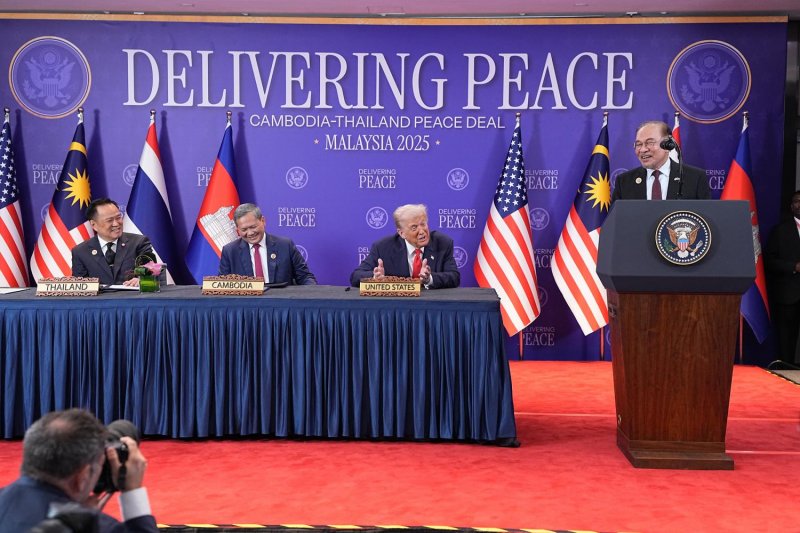
The ceasefire began on July 29 after US President Donald Trump threatened more trade penalties of the hostilities continued. Chinese diplomats and Malaysian Prime Minister Anwar Ibrahim also helped the process along.

Thailand and Cambodia signed a joint declaration last month, agreeing to withdraw heavy weapons and allowing ceasefire monitors access to the border.

While the deal failed to address the core territorial claims issue, Trump flew into Kuala Lumpur to oversee the signing, which he cited as evidence of his presidential peace-making abilities.

But the fresh landmine blast and renewed clashes have thrown the deal’s future into doubt.

Thailand has already delayed the release of 18 captured Cambodian soldiers, a key plank of the declaration.

Preparedness as a national mindset

Z-FACTOR – Joe Zaldarriaga – The Philippine StarNovember 12, 2025 | 7:42pm

MANILA, Philippines — At the start of November, the Philippines was batt…

Z-FACTORJoe Zaldarriaga – The Philippine Star

November 12, 2025 | 7:42pm

MANILA, Philippines — At the start of November, the Philippines was battered by two consecutive typhoons, striking just days apart and leaving a trail of devastation. Typhoon Tino (Kalmegi) brought landslides and floods across the Visayas, claiming more than 200 lives. Before the country could recover, Super Typhoon Uwan (Fung Wong) followed – a storm so massive it captured global headlines and drew renowned storm chasers to document its impact.

Typhoon Uwan ripped through Luzon with relentless force. Torrential rains sent walls of mud cascading down hillsides into residential areas. In other neighborhoods, fast-moving flash floods destroyed homes in minutes.

As of this writing, families are struggling to piece their lives back together, and the full extent of the damage remains unclear. But the images we see on news reports and social media tell an all too familiar, heartbreaking story: dozens dead including helpless children, homes flattened, farmlands submerged, roads washed out, and livelihoods swept away by floods and landslides.

One thought that comes to mind upon seeing the magnitude of the damage left by typhoons Uwan and Tino is this: Why is it that year after year, despite decades of experience with monster typhoons, our country remains pitifully unprepared?

This is not just about climate change, it is also a matter of governance and foresight. The failure to plan and invest in resilience is costing us more than property, it’s costing us futures. The storms will keep coming, given the location where the Philippines is in.  But for me, the real disaster lies in our failure to demand accountability and our inability to learn and act.

For over two decades, the Philippines has remained as one the world’s most disaster-prone nation, topping the 2025 World Risk Index again, which measures disaster risks for 193 countries based on exposure to climate-related hazards; susceptibility of the population; and coping and adaptive capacities of communities.

The impact of natural disasters, whether typhoons or earthquakes, is not just disruption but has long-lasting consequences to our nation’s economy and development.

Behind the numbers on economic losses are human stories – Filipinos who lost their loved ones and homes to floods and landslides, families forced to flee every time there is a storm, farmers watching entire harvests get washed away by floodwaters, and small businesses closing indefinitely.

While resilience and solidarity during crises are admirable, these should not be normalized as solutions. Recovery must go beyond rebuilding what was lost. Structural and systemic solutions must be put in place to ensure that public funds are used properly to help our communities withstand severe weather events – not drown them in corruption.

In the coming years, the storms entering Philippines will probably be more frequent and stronger. The question is, how do we adapt to finally put an end to what seems to be an unending cycle of recovery and rebuilding?

Readiness must be a mindset that is reflected in our education system, public infrastructure, policies and government spending.

Disaster literacy should be taught to children in schools as early as kindergarten and in communities by local government units. Urban planning should reflect climate readiness with infrastructure designed to withstand severe weather events. Government spending should be scrutinized and watched like a hawk to ensure that the budget for flood control projects and disaster readiness is spent properly. We must demand accountability from national agencies down to local officials. Disaster funds must be transparent, and infrastructure projects must meet climate-resilient standards.

The Philippines must prioritize resilience by investing heavily in advanced weather monitoring systems and impact-based forecasting. Accurate, real-time data can save lives by helping communities anticipate risks, prepare effectively, and reduce losses before disaster strikes.  Readiness is not just about responding faster; it’s about preventing devastation.

We don’t have to look far for inspiration. Japan, one of the most seismically active nations on Earth, faces earthquakes and tsunamis regularly, yet it has transformed vulnerability into strength. Through rigorous building codes, cutting-edge early warning systems, and a culture of preparedness ingrained in every citizen, Japan has proven that disasters can be managed, and their impact minimized.

If Japan can do this, so can we. Filipinos have the knowledge, technology and experience. What we need now is the political will and unified action to make disaster preparedness a critical element of national development.

It is time to shift our mindset as a nation and start viewing storms not as seasonal disruptions but as a constant part of life in the Philippines. This way, we can embrace disaster readiness, rebuild smarter communities, and protect what we have built as a nation.

Readiness is not a luxury; it is a necessity. We owe it to ourselves and to the future generation of Filipinos to build a future where a typhoon is no longer synonymous with devastation.

Preparedness as a national mindset

Z-FACTOR – Joe Zaldarriaga – The Philippine StarNovember 12, 2025 | 7:42pm

MANILA, Philippines — At the start of November, the Philippines was batt…

Z-FACTORJoe Zaldarriaga – The Philippine Star

November 12, 2025 | 7:42pm

MANILA, Philippines — At the start of November, the Philippines was battered by two consecutive typhoons, striking just days apart and leaving a trail of devastation. Typhoon Tino (Kalmegi) brought landslides and floods across the Visayas, claiming more than 200 lives. Before the country could recover, Super Typhoon Uwan (Fung Wong) followed – a storm so massive it captured global headlines and drew renowned storm chasers to document its impact.

Typhoon Uwan ripped through Luzon with relentless force. Torrential rains sent walls of mud cascading down hillsides into residential areas. In other neighborhoods, fast-moving flash floods destroyed homes in minutes.

As of this writing, families are struggling to piece their lives back together, and the full extent of the damage remains unclear. But the images we see on news reports and social media tell an all too familiar, heartbreaking story: dozens dead including helpless children, homes flattened, farmlands submerged, roads washed out, and livelihoods swept away by floods and landslides.

One thought that comes to mind upon seeing the magnitude of the damage left by typhoons Uwan and Tino is this: Why is it that year after year, despite decades of experience with monster typhoons, our country remains pitifully unprepared?

This is not just about climate change, it is also a matter of governance and foresight. The failure to plan and invest in resilience is costing us more than property, it’s costing us futures. The storms will keep coming, given the location where the Philippines is in.  But for me, the real disaster lies in our failure to demand accountability and our inability to learn and act.

For over two decades, the Philippines has remained as one the world’s most disaster-prone nation, topping the 2025 World Risk Index again, which measures disaster risks for 193 countries based on exposure to climate-related hazards; susceptibility of the population; and coping and adaptive capacities of communities.

The impact of natural disasters, whether typhoons or earthquakes, is not just disruption but has long-lasting consequences to our nation’s economy and development.

Behind the numbers on economic losses are human stories – Filipinos who lost their loved ones and homes to floods and landslides, families forced to flee every time there is a storm, farmers watching entire harvests get washed away by floodwaters, and small businesses closing indefinitely.

While resilience and solidarity during crises are admirable, these should not be normalized as solutions. Recovery must go beyond rebuilding what was lost. Structural and systemic solutions must be put in place to ensure that public funds are used properly to help our communities withstand severe weather events – not drown them in corruption.

In the coming years, the storms entering Philippines will probably be more frequent and stronger. The question is, how do we adapt to finally put an end to what seems to be an unending cycle of recovery and rebuilding?

Readiness must be a mindset that is reflected in our education system, public infrastructure, policies and government spending.

Disaster literacy should be taught to children in schools as early as kindergarten and in communities by local government units. Urban planning should reflect climate readiness with infrastructure designed to withstand severe weather events. Government spending should be scrutinized and watched like a hawk to ensure that the budget for flood control projects and disaster readiness is spent properly. We must demand accountability from national agencies down to local officials. Disaster funds must be transparent, and infrastructure projects must meet climate-resilient standards.

The Philippines must prioritize resilience by investing heavily in advanced weather monitoring systems and impact-based forecasting. Accurate, real-time data can save lives by helping communities anticipate risks, prepare effectively, and reduce losses before disaster strikes.  Readiness is not just about responding faster; it’s about preventing devastation.

We don’t have to look far for inspiration. Japan, one of the most seismically active nations on Earth, faces earthquakes and tsunamis regularly, yet it has transformed vulnerability into strength. Through rigorous building codes, cutting-edge early warning systems, and a culture of preparedness ingrained in every citizen, Japan has proven that disasters can be managed, and their impact minimized.

If Japan can do this, so can we. Filipinos have the knowledge, technology and experience. What we need now is the political will and unified action to make disaster preparedness a critical element of national development.

It is time to shift our mindset as a nation and start viewing storms not as seasonal disruptions but as a constant part of life in the Philippines. This way, we can embrace disaster readiness, rebuild smarter communities, and protect what we have built as a nation.

Readiness is not a luxury; it is a necessity. We owe it to ourselves and to the future generation of Filipinos to build a future where a typhoon is no longer synonymous with devastation.